

Data analytics salary vs data science salary: how responsibilities change compensation
If you are choosing between analytics and data science mainly on earnings, start with the plain answer: data science usually pays more. The better question is whether the extra pay matches the kind of work you actually want to do. In the U.S., cited benchmarks put median total pay around $93,000 for data analysts and $154,000 for data scientists, while another comparison places average pay at $82,640 versus $122,738. That is a real gap, but it does not settle your decision, because seniority, specialty, location, and company can change the outcome fast.
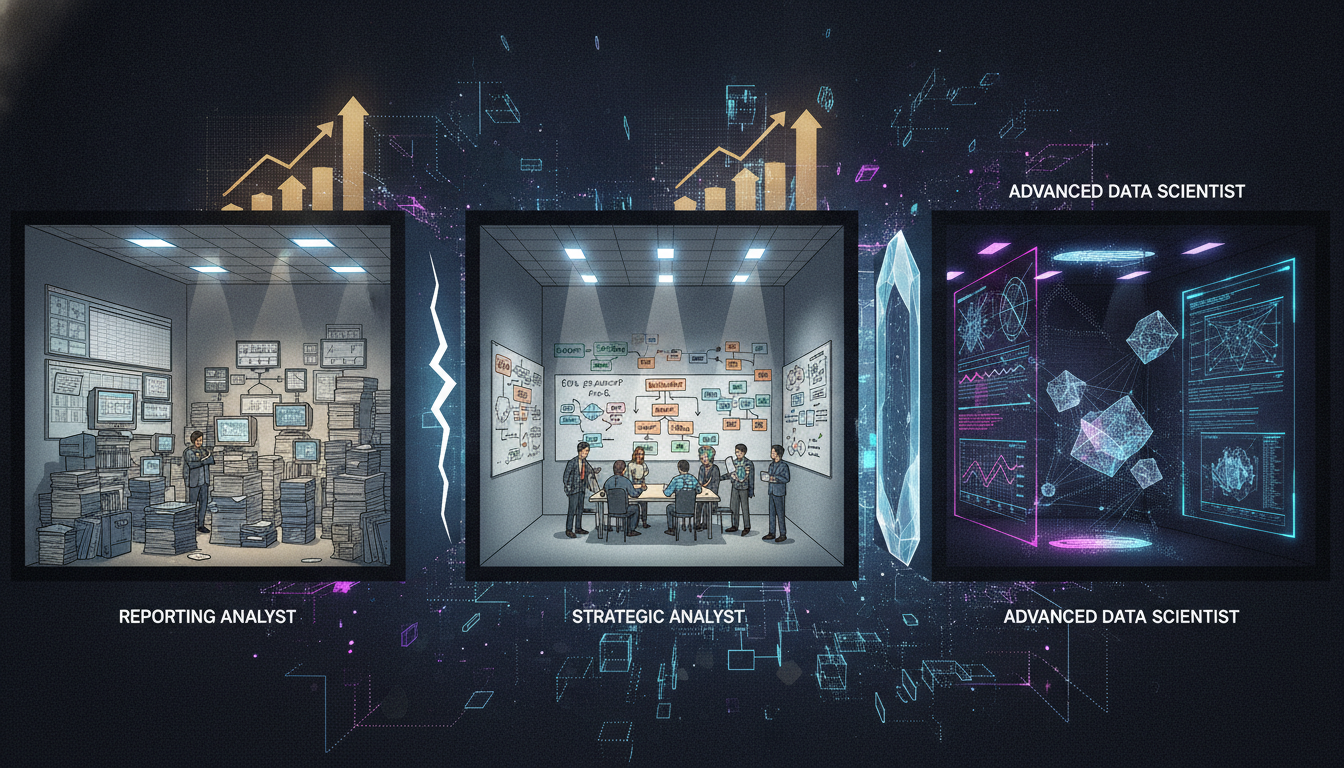
This is why a simple salary snapshot is not enough. The real driver in data analytics vs data science salary comparisons is responsibility: who explains what happened, who predicts what happens next, who designs experiments, and who ships work that affects products or operations at scale. If you want a clear answer on which path fits you specifically, focus less on title prestige and more on the type of business problem you want to own.
The fastest answer: which path pays more, and why?
Data scientist salary is usually higher because the role tends to sit closer to predictive decision-making, automation, and model-driven product or operational impact. Employers often pay more for advanced statistics, machine learning, production-ready coding, forecasting, and experimentation because those responsibilities are harder to hire for and can influence revenue, risk, or efficiency more directly.
Data analyst salary is usually lower because many analyst roles center on SQL, Excel, dashboards, KPI tracking, reporting, and turning existing data into business insight. That work matters, but the market often prices it differently from model-building work. Analysts are frequently asked to explain what happened and why; data scientists are more often asked to predict outcomes, test interventions, or build systems that act on data.
| Criterion | Data analytics | Data science |
|---|---|---|
| Typical core question | What happened, and why? | What will happen, and what should we automate or optimize? |
| Common tools | SQL, Excel, Tableau, Power BI, dashboards | Python, statistics, machine learning, experimentation, modeling |
| Usual pay position | Lower on average | Higher on average |
| Best fit | Business-facing problem solvers who like decision support | Technical builders who like predictive systems and deeper math |
How responsibilities change compensation more than titles do
Titles are messy. Two people can both be called “analyst” and do very different work. This section matters because pay usually rises when responsibilities move from reporting toward ownership, experimentation, and technical leverage.
Responsibilities that keep pay in the standard analytics band
Routine dashboard maintenance, recurring stakeholder reports, KPI definitions, ad hoc business questions, and descriptive analysis tend to keep data analytics pay in the more conventional analyst range. These are valuable responsibilities, but they are common enough that employers usually do not price them like scarce technical specializations.
If your day is mostly spent cleaning spreadsheets, refreshing BI layers, and answering one-off performance questions, your ceiling will often depend more on company size and industry than on technical scarcity. A healthcare team, for example, may still pay well for domain knowledge, which is why specialized tracks such as healthcare data analyst salary roles can outpace more general reporting positions.
Responsibilities that push analytics pay upward
Within analytics, compensation jumps when the role adds harder-to-replace responsibilities: product instrumentation, experiment design, statistical testing, data modeling, pipeline ownership, metric governance, and close partnership with engineering. Those are the analyst jobs that stop being “reporting support” and start becoming infrastructure or decision systems work.
A strong example is analytics engineering. In the U.S., Salary.com’s analytics engineer salary data places the average at $122,434, with a 25th–75th percentile range of $112,307 to $133,019, which helps explain why analytics engineers often out-earn traditional dashboard-focused analysts. The same logic often applies to product analytics salary growth: when your work shapes experiment readouts, feature decisions, and trusted metrics across a product team, the business impact is easier to price at a premium.
Responsibilities that justify higher data science compensation
Data science compensation usually rises when the role goes beyond notebooks and into consequential systems. Building churn models, forecasting demand, ranking content, detecting fraud, optimizing pricing, or deploying machine learning into production typically carries more pay because the risk, complexity, and expected return are all higher.
That does not mean every data scientist role is deeply advanced. Some “data scientist” jobs are really analytics roles with Python. But when the job includes experimental design, predictive modeling, and code that influences product or operational behavior, the market tends to reward it more aggressively than classic analyst work.
When can a senior data analyst out-earn an entry-level data scientist?
This is one of the few comparison questions where the right answer is not abstract. A senior data analyst can out-earn an entry-level data scientist when the analyst role sits in a stronger market, at a better-paying company, or inside a higher-value specialty such as product analytics or analytics engineering.
That pattern shows up clearly in compensation data: Levels.fyi senior data analyst compensation shows a U.S. median of $160,000, and New York City senior analyst median pay at $180,000. So while data science salary range is higher overall, a high-level analyst in a premium market can absolutely beat a junior or lower-tier data scientist offer.
This matters for your decision because many people compare a generic data analyst salary with a generic data scientist salary and miss the level effect. If you are already positioned to become a senior analyst within one to two years, switching into entry-level data science may not improve your pay immediately. It may still be the right move for long-term upside, but it is not automatically the better short-term earnings choice.

How salary ranges change by level
The cleanest way to think about analytics vs data science salary is by level, not just title. National comparisons tell you the direction of travel; level tells you what you are likely to feel in your own career.
Junior and entry level
At junior level, data analytics is usually easier to enter because employers more often accept bachelor’s degrees, certificates, or adjacent business experience. Entry-level analyst work is also easier to define operationally: reporting, KPI support, dashboard upkeep, and business analysis. Data science roles at this level are fewer, often more competitive, and more likely to expect stronger programming and statistics foundations.
For that reason, entry-level data scientist salary can still be solid, but getting the role is harder. If your profile is not yet strong in Python, modeling, and statistical reasoning, analytics may give you the faster route to income.
Mid-level
At mid-level, the gap often widens. A mid-level analyst who still mainly reports on existing metrics may see slower salary growth than a mid-level data scientist working on predictive models or experimentation frameworks. This is the stage where responsibility divergence becomes obvious.
It is also where domain specialization starts to matter more. In revenue-heavy sectors, including fintech, highly commercial analytics work can command stronger pay, and that is part of why some fintech data analyst salary ranges run above general business analyst benchmarks.
Senior and staff
At senior level, both paths can pay very well, but they reward different forms of leverage. Senior analysts earn more when they own critical metrics, shape strategy, lead cross-functional decisions, or build trusted data foundations. Senior data scientists earn more when they create reusable modeling systems, improve experiment velocity, or influence revenue, risk, or product performance at scale.
Staff-level distinctions are even sharper. A staff analytics leader may be paid for measurement architecture, analytics engineering, organizational metric quality, and decision enablement across teams. A staff data scientist may be paid for modeling strategy, ML systems, forecasting frameworks, or AI-linked product capabilities. Both can be lucrative; the data science path more often has the higher absolute ceiling.
How to evaluate the two paths for your own decision
Since this is a comparison decision, use criteria that reflect actual career fit, not just headline pay. The right choice is the one you can realistically enter, perform well in, and continue to enjoy as the responsibilities get harder.
| If this sounds like you | Better fit | Why |
|---|---|---|
| You want the faster route into a data career and prefer business-facing work | Data analytics | Lower barrier to entry and stronger fit for reporting, KPI analysis, and stakeholder support |
| You enjoy statistics, coding, and building predictive systems | Data science | Higher long-term pay usually comes with deeper technical ownership |
| You like analytics but want stronger compensation without fully moving into ML | Advanced analytics path | Product analytics and analytics engineering can raise pay materially |
| You already have analyst experience and are near senior level | Often stay in analytics first | Immediate pay may be better than resetting into junior data science |
Which one is right for you specifically?
You do not need a balanced answer here. You need a decision rule.
- Choose data analytics if you want a faster, more accessible entry into the field, prefer working closely with business teams, and would rather explain performance than build predictive systems.
- Choose data science if you are willing to invest more in statistics, programming, and machine learning in exchange for a higher usual pay ceiling and more technical ownership.
- Choose a specialized analytics route if you like analytics but want better compensation than standard reporting roles can usually offer. Product analytics, experimentation-heavy roles, and analytics engineering are the strongest options.
One more practical filter helps. If you would be frustrated spending months leveling up Python, ML concepts, and mathematical modeling, do not chase data science just for the title. The compensation premium exists for a reason: the responsibilities are tougher, the entry path is narrower, and the work is usually more technical day to day.
By contrast, if you already enjoy SQL, metrics, and business problem-solving but want to stretch beyond classic dashboards, aim for the high-value middle ground. Roles connected to experimentation, product decision-making, and data modeling often offer better upside than general analyst jobs, and they can position you well even if you later pivot toward data migration consultant salary or other specialized data careers.
What the compensation gap is really telling you
The gap between data analyst vs data scientist salary is not just a reward for technical skills in isolation. It is the market pricing the kind of risk and leverage attached to the job. Reporting and insight roles help teams decide. Predictive and automated systems can change what the business does at scale. That is why data science pay is usually higher.
For your specific choice, the clearest answer is this: pick data analytics if you want the better near-term path into the field and a career centered on decision support; pick data science if you want the better long-term odds of top-end compensation and you genuinely want the technical responsibilities that cause that premium. If you are torn, do not split the difference with a vague “data” goal. Choose analytics with a plan to specialize, or choose data science with a plan to commit. Compensation follows responsibility, and responsibility follows the work you are prepared to own.