

Machine learning basics for beginners who know some programming
If you already know how to write loops, functions, and basic data structures, the hard part of machine learning basics for beginners is not syntax. It is learning how to think in terms of data, targets, errors, and tradeoffs. Start smaller than your ambition suggests: scikit-learn notes that toy datasets such as Iris and Diabetes are useful to quickly illustrate algorithms, even though they are too small to represent most real-world work. That is exactly why they are good teaching tools. They let you understand classification, regression, preprocessing, and evaluation before messy data gets in the way.
This guide is built for programmers who want depth, not a skim. You will learn the machine learning fundamentals that actually matter first, the minimum math and coding background you need, the practical order to learn the field without getting overwhelmed, and the beginner machine learning projects that teach the right instincts. The goal is simple: by the end, you should understand the core machine learning concepts well enough to build small models, evaluate them correctly, and know what to learn next.
What machine learning is really doing
Most beginner explanations stop at “computers learn from data.” True, but incomplete. A better mental model is this: machine learning builds a function that maps inputs to outputs by finding patterns in examples rather than by following hand-written rules for every case.
In ordinary programming, you write rules. In machine learning, you provide examples and an objective, and the algorithm adjusts internal parameters to reduce error. If you have ever written validation logic, recommendation filters, or simple heuristics, you already know the limitation of pure rules: they become brittle when the patterns are messy, high-dimensional, or too numerous to encode manually.
That is why machine learning is a branch of artificial intelligence focused on learning from data to make predictions or decisions without being explicitly programmed for every task. In practice, the core shift is not magical intelligence. It is statistical pattern-finding plus evaluation on unseen data.
The minimum background you actually need
Many people delay starting because they think they need advanced mathematics first. They do not. For a programmer, the real entry barrier is lower than the internet often suggests, but you do need a few foundations to make sense of models and avoid cargo-cult learning.
Programming background: enough to manipulate data and reason about code
You are ready to begin if you can read tabular data, write functions, use libraries, and debug basic code. Comfort with Python helps because the beginner ecosystem is mature, but the essential skill is not the language. It is being able to transform inputs, inspect outputs, and understand why a pipeline failed.
If you want a structured starting point before diving into models, a Free Online Data Science Bootcamp can help bridge the gap between general programming and data-oriented work without forcing you into advanced theory too early.
Math background: less calculus, more intuition
You do not need to derive every algorithm. You do need working intuition for a short list of ideas:
- Algebra: variables, functions, and solving simple expressions
- Statistics: mean, variance, distributions, correlation, sampling
- Probability: likelihood, conditional probability, uncertainty
- Vectors and matrices: enough to understand features as arrays of numbers
Calculus becomes useful when you study optimization in depth, especially gradient-based learning, but it is not the first bottleneck for beginners. Poor understanding of data leakage, train/test splits, and evaluation metrics causes more damage early on than weak calculus.
Mindset background: willingness to be empirical
Machine learning rewards experimentation over certainty. A good beginner is willing to test a baseline, inspect errors, compare metrics, and revise assumptions. If you prefer exact guarantees from code, this field will feel uncomfortable at first. That discomfort is normal. Models are judged by performance on data, not by elegance alone.

A practical learning order that does not overwhelm you
The usual beginner advice throws too many topics together: neural networks, loss functions, clustering, feature engineering, hyperparameters. That creates noise. A better path builds one layer of understanding at a time, with each step giving you a usable mental model for the next.
- Learn the problem types. Understand classification, regression, clustering, and dimensionality reduction before you learn named algorithms.
- Learn the machine learning workflow. Data collection, preprocessing, exploratory data analysis, model training, and evaluation are more important than memorizing model names.
- Start with supervised learning. It is the most concrete path because labeled data gives you a clear target and measurable error.
- Study a small set of core algorithms. Linear regression, logistic regression, decision trees, random forests, k-nearest neighbors, and naive Bayes are enough to teach most beginner lessons.
- Add unsupervised learning. Learn k-means clustering and principal component analysis after you understand feature spaces and scaling.
- Then learn generalization tools. Train/test split, cross-validation, regularization, and overfitting and underfitting belong here.
- Only after that, expand outward. Reinforcement learning, semi-supervised learning, self-supervised learning, and deep learning make more sense once the basics are stable.
This order works because it mirrors real practice. The best beginners do not ask, “Which algorithm should I memorize next?” They ask, “What problem type is this, what does the data look like, what baseline should I try, and how will I know whether it generalizes?”
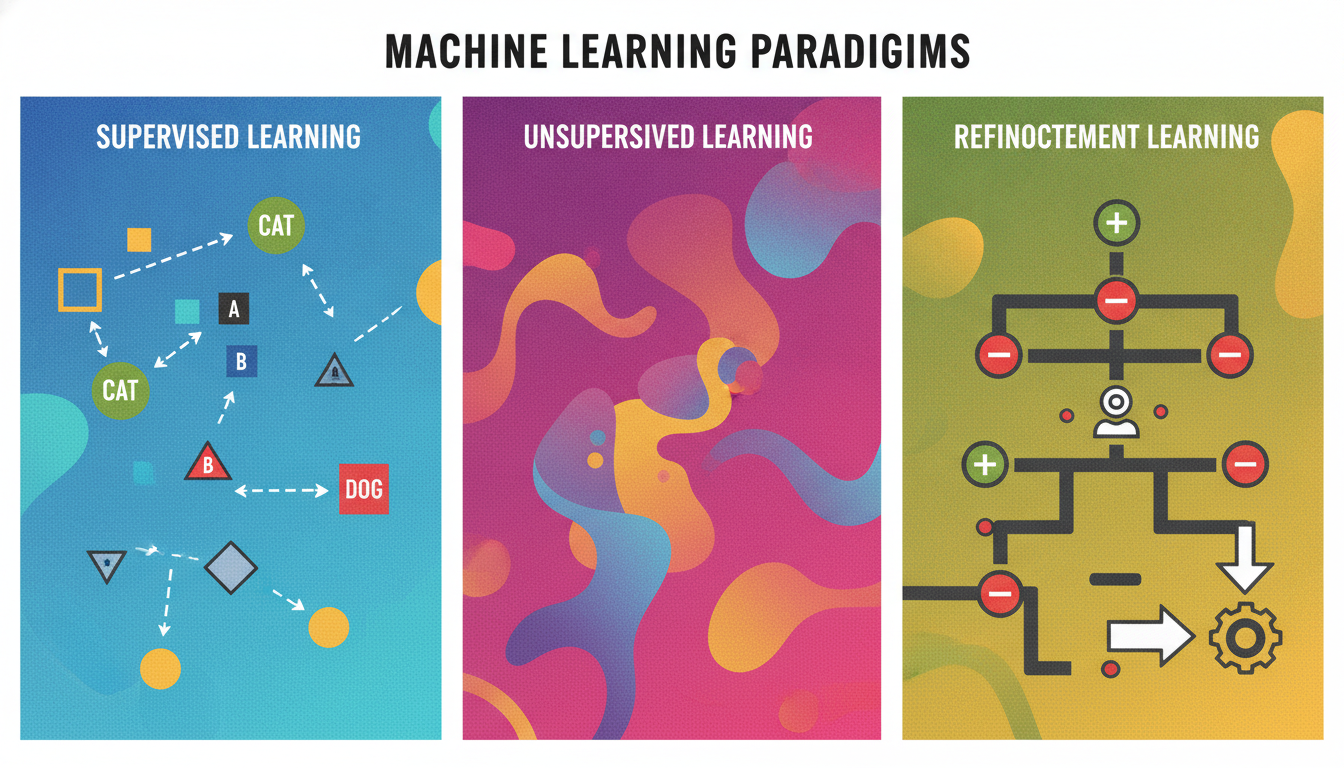
The core learning types, with the distinctions that matter
These categories are standard, but the nuance is in how they change your workflow and your expectations. Knowing the labels is easy. Knowing what each label implies about data and evaluation is the useful part.
Supervised learning
Supervised learning uses labeled data. Each training example includes input features and a target output. This category divides into classification, where the target is a category such as spam/not spam, and regression, where the target is a number such as house price or daily sales.
Supervised learning is where most programmers should start because feedback is immediate. You can quantify error, compare models directly, and see how changes in data preprocessing affect outcomes.
Unsupervised learning
Unsupervised learning finds patterns in unlabeled data. Common tasks include clustering, dimensionality reduction, and association rule mining. The key challenge is that “success” is often less obvious than in supervised tasks. You are not matching a known target; you are looking for structure that is useful or interpretable.
That makes unsupervised learning powerful, but it also makes it easier to misuse. Beginners often run k-means clustering because they can, not because the data actually supports a meaningful segmentation.
Reinforcement, semi-supervised, and self-supervised learning
Reinforcement learning trains an agent through rewards and penalties across sequential decisions. It is important, but not a sensible first stop for most programmers learning basics. Semi-supervised and self-supervised learning matter in real systems because labeled data is expensive, while unlabeled data is abundant. Still, they are easier to appreciate once supervised learning is already familiar.
The machine learning workflow is where most beginner mistakes happen
Algorithms get the attention, but workflow determines whether the model is meaningful. A weak workflow can make a strong algorithm look good for the wrong reasons. A solid workflow can make even a simple baseline surprisingly effective.
1. Define the prediction task precisely
“Predict customer behavior” is not a task. “Predict whether a customer will churn in the next 30 days” is a task. Good problem framing identifies the target variable, what information is available at prediction time, and what a useful error looks like.
2. Collect and inspect data before you model
Do not jump straight to fit(). Look at the rows. Check column meanings. Ask whether the target is imbalanced, whether timestamps leak future information, and whether categories are consistent. Exploratory data analysis is not decoration. It is how you discover that the dataset is lying to you.
3. Do data preprocessing deliberately
Data preprocessing often includes cleaning, handling missing values, scaling numerical variables, encoding categorical variables, feature engineering, and feature selection. Beginners tend to treat these as chores. They are not. Preprocessing determines what the model is allowed to notice.
A distance-based model such as k-nearest neighbors is sensitive to scale, so unscaled features can distort similarity. A tree-based model may care less about scaling but can still be hurt by low-quality features or leakage. This is why preprocessing should follow the data and the model together, not generic rules.
4. Train a baseline before trying complexity
A baseline is not a beginner crutch. It is a professional habit. If logistic regression or a decision tree gives sensible performance, you have learned something important about the structure of the problem. If a more complex model barely improves it, complexity may not be paying rent.
5. Evaluate on unseen data
The entire point of machine learning is generalization. Hold out test data, and use cross-validation when data is limited or model comparisons are sensitive. Training accuracy alone is close to meaningless for judging future performance.
When you are ready to move from tutorials into something tangible, the fastest way to internalize this workflow is to create your own machine learning model on a small dataset and force yourself to document each choice from preprocessing through evaluation.
How to choose your first algorithms without turning it into trivia
You do not need twenty algorithms to learn the field. You need a handful that reveal different modeling assumptions. Each of the models below teaches a distinct lesson about data, interpretability, nonlinearity, or bias-variance tradeoffs.
| Algorithm | Best first lesson | Typical beginner use | Main limitation to notice |
|---|---|---|---|
| Linear Regression | How features relate to a numeric target | Regression baseline | Misses nonlinear patterns easily |
| Logistic Regression | Probability-based classification | Binary classification baseline | Decision boundary is often too simple |
| Decision Tree | Rule-based splits and interpretability | Small classification or regression tasks | Overfits easily if unconstrained |
| Random Forest | Ensembles improve stability | Strong general-purpose tabular model | Less interpretable than a single tree |
| k-Nearest Neighbors | Similarity depends on feature space | Simple local classification | Sensitive to scaling and irrelevant features |
| Naive Bayes | Simple probabilistic assumptions | Text or sparse-feature classification | Assumptions can be unrealistic |
| k-Means Clustering | Grouping unlabeled data | Basic segmentation practice | Requires choosing k and assumes cluster shapes |
| Principal Component Analysis | Dimensionality reduction | Visualization and compression | Components may be hard to interpret |
The right question is not “Which is best?” It is “What assumption does this algorithm make, and does that match the data?” Linear models assume simpler relationships. Trees and forests can capture nonlinear interactions. k-nearest neighbors assumes local similarity. PCA assumes that a lower-dimensional representation preserves useful structure.
Model evaluation metrics: use the metric that matches the mistake
Metrics are not bookkeeping. They define what “good” means. If you pick the wrong metric, you can optimize the wrong behavior and feel falsely successful.
Classification metrics
For classification, common model evaluation metrics include accuracy, precision, recall, F1-score, and ROC-AUC. Accuracy is intuitive but weak when classes are imbalanced. If only 1% of cases are positive, a model can be 99% accurate by predicting “negative” every time.
Precision matters when false positives are costly. Recall matters when missing true positives is costly. F1-score balances precision and recall. ROC-AUC is useful for comparing ranking quality across thresholds, though it should not replace thinking about the actual operating threshold you need.
Regression metrics
For regression, common metrics include MAE, MSE, RMSE, and R-squared. MAE tells you the average absolute error in the same units as the target. MSE and RMSE punish large errors more heavily. R-squared describes how much variance the model explains, but beginners often overread it. A respectable R-squared does not guarantee practical usefulness, and a low R-squared does not always mean the model is worthless if the domain is inherently noisy.
Overfitting, underfitting, and the discipline of generalization
Most beginner errors eventually reduce to one of these two failures. The model is either too simple to capture the pattern, or too tuned to the training data to survive contact with new examples.
Underfitting happens when the model is too simple or the features are too weak. Training performance is poor, and test performance is poor as well. Overfitting happens when the model fits the training data very well but performs poorly on unseen data. That gap is the warning sign.
Cross-validation helps estimate how stable performance is across different data splits. Regularization helps constrain model complexity so the model does not memorize noise as if it were signal. The lesson beginners should keep is blunt: if you are not evaluating on unseen data, you are not learning whether the model works.

The best first projects for a programmer learning machine learning
Your first projects should be small enough to finish, rich enough to teach the workflow, and simple enough that you can explain every decision. Good project choice matters more than project originality at this stage.
Start with one classification project
A clean first option is a small tabular classification task: predict species, customer churn, spam, or loan approval from a structured dataset. This teaches train/test splitting, preprocessing, class labels, confusion between precision and recall, and comparison between logistic regression, decision trees, and random forests.
Then do one regression project
Predicting a numeric target teaches different instincts. You learn about residuals, scale of error, and how MAE or RMSE changes your interpretation of performance. Housing, medical progression, and sales prediction are common educational examples.
Add one unsupervised project
Use k-means clustering or PCA on a dataset with several numerical features. The goal is not to discover hidden truths. The goal is to learn scaling, geometry, and the fact that pattern discovery without labels requires more judgment.
If you get stuck at the project stage, targeted machine learning project help is most useful when you use it to sharpen your problem framing and evaluation choices, not when you outsource the thinking that the project is supposed to teach.
Common beginner traps that waste months
These are not minor mistakes. They are the habits that make people feel busy while learning very little.
- Jumping to deep learning too early. Neural networks make more sense after you understand baseline models, metrics, and preprocessing.
- Treating preprocessing as mechanical. Cleaning, encoding, scaling, and feature engineering are part of modeling, not a separate chore.
- Memorizing algorithms instead of assumptions. Learn what kinds of structure each model can and cannot capture.
- Ignoring data leakage. Any information from the future or from the target sneaking into features can make a useless model look brilliant.
- Using one metric blindly. Accuracy is not enough, and R-squared is not a victory lap.
- Confusing a tutorial run with understanding. If you cannot explain why a model improved, you have not learned the lesson yet.
How to know you understand the basics well enough to move on
You do not need mastery before advancing. You do need operational competence. That means you can take a small tabular dataset, identify whether the task is classification or regression, perform basic data preprocessing, train at least two baseline models, choose sensible model evaluation metrics, and explain whether the result suggests underfitting, overfitting, or a data problem.
You should also be able to answer practical questions in plain language: Why was scaling necessary here? Why did random forest outperform logistic regression? Why is recall more important than precision in this task? Why does cross-validation give a better comparison than one lucky split?
If you can do that, your machine learning fundamentals are real. If not, do not collect more advanced topics yet. Tighten the basics by repeating the workflow on another small dataset until the decisions feel deliberate rather than copied.
Machine learning basics for beginners become clear when the workflow becomes second nature
The field feels overwhelming when you see it as a catalog of algorithms. It becomes manageable when you see it as a disciplined process: define the task, inspect the data, preprocess carefully, fit a baseline, evaluate on unseen data, and only then increase complexity. That is the thread connecting supervised learning, unsupervised learning, feature engineering, and model selection.
For a programmer, the biggest early win is not building an impressive model. It is developing reliable judgment. When you can look at a dataset and think clearly about targets, leakage, scaling, metrics, and generalization, you stop being a person who ran a notebook and start being a person who understands machine learning. That is the point where more advanced topics become worth your time.