

Healthcare data analyst salary and common compensation add-ons: data analyst salary in healthcare explained
If you want the short answer first, the data analyst salary in healthcare usually lands around the low six figures once total compensation is counted, but the real number moves with employer type, experience, and whether your work affects reimbursement, cost reduction, or clinical outcomes. One widely cited estimate places median total pay for a healthcare data analyst at about $108,000, while Salary.com’s Healthcare Data Analyst salary range puts average base pay at $100,418, with a typical range of $80,272 to $118,310.
That gives you a baseline, not a guaranteed offer. A hospital analyst building internal dashboards is usually paid differently from an insurer analyst working on claims optimization, and both can differ from pharma, government, or health-tech roles. The rest of this guide breaks down what changes the number, what compensation add-ons are common, and what salary range candidates can reasonably expect at different career stages.
What does healthcare data analyst pay usually include?
Readers often focus on salary alone, but healthcare analyst compensation is usually a package. That matters because two jobs with similar base pay can produce noticeably different annual earnings once bonuses and other add-ons are included.
Base salary is the fixed annual amount. Total compensation adds any extra pay on top of it, which can include a healthcare data analyst bonus, profit sharing, commissions in some employer settings, and other cash or equity-like awards. In practice, the most common add-ons in healthcare analytics roles are annual performance bonuses and organization-wide incentive payouts rather than sales-style commissions.
- Base salary: the guaranteed annual pay.
- Performance bonus: often tied to team goals, project delivery, cost savings, or company results.
- Profit sharing: more likely in private-sector or health-tech environments than in government roles.
- Commission or incentive pay: less common for pure analyst roles, but possible where analytics supports client delivery or revenue teams.
- Other compensation: retention awards, sign-on bonuses, or long-term incentives in selected organizations.
The practical effect is straightforward: common add-ons usually lift healthcare data analyst total compensation above base salary, but they do not transform a low-paying role into a top-paying one. Employer type and scope of work still do most of the heavy lifting.
Expected healthcare data analyst pay range by career stage
Experience level is one of the clearest predictors of salary. The market pays more not just for years worked, but for the ability to handle ambiguous questions, regulated data, and decisions that carry financial or clinical consequences.
| Career stage | Typical pay position | What employers usually expect |
|---|---|---|
| Entry-level analyst | Usually below the market average | SQL, Excel or BI reporting, basic data cleaning, comfort with HIPAA-sensitive workflows, and support on claims, EHR, or quality reports |
| Mid-level analyst | Often around the average range | Independent analysis, dashboard ownership, stronger statistics, stakeholder communication, and domain knowledge in revenue cycle, coding, utilization, or outcomes |
| Senior analyst or analytics lead | Often above the average range | Advanced modeling, forecasting, cross-functional leadership, data pipeline understanding, and direct influence on reimbursement, operations, or strategy |
For a realistic reading of the healthcare data analyst pay range, entry-level candidates should expect less than senior analysts, and senior analysts should expect more only if they are solving harder business problems. A title alone does not guarantee higher pay. Employers generally reward business impact: reducing denials, improving utilization management, supporting value-based care metrics, or helping clinical operations use data more effectively.
How salary changes by healthcare employer type
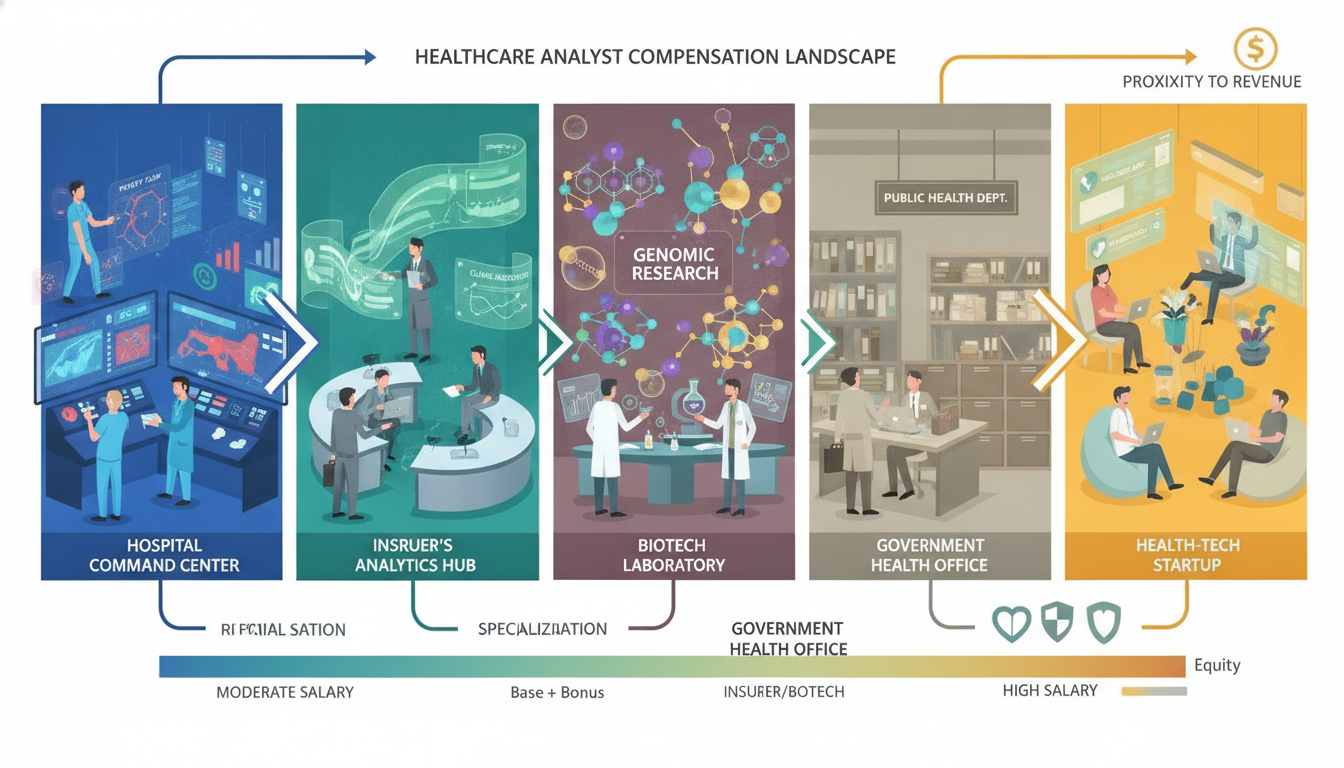
Employer type matters because different healthcare organizations generate value in different ways. The closer your analytics work is to revenue, reimbursement, cost control, product strategy, or measurable patient outcomes, the more likely the role is to command stronger compensation.
Hospitals and health systems
Hospitals often hire analysts for EHR reporting, quality metrics, patient flow, service line performance, and revenue cycle analysis. These roles can be stable and domain-rich, but budgets may be tighter than in sectors where analytics is tied more directly to margin expansion. Analysts who understand clinical workflows, coding systems, and operational bottlenecks tend to do better than generalists.
Health insurers and payer organizations
Insurers often pay well for analysts working in claims, risk adjustment, utilization management, network performance, and reimbursement optimization. The reason is simple: analytics in payer settings can directly affect cost containment and payment accuracy. If you can translate data into lower medical loss, cleaner claims operations, or better forecasting, your healthcare analytics salary ceiling typically rises.
Pharma, biotech, and life sciences
These employers may pay more for analysts who can work with commercial data, market access, outcomes, real-world evidence, or regulated research environments. The work is often specialized, and specialized healthcare domain knowledge usually commands more compensation than broad dashboard work.
Government and public sector healthcare
Government agencies and public health entities may offer more standardized pay structures. That can mean less upside in bonus-heavy compensation, but often more predictability. If your goal is maximum healthcare data analyst total compensation, public-sector roles are not usually the first place candidates look. If your goal is mission alignment and stable pay bands, they can still be attractive.
Health-tech companies
Health-tech firms can be some of the highest-variance employers. Some pay aggressively for product analytics, data engineering crossover skills, and machine learning capability. Others run lean. The upside is highest when the analyst role influences customer retention, product decisions, care navigation performance, or measurable cost savings.
Which skills actually raise healthcare analyst compensation?
Not all analytics skills are priced equally in healthcare. Employers pay more when a skill is scarce and when it works inside a regulated environment, not just in a generic data stack.
- Claims and reimbursement expertise: strong in payer, provider, and revenue cycle roles.
- EHR and clinical workflow knowledge: especially useful in hospitals and integrated delivery networks.
- Quality and outcomes analytics: valuable where reporting affects contracts, ratings, or patient care decisions.
- Advanced statistics and predictive modeling: often associated with stronger pay than reporting-only work.
- Data engineering fluency: analysts who can move from analysis to pipeline logic are more marketable.
- Healthcare economics: especially relevant in payer, pharma, and strategy-heavy roles.
Regulated-data fluency also matters. Healthcare analytics jobs salary levels often rise when the analyst can work confidently within privacy, security, and compliance constraints such as HIPAA. That is one reason healthcare analytics can pay differently from adjacent analyst roles discussed in broader comparisons like data analytics vs data science salary.

How healthcare salaries compare with adjacent analyst benchmarks
A useful market check is to compare healthcare roles with a related analytics occupation rather than relying on generic “data analyst” numbers. The U.S. Bureau of Labor Statistics lists a median annual wage of $91,290 for operations research analysts, a nearby benchmark that helps frame healthcare analyst compensation without pretending the jobs are identical; see the BLS profile for operations research analysts.
The practical takeaway is that healthcare data analyst salary can run above or below adjacent benchmarks depending on domain depth. Analysts doing straightforward reporting may cluster near broader market levels. Analysts combining healthcare knowledge with predictive modeling, utilization analysis, or reimbursement strategy often push higher because the business case for their work is easier to quantify.
What candidates should ask when evaluating an offer
A healthcare business analyst salary or healthcare data analyst salary offer can sound competitive until you inspect how the organization defines the role. The right questions reveal whether the pay is aligned with the actual difficulty and business value of the work.
- Ask whether the quoted number is base salary or total compensation.
- Ask how bonuses are calculated and whether they have been paid consistently.
- Ask which datasets you will own: claims, EHR, revenue cycle, quality, or product data.
- Ask whether the role is reporting-focused or expected to drive modeling and strategy.
- Ask which business outcomes the team influences, such as denials, reimbursement, utilization, or patient outcomes.
If a role demands heavy cross-functional work, advanced analytics, and responsibility in a regulated environment, the compensation should reflect that. This is the same logic candidates use when sanity-checking adjacent specialist roles such as data migration consultant salary: the harder the implementation risk and business dependence, the stronger the pay case should be.
What this means for your next healthcare analytics move
The cleanest way to think about data analyst salary in healthcare is this: base salary gives you the floor, but employer type and business impact determine the ceiling. Hospitals, insurers, pharma companies, government agencies, and health-tech firms are not just different logos on a resume. They reward different forms of analytics value, and that difference is often bigger than small variations in title.
If you are early in your career, focus on gaining healthcare-specific fluency in claims, EHRs, coding systems, quality metrics, or revenue cycle. If you are already mid-career, the best path to higher healthcare analyst compensation is usually not another reporting job. It is moving closer to advanced modeling, reimbursement optimization, utilization strategy, or outcomes-driven decision support. That is where healthcare employers are most likely to pay above average, and where compensation add-ons become meaningful rather than cosmetic.