

Is a data analytics certification worth it for a career switch?
Yes—if your goal is to use it as a fast, practical bridge into entry-level analytics work. For most career switchers, the honest answer to “data analytics certification worth it” is this: a certificate can help you get interviews faster, build job-relevant skills like SQL, Excel, Tableau, Power BI, and basic statistics, and produce portfolio projects you can talk through. It is usually not enough on its own to land a job.
The strongest outcomes tend to come when the program is affordable, recognized by employers, and built around hands-on work rather than passive video lessons. That matters most if you are targeting junior analyst, reporting, BI, or operations analytics roles—jobs where employers often want proof of baseline competence more than a perfect academic background.
If you want the shortest answer: a data analytics certification is worth it for a career switch when it closes a credibility gap, teaches tools you can actually use, and fits into a broader job-search plan. If you already have quantitative experience or strong self-taught projects, the certificate may help less than networking, portfolio refinement, and targeted applications.
When a data analytics certification is actually worth it
The certificate is valuable for one reason above all: it can reduce employer uncertainty. Hiring teams do not know whether a career switcher can clean data, write SQL, build dashboards, or explain findings to stakeholders. A good certification gives them at least some evidence.
- You need a clear entry point: You are moving from a different field and want to qualify for junior analyst or reporting roles faster.
- You lack structure: You know you need SQL, Excel, dashboarding, and statistics, but you do better with a guided curriculum than with scattered free resources.
- You need portfolio material: The program includes projects you can improve, present, and use in interviews.
- You want internal mobility: If you already work in operations, finance, marketing, or customer support, a certification can support a move into analytics-adjacent work inside the same company.
- You are targeting employer-recognized tools: A SQL certification for analytics, Power BI certification, or Tableau certification can be more useful when it matches the jobs you are actually applying for.
For beginners, the bridge effect can be real. On Coursera’s page for the Google certificate, Google Data Analytics Professional Certificate outcomes state that 75% of graduates reported a positive career outcome within six months, including a new job, promotion, or raise. That does not prove every certificate delivers the same result, but it does show why beginner-friendly programs attract career changers.
When the certification is probably not worth it
Some people buy a credential when what they really need is proof of work. That is where certification ROI often breaks down.
- You already have strong evidence: If you can already show solid analytics portfolio projects, SQL queries, dashboards, and business reasoning, another certificate may add little.
- The program is expensive and light on practice: A high price with weak project work is a bad trade.
- You are using it to avoid the job search: Studying feels productive, but it can become a way to delay networking and applications.
- Your target role is more advanced: For analytics engineering, data science, or senior BI work, a beginner certificate rarely carries much weight by itself.
- You need immediate income: If time is tight, spending months in coursework without applying for jobs can create opportunity cost.
The long-term pattern is straightforward: early in a data analyst career change, the credential can help signal discipline and baseline skill-building. After you gain real experience, its importance usually fades. Employers care more about measurable impact, domain knowledge, and whether you can solve business problems with data.
How to decide based on your background
This is where many articles stay too general. The same certification has very different value for someone coming from retail operations than for someone with a quantitative degree.
If you have no technical background
A data analytics certification is often more worth it here because it solves three problems at once: structure, vocabulary, and credibility. You need to learn how spreadsheets, SQL, dashboards, and basic statistics fit together in real work. You also need enough shared language to speak confidently in interviews about joins, KPIs, data cleaning, and stakeholder communication.
For this group, beginner-friendly programs with hands-on projects make the most sense. The certificate is not the finish line; it is the scaffold that helps you produce your first serious portfolio pieces.
If you have quantitative experience
If you come from finance, economics, engineering, research, accounting, or a heavy-Excel operations role, you may not need a broad general certificate. Your problem is usually not analytical thinking. It is tooling and translation.
In that case, a narrower path often works better: strengthen SQL, learn one BI tool deeply, and build two or three analytics portfolio projects tied to business questions. A Power BI certification, Tableau certification, or practical SQL certification for analytics can be more efficient than a general beginner program if it fills a specific gap visible in job descriptions.
If you are already employed and want an internal move
This is one of the best use cases. Internal hiring managers already know your domain knowledge, reliability, and communication style. The certification then acts less like a full reset and more like proof that you are ready to handle reporting, dashboards, or operational analysis. That combination—business context plus new analytics skills—is often stronger than a cold external application.

How to estimate your personal data analytics certification ROI
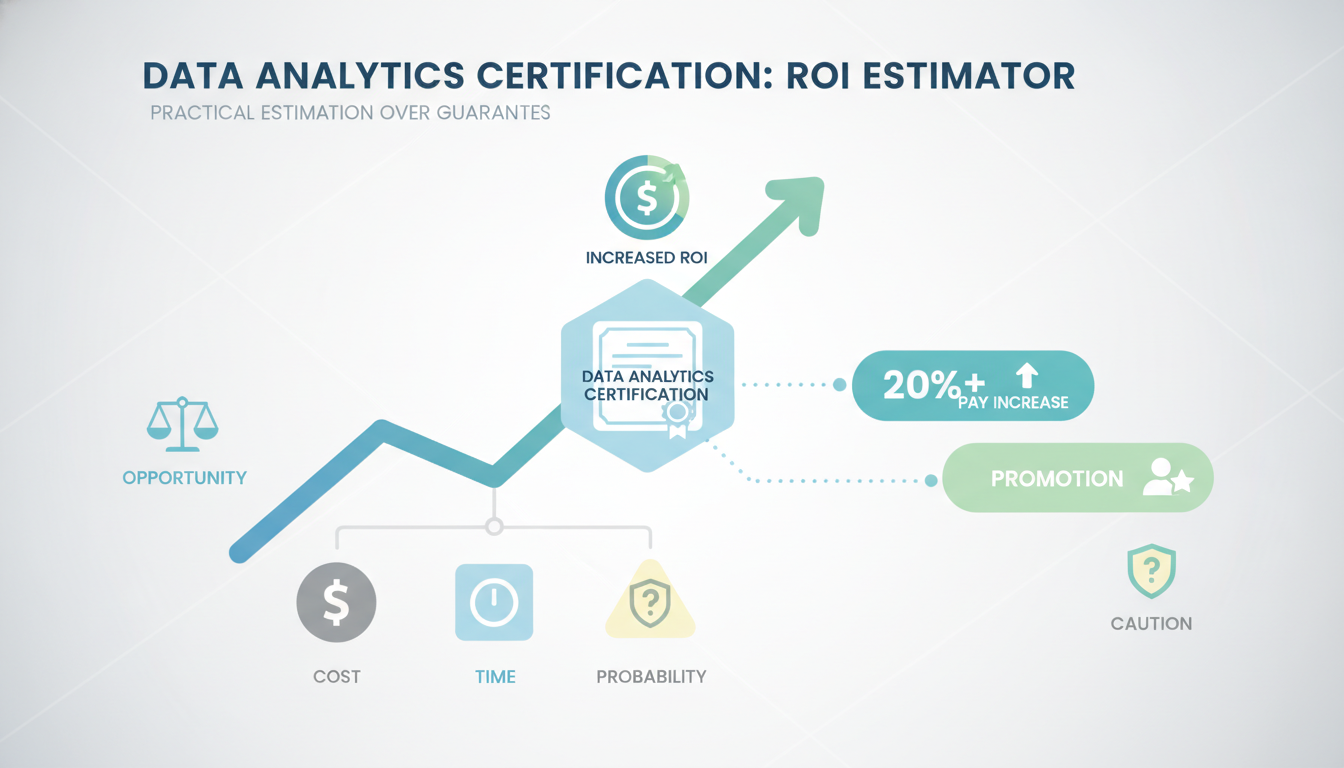
You do not need a perfect salary forecast to make a good decision. You need a practical estimate. Think in terms of cost, transition speed, and probability of converting the credential into interviews.
| ROI factor | What to look at | Good sign | Warning sign |
|---|---|---|---|
| Direct cost | Tuition, exam fees, software, subscriptions | Affordable enough that you can finish without financial strain | High cost with no clear employer recognition or project depth |
| Time cost | Hours per week and months to complete | Leaves time for networking and applying while studying | Consumes all available time and delays your search |
| Skill lift | SQL, Excel, BI tools, statistics, presentation | Teaches obvious gaps required for target jobs | Covers what you already know |
| Portfolio value | Projects you can improve and show publicly | Produces case studies you can explain in interviews | Only quizzes or generic completion badges |
| Career payoff | Higher salary potential or faster transition | Clear path to better-paying analytics-adjacent roles | No realistic role change attached to the certificate |
A simple formula helps: estimate total cost, then ask what increase in pay or speed to hire would justify it. If a certification costs a manageable amount and meaningfully shortens your career switch to data analytics, the math can work. That payoff is not hypothetical in every case; Coursera’s micro-credentials report says 28% of entry-level employees received a pay increase and 21% were promoted after earning a micro-credential. You should still treat that as one data point, not a guarantee.
A practical decision rule: if the certification is affordable, closes a real skill gap, and helps you produce job-search assets within a few months, it likely has decent data analytics certification ROI. If it is expensive and mainly gives you a logo for your resume, it probably does not.
What employers usually care about more than the certificate
This matters because many career switchers overestimate the credential and underestimate the proof around it. Employers hire analysts to answer questions, not to collect badges.
- SQL fluency: Can you filter, join, aggregate, and reason through messy data?
- Business communication: Can you explain what changed, why it matters, and what someone should do next?
- Dashboard judgment: Can you build reports that support decisions rather than just display charts?
- Problem framing: Can you translate a vague business question into metrics, assumptions, and analysis steps?
- Project evidence: Can you walk through your approach, tradeoffs, findings, and limitations?
That is why the best data analytics certification programs are not really about the certificate. They are about the work product you leave with.
The job-search strategy that turns a certificate into interviews
This is the step many candidates skip. A certification can improve interview access, but only if you package it correctly. The program should feed your applications, not sit in a separate “education” box on your resume.
- Turn every course project into a case study. Rewrite it with a business question, dataset context, methodology, screenshots, findings, and recommendations.
- Target adjacent roles, not only “data analyst.” Apply to reporting analyst, BI analyst, operations analyst, workforce analyst, marketing analyst, and junior analytics roles.
- Mirror the language of job descriptions. If roles ask for SQL, KPI reporting, Tableau, Power BI, and stakeholder communication, make those visible in your resume and project bullets.
- Use your previous domain as an advantage. A healthcare worker applying to healthcare analytics or a retail manager applying to operations analytics has a stronger story than a generic applicant.
- Network while studying. Reach out to analysts, recruiters, and internal teams before you finish the certificate, not after.
The strongest applications usually combine three things: a recognizable credential, clear entry-level data analyst skills, and projects that show business reasoning. If one of those is missing, interviews are harder to win.
Which kind of certification fits which goal?
Not every certificate solves the same problem. The right choice depends on whether you need broad foundations or a targeted skill signal.
| Certification type | Best for | Main benefit | Main tradeoff |
|---|---|---|---|
| General data analytics certification | Career switchers starting from near zero | Builds a structured foundation across tools and concepts | May stay too shallow in any one tool |
| SQL certification for analytics | Candidates who already understand business data but need technical proof | Targets one of the most common analyst screening skills | Does not show dashboarding or communication ability |
| Power BI certification or Tableau certification | Applicants pursuing BI, reporting, or dashboard-heavy roles | Signals tool alignment for visualization jobs | Tool-specific signal can be narrow if employers use a different stack |
If you are unsure, read 20 job descriptions in your target area and tally the recurring tools. That gives you a better decision basis than brand recognition alone.
Where a data analytics certification makes the most sense for a career switch
The best reason to pursue a certification is not that it looks good on LinkedIn. It is that it can compress a messy transition into a more believable candidate story: “I learned the core tools, built projects, and can now contribute in a junior analytics role.” For someone with no technical background, that story can be enough to open doors that self-study alone may not.
But a certificate is not a substitute for execution. If you want a data analyst career change, treat the program as a package deal: skills, projects, resume proof, and a live job search happening at the same time. The moment you separate the credential from the portfolio and the applications, its value drops sharply.
So, is a data analytics certification worth it? Usually yes for career switchers who need structure and evidence, usually less so for people who already have quantitative credibility and only need sharper project proof. The smartest move is not asking whether certificates work in general. It is asking whether this certificate will help you cross your specific gap faster than the next best use of your time.