How AI Consulting Services Build Production Systems
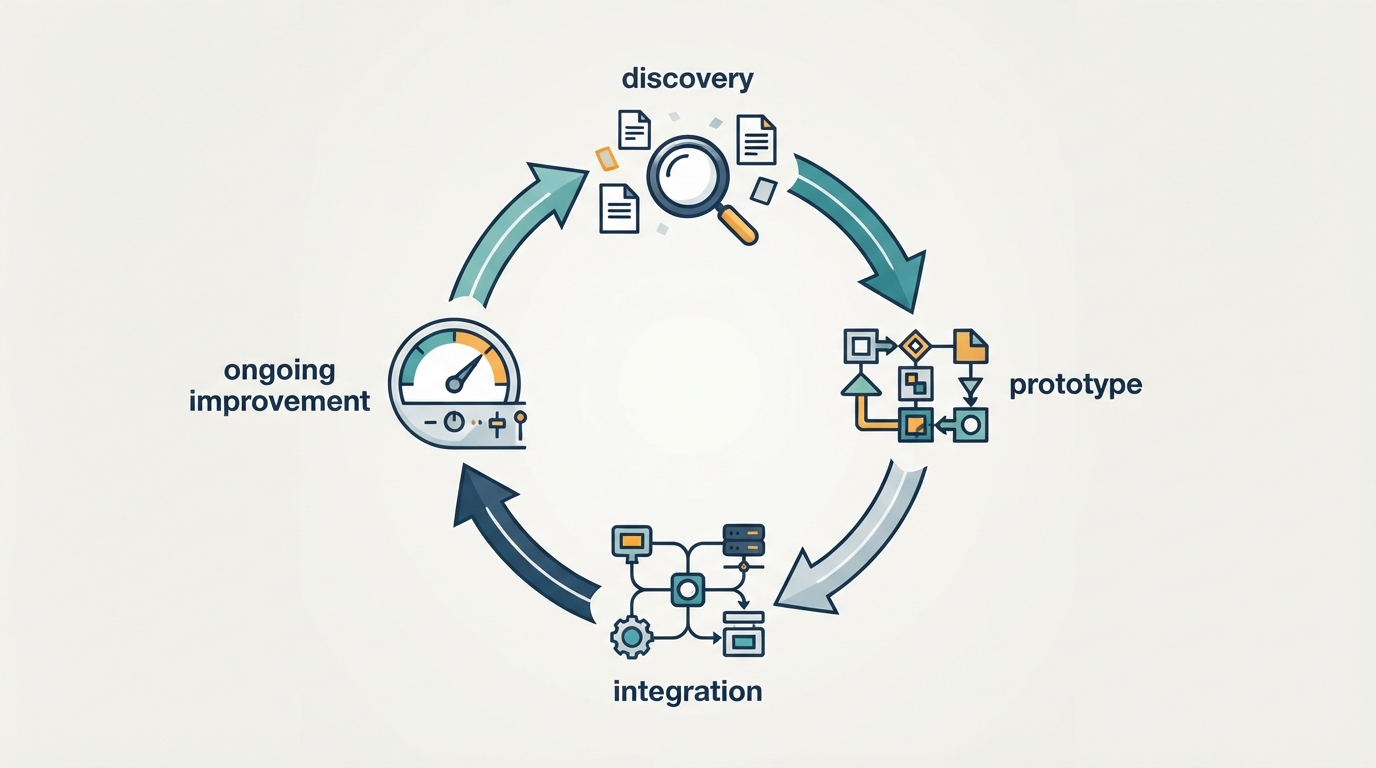
AI consulting services turn business problems into production systems through careful discovery, practical design, testing, integration, measurement, and improvement. Instead of starting with impressive technology, consultants start with costly, repetitive, error prone work. They identify where teams lose time, where mistakes happen, and where customers wait. Then they build focused systems that fit existing tools and real operating conditions. The result is not merely an experiment or demonstration. It is a reliable workflow that employees can use every day. Good consulting keeps the first project narrow, measurable, and manageable. That approach reduces risk while creating evidence for future automation investments.
From Business Pain to Working Software
A production system is an AI solution operating inside normal business processes. It receives information, makes supported decisions, sends outputs, records activity, and handles exceptions. For example, it might read incoming invoices, extract fields, check purchase rules, and route approvals. Another system could sort customer emails, suggest responses, and send complex cases to people. The important difference is reliability. A production system needs access controls, monitoring, clear ownership, and recovery steps when something fails. Consultants help businesses move beyond isolated chatbot trials by designing these practical foundations. They connect business goals with technology choices, creating useful automation instead of disconnected artificial intelligence experiments.
Which Problems Should AI Solve First?
The best starting point is usually a workflow with visible pain and manageable complexity. Consultants map candidate processes before recommending an AI solution. They ask who performs each task, what information is needed, how often work occurs, and what happens after errors. They also review systems, documents, emails, spreadsheets, and approval steps involved. This process mapping reveals hidden delays that teams may consider normal. It also separates tasks that truly need intelligence from tasks solved better through simpler automation. A clear map prevents expensive assumptions. It gives leaders a shared view of the current process before anyone begins changing tools, roles, or customer experiences.
Business impact helps determine whether a workflow deserves attention. Consultants consider hours spent each week, current error rates, customer impact, missed revenue, and costs created by mistakes. A team spending twenty hours weekly routing inquiries has a meaningful opportunity. If AI handles seventy percent accurately, the team could recover fourteen hours each week. Over a year, that equals 728 hours that employees can use elsewhere. However, impact alone is not enough. A valuable process may still be difficult to automate safely. Consultants balance potential gains against delivery risk, ensuring leaders do not select projects that sound impressive but cannot deliver useful results quickly.
How Do Consultants Choose High ROI Workflows?
An AI automation prioritization matrix usually compares business impact with implementation feasibility. High impact and high feasibility workflows should move first because they offer strong returns with lower risk. High impact but low feasibility projects may require better data, clearer rules, or system upgrades. Low impact and high feasibility ideas can work as quick wins, but only when completed rapidly. Low impact and low feasibility proposals should generally be rejected. This simple framework protects budgets and attention. It helps organizations avoid automating minor tasks while major customer, operational, or financial problems remain unresolved. Clear priorities make AI programs easier to explain and govern internally.
Feasibility depends on several practical details. Consultants check whether the process follows clear rules or requires nuanced judgment. They examine data quality, system access, integration effort, privacy requirements, and error recovery options. A workflow using clean information from an API is easier than one relying on incomplete PDFs and scattered emails. They also consider how many business systems the process touches. Every additional connection can add cost, security review, and maintenance work. If a mistake is easy to correct, teams can accept more automation risk. If a mistake affects payments, health records, or legal decisions, stronger controls and human review become essential.
Phase One: Audit the Actual Process
During the first two weeks, AI consulting services often conduct a focused process audit. The goal is not to document everything the organization does. Instead, consultants identify the five strongest candidate workflows and compare them consistently. Interviews with frontline employees are especially valuable because they expose workarounds, missing information, and frequent exceptions. Consultants observe how a task begins, where data changes hands, and how success is currently judged. They then choose one workflow with meaningful value and limited friction. This disciplined selection creates momentum. It also prevents leaders from launching several loosely defined projects that compete for data, technical resources, and employee attention.
Consultants should define success before designing the solution. The measure might be hours recovered, response speed, fewer errors, lower handling costs, increased processing volume, or improved consistency. A finance team, for example, may want invoices processed faster while flagging more discrepancies. A sales team may want better lead scoring so representatives focus on likely buyers. A support team may want routine requests categorized without delaying urgent cases. The chosen metric must be simple enough to track and relevant enough to matter. Without a baseline, teams cannot prove whether automation improved operations or merely shifted work into less visible parts of the process.

Phase Two: Test Data and Technical Fit
Technical feasibility begins with data readiness. AI systems need useful information in forms they can access safely. Consultants assess whether data is structured, accurate, current, and available through approved connections. Customer records in a CRM with an API are often easier to use than details buried in email threads. Documents can still support automation, but extraction and validation require more testing. Consultants identify duplicates, missing fields, inconsistent labels, and unclear ownership early. Fixing these problems before development is usually cheaper than correcting them after launch. Data readiness also includes permissions, retention rules, and safeguards for sensitive business or personal information.
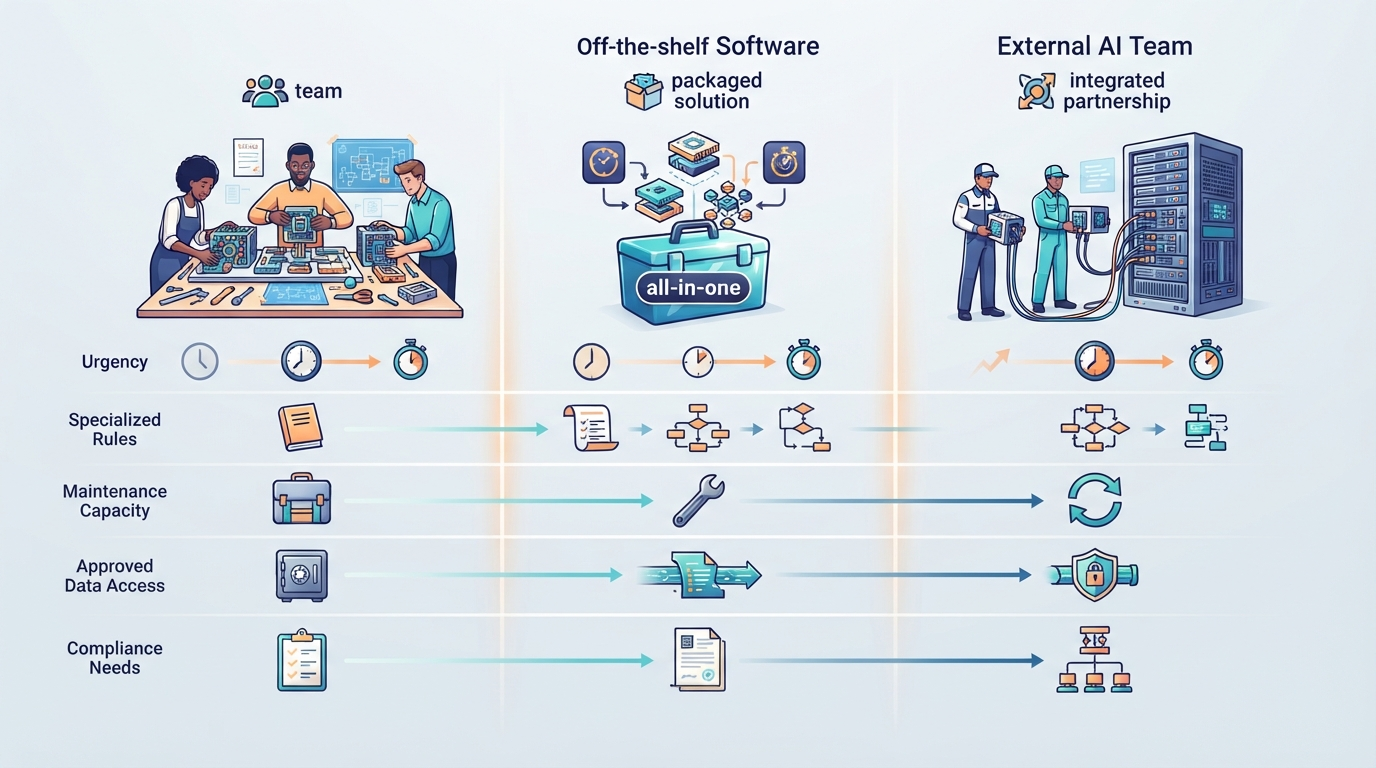
Next, consultants recommend whether the organization should buy, build, or combine solutions. Off the shelf tools can work well for common needs such as meeting summaries, help center search, email sorting, or document extraction. Custom development may be necessary when workflows use specialized rules, internal knowledge, or unusual systems. A hybrid approach often provides the best balance. It may use a commercial AI model alongside custom prompts, business rules, and integrations. The right choice depends on value, urgency, budget, maintenance capacity, and compliance needs. Consultants explain these tradeoffs plainly, helping leaders avoid paying for complexity they neither need nor can support.
How Is an AI System Built Safely?
During development, the team converts the selected workflow into clear steps. They define inputs, decision rules, expected outputs, exceptions, and responsible people. For document processing, the system may read a file, extract key details, compare them against policies, and update a destination platform. For customer service, it may classify intent, retrieve approved information, draft a response, and route uncertain cases. This design makes the AI component only one part of a larger process. Reliable automation also needs validation, logging, notifications, and escalation paths. Consultants make these parts visible so employees understand what the system does and where human responsibility remains.
Human in the loop design is especially important when consequences are serious. The system can prepare recommendations while employees approve final actions. It can also operate automatically only within defined limits. For example, a tool may send standard replies to simple questions but escalate billing disputes. It may extract invoice data automatically but require approval before payment release. These guardrails support speed without treating AI output as unquestionable. Consultants set confidence thresholds, sample completed work, and create queues for exceptions. This structure helps people trust the system because they can see when it acts independently and when it asks for informed human judgment.
Phase Three: Build Integrate and Test
Production systems must work with existing technology rather than forcing employees into isolated tools. AI consulting services connect solutions to CRMs, help centers, document repositories, accounting platforms, and communication channels where appropriate. A chatbot may use approved help articles and send unresolved issues into an existing ticket system. Email sorting may tag messages directly inside the customer relationship platform. Document automation may populate records after validation. Integration planning also addresses authentication, permissions, data transfer, and audit trails. When APIs are weak or unavailable, consultants may design secure alternatives. The objective is a workflow that feels natural, not another dashboard employees must remember to open.
Testing with real data is the bridge between a promising prototype and dependable deployment. Synthetic examples are useful early, but they rarely include messy documents, unusual language, missing values, or unexpected customer requests. Consultants test representative cases and deliberately include difficult exceptions. They measure accuracy, consistency, response time, and the quality of escalation behavior. Employees review outcomes and identify issues the technical team may miss. The system should be improved before wide release, not after customers experience repeated failures. Testing also confirms whether business rules were understood correctly. It turns vague confidence into operational evidence that leaders can use when deciding whether to launch.
Phase Four: Measure Improve and Expand
A focused first automation can often reach production within eight to twelve weeks when scope, data, and integrations are manageable. After launch, consultants compare results with the success metric selected during scoping. They examine recovered work hours, error reductions, processing speed, exception volume, and operating costs. They also listen to employees using the system daily. Their feedback shows whether instructions are clear, outputs are useful, and review queues are manageable. Measurement should continue after the initial launch because business conditions change. New document formats, product policies, or customer needs can affect performance. Ongoing review keeps the system accurate, useful, and aligned with real operations.
Return on investment should include both direct and indirect benefits. Direct benefits include reduced manual effort, fewer mistakes, faster approvals, and lower service costs. Indirect benefits may include improved customer response times, better employee focus, stronger compliance records, and more consistent decisions. Leaders should compare these benefits with implementation, software, support, and maintenance costs. They should also consider the cost of doing nothing when delays and errors already harm operations. A small project that produces measurable gains is often more valuable than a broad initiative with uncertain outcomes. Once value is proven, the organization can reuse patterns, controls, and integrations for the next automation opportunity.
Governance Makes Automation Dependable
Governance means setting clear rules for how an AI system is used, monitored, and changed. It does not need to be bureaucratic. At a basic level, every production system needs an owner, approved data sources, security controls, review procedures, and documented escalation paths. Teams should know who can alter prompts, policies, integrations, or access permissions. They should also know how to pause automation if unexpected behavior appears. In healthcare, finance, legal work, and other regulated settings, compliance requirements shape architecture from the beginning. Consultants help businesses match controls to risk, ensuring that innovation does not create avoidable privacy, fairness, or accountability problems later.
Monitoring keeps a production system from quietly drifting away from business needs. Consultants may track completion rates, confidence levels, exception categories, manual overrides, and changes in source data. A rise in escalations can signal that a policy changed or incoming documents now look different. A drop in accuracy may reveal a broken integration or confusing instructions. Monitoring should trigger practical action, not produce reports nobody reads. Regular reviews allow teams to correct weaknesses, retrain employees, update rules, and refine prompts. This cycle turns AI from a one time project into a managed business capability that improves with use and remains accountable.
Frequently Asked Questions About AI Consulting Services
How long does a first production project take?
A well scoped first project commonly takes eight to twelve weeks. The timeline depends on data quality, integration needs, security reviews, workflow complexity, and employee availability for testing. Simple automations using accessible data and existing APIs can move faster. Complex projects involving many legacy systems, sensitive information, or unclear business rules can take longer. Speed should never mean skipping real world testing or human oversight. AI consulting services shorten delivery by selecting a focused workflow first, clarifying decisions early, and avoiding unnecessary custom development. A practical launch plan includes time for training, monitoring, and fixing exceptions discovered during controlled use.
Do consultants always recommend custom AI models?
No. Custom models are not automatically the best answer for every business problem. Many production systems combine established AI tools with clear prompts, retrieval of approved knowledge, business rules, and integrations. This approach can be faster, less expensive, and easier to maintain than building everything from scratch. Consultants recommend custom work when a workflow has specialized data, unique decisions, strict performance requirements, or unusual technical constraints. They should explain why a standard tool cannot meet the need before proposing a complex build. The best solution is the one that delivers reliable business value while remaining secure, understandable, and realistic for the organization.
What data problems can delay deployment?
Common delays include missing fields, duplicate records, inconsistent naming, inaccessible systems, unclear permissions, and documents with unpredictable formats. Data may also be trapped in spreadsheets, email inboxes, scanned PDFs, or separate departmental platforms. Consultants identify these obstacles during readiness assessments rather than discovering them after development begins. Some issues can be solved through cleaning, standardization, extraction tools, or better integrations. Others may require process changes and clearer ownership. A delayed launch is not always failure. Sometimes the most valuable consulting outcome is recognizing that data foundations need improvement before automation can operate safely, accurately, and at a scale worth supporting.
How should leaders calculate automation value?
Leaders should begin with a baseline of current work. Measure time spent, cost per task, error rates, rework, delays, customer impact, and revenue opportunities. After deployment, compare those measures with actual system performance. Include implementation costs, ongoing software fees, maintenance effort, and human review time. For example, saved hours matter only when employees can use that time for higher value work. Better accuracy matters when it reduces meaningful costs or risks. Consultants help define practical measures before work begins, so results are credible. The strongest ROI case connects one automation directly to measurable operational improvement rather than broad claims about artificial intelligence.
When is review necessary?
Human review remains necessary when decisions involve high financial, legal, safety, privacy, or customer relationship consequences. It is also important when information is incomplete, the system has low confidence, or policies require professional judgment. Review does not mean automation failed. It means the process is designed responsibly. AI can collect information, identify patterns, prepare drafts, and highlight issues while qualified people make final decisions. Over time, teams may adjust thresholds as they learn where the system performs reliably. AI consulting services help define these boundaries, giving organizations speed for routine work and careful oversight for the situations where mistakes could cause material harm.