

Custom AI vs Off-the-Shelf: Which Delivers Better ROI?
If you are choosing between custom AI development and off-the-shelf AI, the fastest way to a sound decision is this: buy off-the-shelf AI for common tasks that are not strategic, and invest in custom AI development when the workflow is unique, the data is proprietary, or the AI output needs to plug deeply into the way your business already runs. That is the real ROI divide. The wrong choice usually does not fail on model quality alone; it fails on fit, integration, adoption, and the hidden work required to make AI useful in production.
That matters because the headline comparison is misleading. Off-the-shelf AI looks cheaper because the subscription starts low and deployment is faster. Custom AI solutions look expensive because they include discovery, data preparation, model work, infrastructure, security, integration, and maintenance. But ROI is not a software-price question. It is a workflow-value question. A packaged tool that automates only 30% of a process can produce worse AI ROI than a custom system that automates 80% of the same process and eliminates handoffs.
How this comparison evaluates ROI
A useful build vs buy AI decision needs more than a feature checklist. The practical buying criteria are speed to value, workflow fit, integration depth, data readiness, compliance risk, ongoing operating cost, and the upside if the system becomes part of your competitive advantage.
| Criteria | Off-the-Shelf AI | Custom AI Development |
|---|---|---|
| Upfront cost | Usually lower | Usually higher |
| Time to deploy | Faster | Slower |
| Workflow fit | Best for standard processes | Best for specialized processes |
| Integration flexibility | Limited by vendor roadmap and APIs | Designed around your systems and data |
| Long-term upside | Moderate for generic use cases | Higher when AI is strategic |
| Risk of lock-in | Higher vendor dependence | Higher build responsibility, lower feature dependence |
Which option usually wins?
For most businesses, off-the-shelf AI wins first and custom AI wins later only if the use case proves important enough. That is the clearest decision rule. Start with packaged software when the task is common, the process is already fairly standard, and the cost of a partial solution is acceptable. Move to custom AI development when the generic tool becomes the bottleneck rather than the accelerator.
A common example is support automation. A generic AI assistant can improve agent productivity quickly; in fact, the Stanford generative AI working paper found that, in a study of 5,179 support agents, access to a generative AI assistant increased productivity by 14% on average and boosted novice and low-skilled workers by 34%. That strongly supports buying first for high-volume, repeatable workflows. But if your support process requires pulling account history from a CRM, checking entitlement rules in an ERP, reading contract terms from internal documents, and logging actions back into several systems, generic software may improve one step while leaving the expensive manual work intact.
Signs off-the-shelf AI is enough
Many teams overestimate how unique their process is. This section is where most ROI mistakes can be prevented. If these signs describe your situation, off-the-shelf AI is probably the right answer for now.
- The workflow is common across industries: meeting notes, drafting emails, summarizing documents, basic chat support, or internal knowledge search.
- You can accept vendor-defined interfaces, prompt patterns, and release cycles.
- The AI output is helpful even if a human still reviews and completes the task.
- Your systems do not need deep AI integration beyond standard connectors to email, Slack, a CRM, or a knowledge base.
- Speed matters more than perfect fit because you need a result this quarter, not a platform next year.
That profile is especially common in early enterprise AI programs. Teams use a packaged tool to prove demand, establish governance, and learn where adoption breaks down. If that is your stage, a bespoke build is often premature. A focused rollout, paired with Enterprise AI consulting services, usually creates better short-term ROI than jumping straight into a full custom stack.
Signs custom AI development is justified
Custom AI development starts paying off when the cost of poor fit is larger than the cost of building. That is a different threshold than “we want something tailored.” Tailoring alone does not justify a project. Economic leverage does.
- The workflow has many exceptions, decision rules, or internal dependencies that generic software cannot model well.
- Your proprietary data is the source of value, not just the language model behind the interface.
- The AI must work inside existing applications, databases, ERP, CRM, or line-of-business tools with minimal user switching.
- Compliance, privacy, explainability, or on-premise deployment requirements rule out standard SaaS patterns.
- The use case affects margin, service quality, risk, or product differentiation enough to matter strategically.
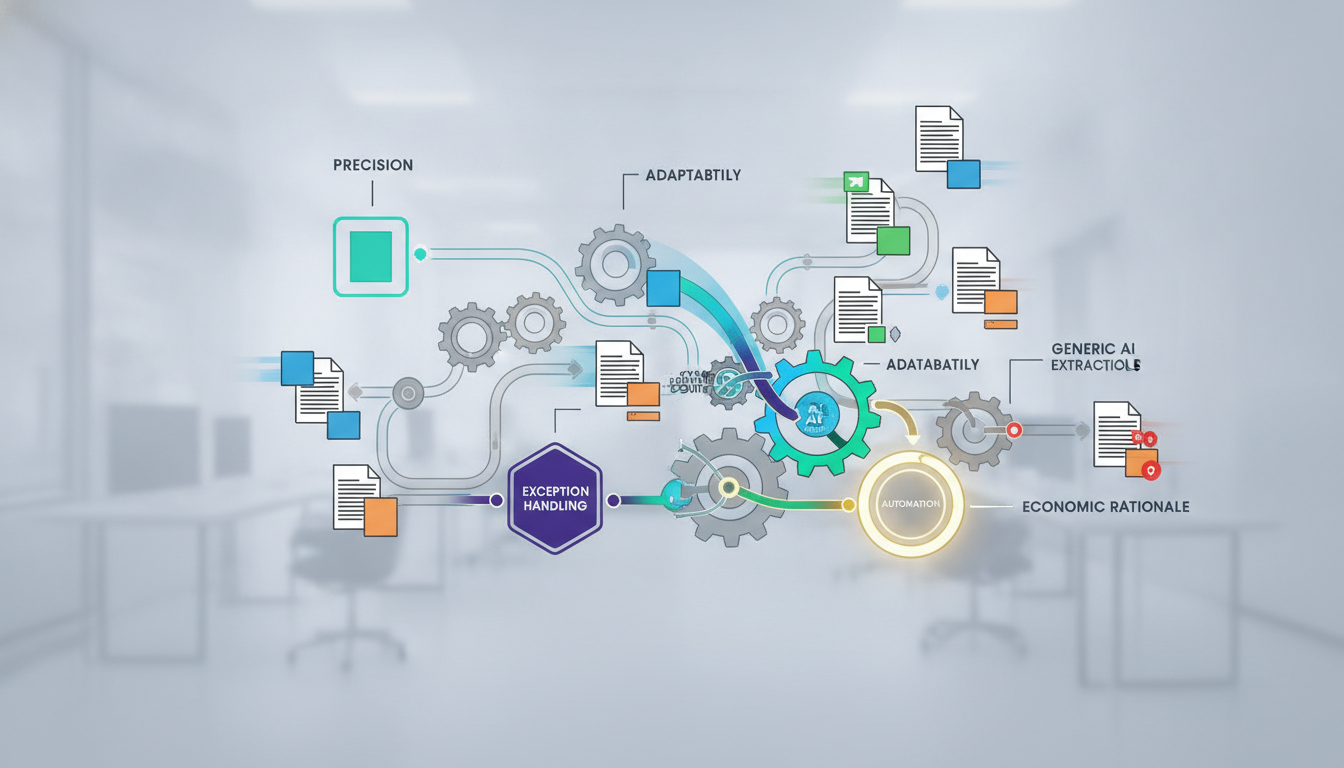
Document processing is a good example. If invoices, claims, legal paperwork, or complex forms all follow your own business rules, a generic tool may extract text but fail at the costly part: validation, exception handling, routing, and actioning. In that case, the value sits in orchestration and AI workflow automation, not just model access. That is where Custom AI software development services become commercially sensible.
How to calculate AI ROI without fooling yourself
A useful AI cost comparison should convert operational changes into money, then subtract all implementation and maintenance costs. The formula is simple enough to use in a spreadsheet and strict enough to expose bad assumptions.
- Estimate annual labor savings: hours saved per task × task volume × loaded hourly cost.
- Estimate error reduction value: fewer mistakes × cost per mistake.
- Estimate revenue lift: conversion gains, retention gains, upsell gains, or faster sales cycle, but only where you can tie AI to the metric.
- Add avoided software or outsourcing costs if AI replaces an existing expense.
- Subtract implementation costs: licenses or build cost, integration, data preparation, security review, testing, training, change management, and ongoing maintenance.
- Model payback period and 2- to 3-year ROI separately. Off-the-shelf AI often wins on payback period; custom AI often wins on multi-year upside.
That last step matters because the two options create value on different clocks. Off-the-shelf AI is often the better answer if you need a fast 6- to 12-month payback. Custom AI development tends to make sense when the annual savings compound because the system becomes embedded in a high-volume workflow or a customer-facing product. Teams exploring this path often start with Custom AI ML software development services after proving there is enough repeatable business value to support the higher initial spend.
The hidden costs that distort the ROI comparison
This is where many “cheap” AI projects become expensive. Software cost is visible. Organizational cost is not. Hidden costs affect both approaches, but they can hit off-the-shelf AI especially hard because buyers assume packaged software needs little adaptation.
Change management is not optional
Even when the software works, people need new habits, review rules, escalation paths, and performance baselines. Gartner’s view of implementation overhead is a useful warning: Gartner on organizational entrenchment says every 100 days implementing AI demands 25 extra days of training and up to 200 days of change management. If a business ignores that, the ROI model is wrong before deployment starts.
Data preparation decides whether AI produces value
Poor data readiness is one of the most common reasons AI projects fail to return measurable value. If your CRM records are inconsistent, your documents are unstructured, or your internal knowledge base is outdated, neither a packaged assistant nor a custom model will rescue the business case. The difference is that custom AI development exposes the problem earlier because discovery and integration work force the issue into the open.
Vendor lock-in can erase future savings
Off-the-shelf AI can become expensive when key workflows start depending on proprietary interfaces, pricing changes, feature limits, or a roadmap you do not control. That does not mean vendor software is bad. It means ROI should include switching cost, not just year-one subscription cost. On the other side, custom systems avoid some feature lock-in but create a different obligation: you own more of the maintenance burden and need stronger internal or partner capability, often supported by AI consulting for enterprise data solutions when data architecture is the real blocker.

Where each approach performs best in practice
The most reliable decision trigger is not company size. It is workflow structure. Similar-sized businesses can make opposite choices and both be right.
| Scenario | Better Fit | Why |
|---|---|---|
| Internal note-taking, drafting, generic summarization | Off-the-shelf AI | Common task, fast deployment, low differentiation |
| Customer support with standard workflows | Off-the-shelf AI first | Quick productivity gains before deeper investment |
| Claims, underwriting, legal review, complex document operations | Custom AI development | Value depends on business rules, exception handling, and system integration |
| AI features inside your product | Custom AI development | Strategic differentiation and control matter more than speed alone |
| Highly regulated or privacy-sensitive workloads | Usually custom AI | Security, explainability, deployment control, and compliance can outweigh convenience |
Which option fits your situation
If you are still undecided, use one question: will a generic tool remove most of the costly work, or only add a smart layer on top of the same old process? If it removes most of the work, buy. If it only improves a slice while the expensive manual flow remains, build.
Choose off-the-shelf AI when your main objective is speed, experimentation, or lightweight productivity gains across standard tasks. That is the safer choice for shared services, back-office assistance, and early-stage AI automation. Choose custom AI development when the workflow is specialized enough that deeper integration, tailored decision logic, and proprietary data can change economics, not just convenience. That is the stronger choice for document-heavy operations, regulated processes, embedded product capabilities, and high-volume workflows where partial automation is not enough.
Why custom AI development only wins when fit is the multiplier
The mistake is to ask which option is “better” in general. Off-the-shelf AI is better when AI is a tool. Custom AI is better when AI becomes part of the operating model. That distinction matters more than any model choice or vendor pitch.
So make the decision in sequence. First, test whether a packaged tool captures most of the available value. If yes, stop there. If not, identify exactly where the value leaks out: exception handling, internal data access, workflow routing, compliance controls, or user handoffs. When those gaps are the reason ROI stalls, custom AI development is no longer a premium option. It is the only route to a materially better return.