

How to Choose a Data Science Consulting Partner Worth the Investment
Picking a data science consulting partner is not mainly a talent search. It is a risk decision. If the partner cannot connect models to operational reality, the project stalls at proof of concept, which is why a pilot matters so much: Gartner’s generative AI forecast says at least 30% of generative AI projects will be abandoned after proof of concept by the end of 2025 because of poor data quality, weak risk controls, rising costs, or unclear business value. The right choice is the firm that can reduce those failure modes in your environment, not the one with the most impressive slide deck.
If you are deciding between a specialist boutique, a broader analytics consultancy, and a larger transformation firm, start with one question: do you need a strategic advisor, a hands-on delivery team, or a partner that can move from discovery to production and handoff? That distinction is more useful than comparing generic claims about innovation. It also helps you sort through best data science service providers without treating very different firms as if they solve the same problem.
Choose the partner type before you choose the partner
Many teams compare proposals too early. A better sequence is to identify which type of data science consulting firm fits the job you actually have, because each option brings a different cost structure, delivery style, and level of operational support.
| Partner type | Best for | Main strengths | Main tradeoff |
|---|---|---|---|
| Specialist data science boutique | Well-defined ML, forecasting, optimization, or experimentation problems | Deep technical focus, senior practitioners, fast diagnosis of modeling issues | May have limited change-management, integration, or global support capacity |
| Broad data and analytics consultancy | Projects that span data engineering, BI, and model deployment | Better cross-functional delivery, practical workflow fit, stronger implementation support | Technical depth can vary by team, so the named experts in the pitch may not do the work |
| Large transformation or AI consulting partner | Enterprise programs with procurement, governance, security, and many stakeholders | Program management, compliance processes, executive alignment, scale | Higher overhead and a greater risk of junior staffing unless the team is verified carefully |
If your problem is narrow and high stakes, such as churn prediction embedded into a product workflow, a boutique can be the best fit. If your challenge is messy data, multiple handoffs, and unclear ownership between product, engineering, and operations, a broader firm often delivers better value because the real work is not just model building. Teams looking for data science development services for product and platform teams usually benefit from this broader view because deployment and adoption tend to dominate project success.
What a strong evaluation should measure
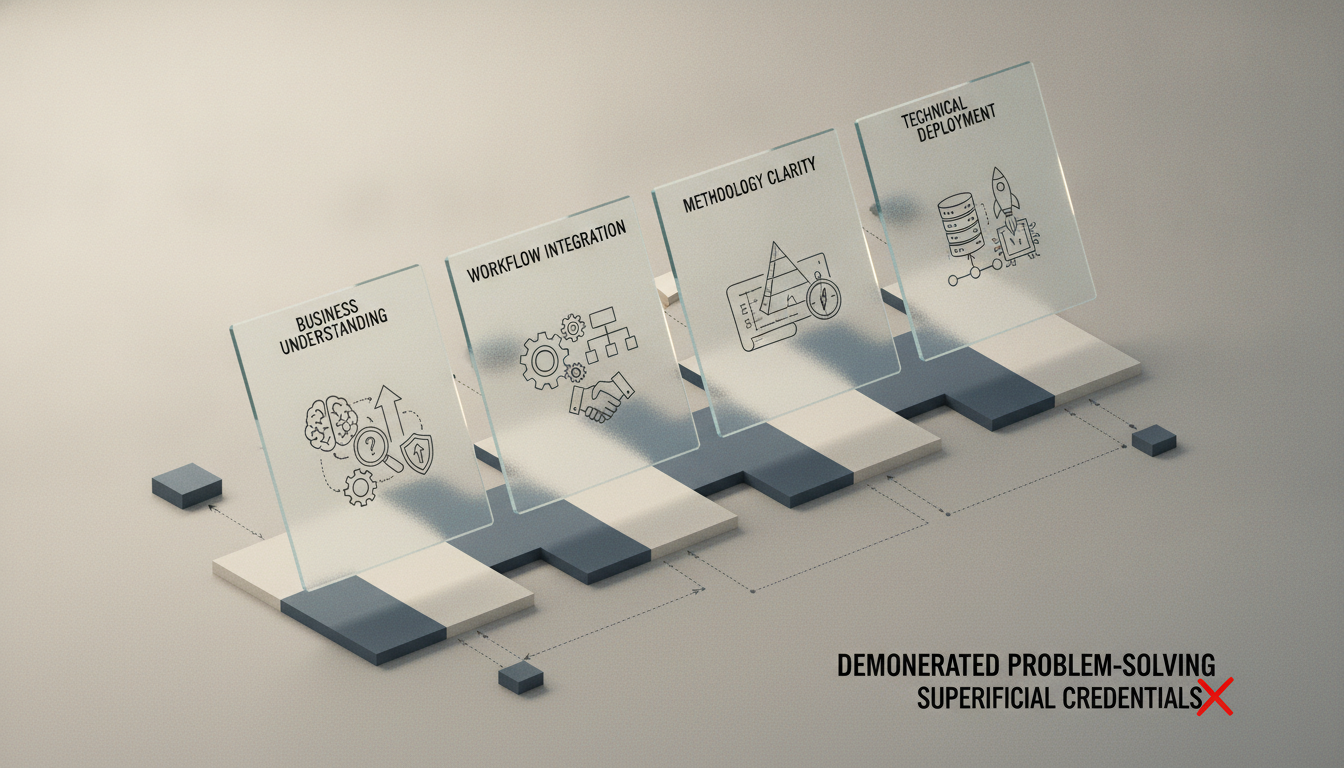
A good consulting partner selection process does not reward polished language. It rewards evidence that the team can solve your problem under your constraints. That means relevant expertise, industry context, workflow fit, and production discipline all need weight in the decision.
Relevant experience beats generic AI credentials
Ask whether the team has handled your class of problem, not whether it has “AI experience.” Fraud detection, demand forecasting, customer segmentation, and pricing optimization look similar in a sales deck but require very different assumptions, data conditions, and deployment patterns. A data analytics consultant who has shipped forecast models into supply-chain planning may be a better fit than a flashy machine learning consulting team that mainly built prototypes for marketing use cases.
Methodology should be explainable in plain English
Look for firms that can describe their workflow clearly: discovery, data audit, feature design, modeling, validation, deployment, monitoring, and handoff. CRISP-DM is still a useful reference point because it forces a connection between business understanding and technical work. If a proposed AI consulting partner cannot explain assumptions, limitations, and tradeoffs without jargon, expect confusion later when results disappoint.
Production readiness is a buying criterion, not a bonus
Many buyers still treat documentation, reproducibility, and deployment planning as secondary. That is a mistake. Reliable data science consulting services should address version control, test environments, model monitoring, rollback plans, and knowledge transfer early. A prototype is not valuable if your internal team cannot maintain it after the consultants leave. This is where Data science consulting services should be judged on operational substance, not on model accuracy claims alone.
The interview questions that reveal real experience
Most vendor interviews are too broad to be useful. You do not need a generic capabilities tour. You need questions that force the team to talk through decisions they actually made on comparable projects.
- Tell us about a project where the first modeling approach failed. What changed, and why?
- What data quality issue caused the biggest delay in a similar engagement, and how did you discover it?
- Which stakeholder disagreed most with the project approach, and how did you resolve it?
- What would make you advise against using machine learning for our use case?
- How do you validate a model when historical labels are incomplete or biased?
- What exactly do you hand over at the end: code, pipelines, runbooks, monitoring setup, training, or only reports?
- Which parts of the solution depend on your proprietary accelerators, and which parts become ours?
Reference calls should be just as specific. Ask former clients whether deadlines slipped because of the client’s internal delays or because the consulting team underestimated complexity. Ask who actually attended working sessions: senior leads or junior analysts. Ask whether the consultants adapted to real workflows or pushed a standard process that looked efficient but fit poorly. Those answers are far more revealing than “Would you hire them again?”
How to compare pricing, scope boundaries, and IP terms
This is where many smart buyers get lazy. They compare total proposal values instead of comparing what each proposal transfers, excludes, and leaves ambiguous. That is how a cheaper bid becomes the more expensive choice.
Pricing model matters because delivery risk is real. One empirical study examined 5,392 IT projects, a useful reminder that overrun behavior is common enough to deserve attention when you evaluate time-and-materials, fixed-fee, and milestone-based structures. For exploratory work, fixed fee can look safe but often hides narrow scope boundaries and change-order traps. Time and materials can be sensible during discovery if reporting is transparent and decision gates are explicit. Outcome-based pricing sounds attractive, but define the outcome carefully or you may reward metrics that do not reflect business value.
| Commercial term | What to ask | Good sign | Warning sign |
|---|---|---|---|
| Scope boundary | What is excluded from the current price? | Clear assumptions on data access, integrations, validation, and deployment | “Standard support included” with no detail |
| Pricing model | What triggers a change request or extra billing? | Named checkpoints and governance around budget changes | Low initial fee with undefined follow-on work |
| IP ownership | Who owns code, features, pipelines, and model artifacts? | Client ownership of project-specific deliverables, with clear license terms for reusable components | Vendor retains broad rights over core deliverables without practical handoff rights |
Read the data science consulting proposal with a lawyer’s eye and an operator’s eye. The legal question is ownership and liability. The operating question is whether your team can run the solution without ongoing dependency. If you need internal capability building, insist that transfer artifacts are part of the contract, not a verbal promise. Buyers comparing one proposal from a specialist team and another from a larger data science services company should expect these terms to differ materially even when the headline price looks close.

What a good pilot or discovery phase looks like
If you are unsure which vendor is right, do not jump straight into a full engagement. Use a short, paid discovery or pilot to test how the team works under real conditions. This is not a miniature version of the full project. It is a structured fit assessment.
- Start with one business decision to improve, not a broad innovation brief.
- Require a data audit that identifies gaps, access issues, lineage concerns, and realistic modeling constraints.
- Define one or two measurable success criteria, such as forecast error reduction, triage accuracy, or analyst time saved.
- Ask for a delivery plan that includes assumptions, risks, dependencies, and what would cause a no-go decision.
- End with a recommendation memo: proceed, reshape scope, or stop.
A strong pilot produces clarity even if the answer is “not yet.” That is valuable. It tells you whether the partner can challenge weak assumptions, involve stakeholders early, and surface security or compliance constraints before budget gets committed. For regulated environments, ask how access controls, retention rules, vendor risk review, and standards such as SOC 2 or ISO/IEC 27001 affect the design from day one.
Which option fits your situation
By this stage, the decision should feel narrower. You are not choosing the “best” firm in the abstract. You are choosing the best fit for your decision speed, internal capability, risk tolerance, and production expectations.
Choose a specialist data science consulting firm if your data is usable, the business problem is well framed, and you need senior technical depth quickly. Choose a broader consultancy if the real challenge is moving from analysis to embedded workflow change across data, product, and engineering. Choose a larger AI consulting partner if governance, procurement, and enterprise integration matter as much as the model itself. Do not pay enterprise overhead for a narrowly scoped problem, and do not hire a boutique for a politically complex transformation unless it has proven delivery support around it.
The strongest buying trigger is simple: hire the partner that makes uncertainty smaller in the first month. That means clearer scope, sharper assumptions, visible risks, realistic handoff, and honest tradeoffs. If one vendor sounds smarter but another makes the operating path more concrete, pick the second one.
When data science consulting is actually worth the investment
Data science consulting earns its cost when it closes a capability gap you cannot close fast enough internally: a missing skill set, a backlog in deployment, a need for outside validation, or a project that needs cross-functional structure your team does not yet have. It loses value when buyers use consultants as a substitute for internal ownership. No external team can rescue a project whose sponsor, end users, and technical owners are misaligned.
If you need a clean decision rule, use this one: choose the partner that demonstrates relevant project experience, can explain its method and limits clearly, treats security and production readiness as part of delivery, and is willing to prove fit through a bounded pilot. Reject the firm that competes mainly on price, avoids hard questions about ownership and exclusions, or treats handoff as an afterthought. That is how you choose a data science consultant worth the investment instead of one that simply wins the pitch.