

Remote data analytics jobs: how to stand out in a global applicant pool
Remote data analytics jobs attract candidates from far beyond one city or country, so being qualified is not enough. You need an application that proves three things fast: you can do the analytical work, you can explain business impact clearly, and you can operate well without constant supervision.
That changes how you should prepare. For remote data analyst jobs, employers often screen first for SQL, then for tools like Python or R, Excel or Google Sheets, and visualization platforms such as Tableau or Power BI. But the candidates who get interviews usually make those skills easy to verify through a focused resume, a practical data analytics portfolio, and evidence of strong remote work skills.
What hiring teams look for first in remote analytics candidates
Most employers are not trying to find the broadest analyst on the internet. They are trying to reduce hiring risk. Your job is to show that you can handle real analytics workflows, communicate with non-technical stakeholders, and stay accountable across time zones.
| Hiring need | What recruiters want to see | What weak candidates submit |
|---|---|---|
| Technical execution | SQL queries, cleaning steps, analysis logic, dashboards, reproducible work | Tool lists with no proof |
| Business judgment | Clear problem statement, metric choice, recommendation, tradeoffs | Charts without decisions |
| Remote readiness | Written updates, documentation, ownership, async collaboration examples | Claims like “self-starter” with no evidence |
That is why generic applications fail. A remote analytics jobs application has to answer unspoken questions: Can this person work independently? Will they write clearly? Can they turn messy data from databases, APIs, surveys, or spreadsheets into a useful recommendation?
Build proof before you apply
If you do not have full-time analytics experience, you can still compete. The strongest early-career candidates build evidence in public or semi-public formats that mirror actual work: a scoped business question, cleaned data, analysis, a dashboard, and a short written memo.
What a remote-ready portfolio should include
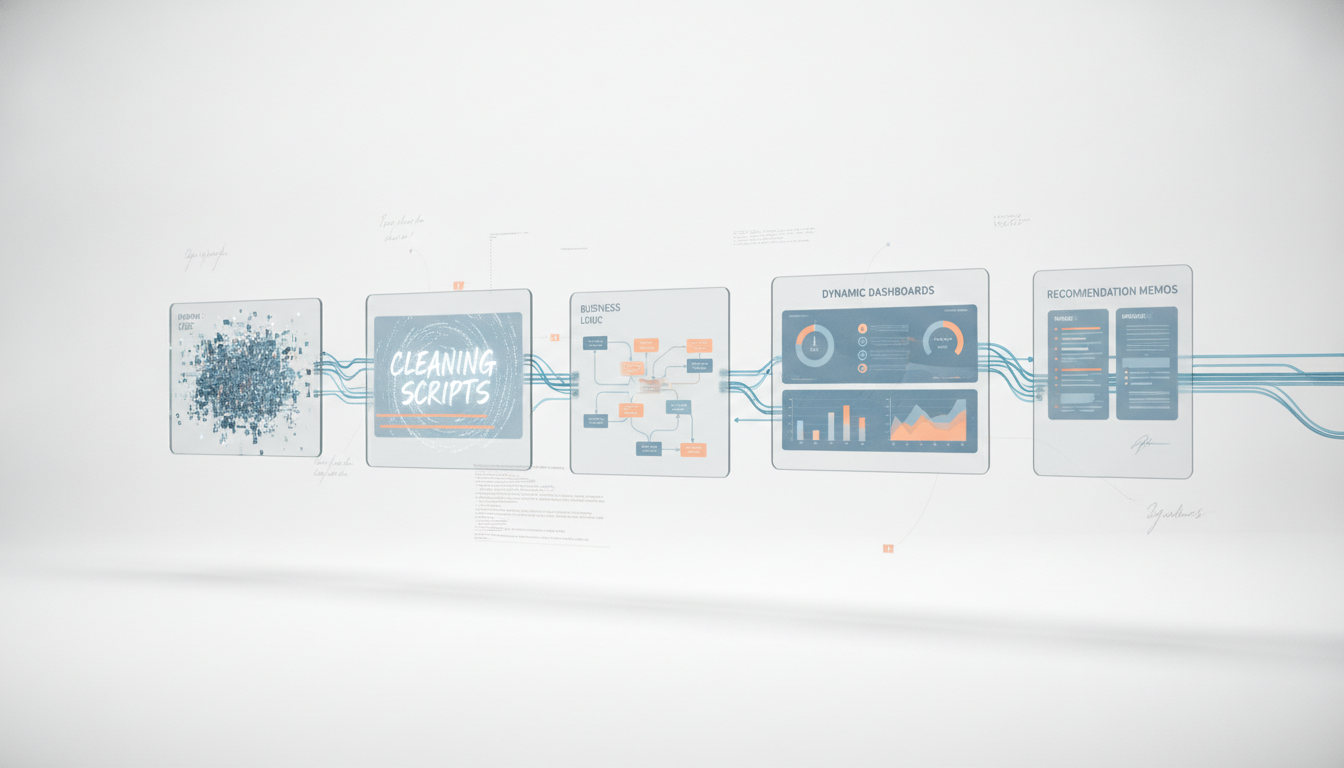
A strong data analytics portfolio should not be a gallery of disconnected charts. It should show how you think from raw input to business recommendation. That means each project should include the source of the data, the cleaning process, the logic behind your metrics, and a final recommendation written for a non-technical audience.
This matters because Tableau’s dashboard user research found that dashboards are a primary interface for workplace data, while users also need both analysis and narratives for sharing and communication. In practice, a portfolio project with a dashboard alone is weaker than one that pairs Tableau or Power BI output with a one-page explanation of what the business should do next.
- One SQL project using joins, aggregations, filters, and a short business summary
- One project using Python for data analysis or R for cleaning, transformation, and exploratory work
- One dashboard project in Tableau or Power BI with written stakeholder takeaways
- One domain-specific case study, such as marketing, finance, healthcare, or product analytics
How to build that portfolio without prior full-time experience
Use project formats that resemble real work instead of tutorial clones. For example, analyze customer churn from a public dataset, clean survey responses into usable segments, or combine API and spreadsheet data to create a reporting workflow. Then document what you would send a manager: objective, assumptions, method, findings, risks, and recommendation.
If your background is still developing, a focused course or Free Online Data Science Bootcamp can help you create work samples, but the sample only becomes persuasive when you add your own scoping, business framing, and explanation. Hiring managers can spot copied capstone projects quickly.
Your resume needs to survive global competition in 15 seconds
A remote resume is not a biography. It is a screening document. When recruiters compare applicants across countries, they cannot decode vague job descriptions or local company context, so your resume must make scope and results instantly legible.
Use a results-first structure
Put your strongest evidence near the top: title or target function, technical stack, domain, and two or three quantified wins. Quantified achievements are much stronger than responsibility lists because they show effect, not activity. “Reduced manual reporting time by automating weekly SQL and spreadsheet workflows” is useful. “Responsible for reporting” is not.
A strong remote data analytics resume usually includes a short headline such as “Data analyst remote candidate focused on product analytics” or “Business intelligence analyst with SQL, Python, Tableau, and stakeholder reporting experience.” If you are deciding between formal education and shorter credentials, the tradeoff is explained well in data analytics degree vs certification, but for application purposes the deciding factor is still proof of usable skill.
Make international context easy to read
Do not assume the reader knows your employer, university, or market. Add one line of context when needed: company size, industry, product type, or customer base. Translate local role language into widely understood analytics terms such as reporting automation, experiment analysis, retention metrics, forecasting support, or stakeholder dashboards.
For early-career applicants, certifications can strengthen credibility, especially when they reinforce foundations in SQL for data analysts, visualization, or analytics workflows. If you are choosing which ones are worth listing, recognized data analytics certifications is a useful reference point; just do not let certificates crowd out project results.
Show async communication instead of claiming it
Many candidates write “excellent communicator” and stop there. Remote employers need more than that. They need evidence that you can move work forward without live meetings, write updates that reduce confusion, and collaborate across time zones without dropping detail.
What evidence looks like in an application
Instead of broad claims, mention behaviors and artifacts. Good examples include writing project documentation, maintaining metric definitions, recording assumptions in analysis notes, or handing off dashboard updates across regions. These signals are specific, and specific is credible.
- Resume bullet: “Documented KPI definitions and dashboard logic for marketing and product teams across different working hours.”
- Portfolio note: “Included a decision memo and data dictionary so a teammate could reuse the analysis asynchronously.”
- Cover letter line: “I structure analysis updates with open questions, blockers, and next actions to keep projects moving without waiting for meetings.”
What to include in your portfolio and cover letter
Your portfolio should show evidence of async communication directly: README files, project summaries, version notes, or a concise stakeholder memo. A candidate who writes clearly about assumptions, limitations, and next steps looks far more remote-ready than one who only shares notebooks and screenshots.
That is also where specialization helps. A product analyst, growth analyst, finance analyst, or business intelligence analyst who speaks the language of one business domain usually stands out more than a generalist listing every possible tool. Salary expectations and role positioning can also vary across tracks, which is why many applicants compare data analytics vs data science salary before narrowing their search.

Target fewer roles, more precisely
Applying to hundreds of postings with the same materials is usually a losing strategy. For remote data analytics jobs, a tighter match often beats a higher volume of applications because screening is fast and global competition is high.
- Choose one primary lane: product, marketing, finance, healthcare, growth, or business intelligence.
- Match your portfolio to that lane with two relevant projects.
- Tailor your resume headline, skills section, and top bullets to that lane.
- Apply to adjacent titles, not just “data analyst”: analytics analyst, operations analyst, reporting analyst, business intelligence analyst, product analyst.
This is where domain knowledge becomes a force multiplier. A candidate with solid SQL, clean written communication, and a clear specialty often beats a broader applicant whose profile feels generic.
A practical application stack for the next 14 days
If you want to take action immediately, do not rebuild everything at once. Create a compact application stack that makes your strengths visible and repeatable across remote data analyst jobs and related roles.
- One-page resume with quantified outcomes and clear technical stack
- Three portfolio projects, each with code, business summary, and documentation
- One reusable cover letter base with domain-specific customization
- A short LinkedIn or profile headline aligned to your target role
- A tracking sheet for roles, tailoring notes, follow-ups, and interview patterns
If your current materials do not yet show SQL, Python for data analysis, spreadsheet work, and one visualization tool, fix that before sending more applications. Breadth matters less than verified competence in the tools most often screened first.
The version of you that wins remote data analytics jobs
The strongest candidates in a global applicant pool do not merely look skilled. They look easy to trust. Their resumes are specific, their portfolio projects resemble actual analytical work, and their writing shows they can operate independently. That combination lowers perceived hiring risk faster than a long list of tools ever will.
If you need a next move, make it concrete: pick one analytics domain, build one portfolio project that ends in a recommendation, rewrite your top three resume bullets with measurable outcomes, and add one example of async collaboration to your materials. Remote data analytics jobs usually go to candidates who make the hiring decision simpler.