

Fintech data analyst salary ranges and in-demand skill premiums
The fastest useful answer on data analyst salary in fintech: in the U.S., entry-level roles commonly land around $60,000–$80,000, mid-level roles around $80,000–$110,000, and senior roles around $110,000–$140,000+. That headline range is real, but it hides the details that matter most in practice: subrole, location, company stage, and whether you bring revenue-linked skills such as Python, SQL, machine learning, or predictive modeling.
That is why broad averages can mislead. A generic U.S. data analyst benchmark sits around $85,600–$97,700, while one fintech-specific analyst title comes in much lower at roughly $69,000 average with a middle range near $60,500–$75,400. If you are comparing offers, negotiating, or planning a move, the useful question is not “What is the average?” It is “Which fintech analyst path pays more, and what exact skill set creates a premium?”
Five salary levers that actually change fintech analyst pay
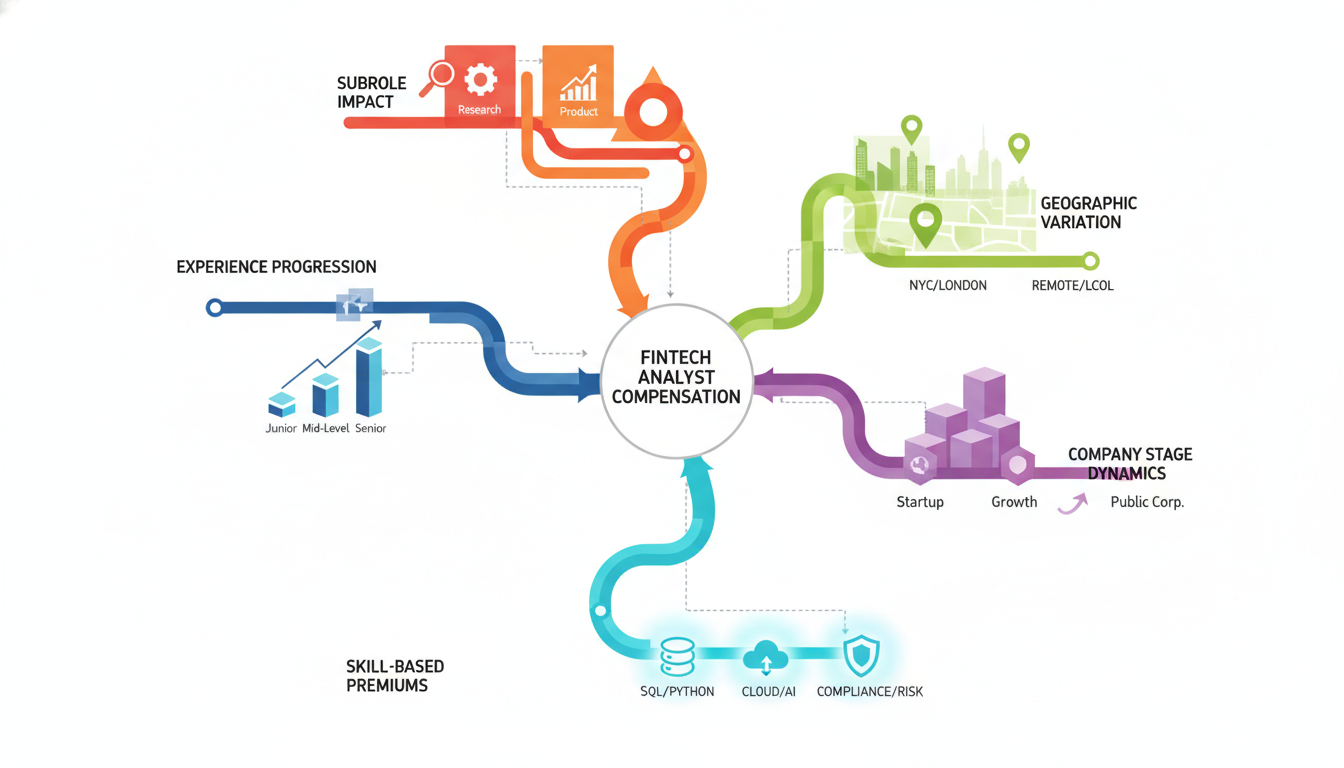
Most articles stop at junior, mid, and senior. That is too shallow for a reader trying to act. These five levers are the ones worth checking first because each can move a fintech analyst salary meaningfully.
1. Experience still sets the floor
Base compensation rises sharply with experience, and fintech is no exception. One U.S. fintech analyst progression shows about $57,800 at entry level, $70,700 at early career, $87,100 at mid-level, and $111,900 at senior level. That progression aligns with the broader market pattern, even if specific job titles differ between startups, payment firms, lenders, and neobanks.
The practical takeaway: if your title says “analyst” but your work includes ownership of forecasting, experimentation, or fraud models, you should benchmark yourself against higher-scope roles, not just years of experience. This matters even more when comparing data analytics vs data science salary paths, because scope creep often shows up before title changes do.
2. Fintech subrole can matter as much as seniority
Not all analyst work inside fintech pays the same. Product analytics often commands stronger pay because it sits closer to growth, retention, pricing, and monetization decisions. By contrast, BI analytics can be broad and valuable but may be paid more conservatively when the role is focused on reporting rather than decision science.
| Fintech analyst subrole | Why it can pay more or less | What to watch for |
|---|---|---|
| Product analytics | Direct tie to user growth, conversion, activation, and retention; product analyst salary data shows a U.S. average of $106,534 with a typical range of $95,402–$117,152 | May require experimentation, funnel analysis, and stakeholder-heavy work |
| Fraud or risk analytics | Critical to loss prevention, underwriting, AML monitoring, and model monitoring | Often rewards domain depth more than dashboard breadth |
| BI analytics | Strong foundation role for reporting, operations, and executive visibility | Can cap lower if the role stays descriptive rather than predictive |
If you want the highest upside, product, fraud, and risk analytics usually deserve a closer look than general reporting roles. That is not a hard rule for every employer, but it is a reliable decision shortcut when you need a curated list of better-paying tracks.
3. Location shifts the base, but not always the best deal
Hub cities often pay more in cash. Still, higher nominal salary does not always mean a better offer once rent, commute, and tax reality enter the picture. In one salary benchmark, fintech analyst salary by city shows a U.S. average of $68,975, compared with $79,417 in New York and $67,543 in Atlanta.
London adds another layer. Fintech analyst pay there is around £47,300 median total pay, with a typical range of roughly £35,000–£67,000, while finance data analyst roles sit nearer £43,000 median. India is lower in absolute terms, with a broad data analyst median around Rs 573,921 serving as a rough baseline, but some global fintech employers narrow that gap for high-demand technical roles.
4. Company stage changes the shape of compensation
This is one of the biggest missing pieces in salary guides. Early-stage startups may offer a lower base salary than larger fintechs, banks, or public tech companies, but they can try to make up for it through equity, broader ownership, and faster title progression. Larger employers tend to be more structured: higher base, clearer bonus targets, stronger benefits, and less uncertainty.
For a candidate, that means the best fintech data analyst salary is not always the highest base. If a startup offer includes meaningful equity and broad remit, it can outperform a safer salary path. If you want predictable cash flow, a later-stage employer usually wins. Readers weighing training routes should also think about how hiring managers read credentials; in some cases, data analytics degree vs certification is less about prestige and more about whether the role needs immediate technical proof.
5. Skill premiums are real, but only when paired with business use
Python and SQL are associated with about a 10%–15% premium in fintech roles. Machine learning and predictive analytics can lift offers by up to 20%. Big data tools such as Hadoop or Spark may add about 10%, while Tableau or Power BI can add roughly 5%–10%.
The important nuance: fintech firms do not usually pay extra just because those tools appear on a resume. They pay more when the tool maps to a money problem. SQL that supports churn analysis, underwriting decisioning, fraud detection, or unit economics is worth more than SQL used only for standard reporting. That distinction matters for career changers considering a data analytics certification for career change rather than a long academic route.
Which skills tend to earn the strongest premium first?
If your goal is salary uplift, prioritize skills by employer value, not by popularity. The best-paying stack is usually the one that helps a fintech reduce losses, improve conversion, or automate a manual decision process.
- Python + SQL: best first upgrade for most analysts because it moves you from dashboard support into scalable analysis and pipeline work.
- Machine learning + predictive analytics: strongest premium when tied to fraud scoring, customer lifetime value, default risk, or propensity models.
- Spark or Hadoop: more relevant in larger data environments, especially payments, lending, or transaction-heavy firms.
- Tableau or Power BI: useful and marketable, but usually a smaller premium unless paired with ownership of business decisions.
A simple rule helps: if two candidates both know SQL, the one who can explain how they improved approvals, cut fraud losses, or increased retention usually gets the stronger offer. For some people, a targeted data analytics certification for career switch makes sense only if it builds those business-facing examples, not just tool familiarity.
How to read total compensation instead of just base salary
Fintech compensation often includes more moving parts than a standard finance data analyst salary discussion suggests. Ignoring them leads to bad comparisons.
- Base salary: your guaranteed cash; easiest number to compare, but not the whole picture.
- Bonus: more common at established employers and can reflect company, team, or individual performance.
- Equity: often more relevant at startups; potentially valuable, but uncertain and illiquid.
- Benefits: pension, healthcare, leave, and learning budgets can materially change the quality of an offer.
When reviewing a fintech analyst salary, ask which component is carrying the package. A lower base with speculative equity is not automatically better than a higher cash offer with a modest bonus. For risk-averse candidates, total compensation should be discounted toward guaranteed pay. For candidates optimizing upside, equity and accelerated scope may justify a lower starting base.

A quick decision table for salary-focused candidates
This is the shortlist version. Use it when you need to decide where to aim next rather than absorb another generic market overview.
| If you want… | Target role or setup | Main tradeoff |
|---|---|---|
| Higher immediate base salary | Later-stage fintech, major city, product or risk analytics | More specialization and less broad ownership |
| Fast salary growth | Role with Python, SQL, experimentation, and predictive analytics scope | Steeper technical expectations |
| Longer-term upside | Earlier-stage fintech with equity and broad commercial exposure | Lower guaranteed cash and more uncertainty |
Why the best fintech salary path is rarely the most obvious title
The biggest mistake is chasing the broadest title instead of the highest-leverage work. A “financial data analyst salary” or “finance data analyst salary” benchmark can be a useful starting point, but fintech rewards analysts who sit close to product decisions, fraud losses, underwriting quality, and revenue operations. That is where the premiums show up.
If you are evaluating your next move, compare roles in this order: business impact first, technical depth second, title third. That approach explains why two jobs with similar names can differ sharply in pay. It also gives you a cleaner negotiation story: not “I know Python,” but “I can use Python, SQL, and predictive analytics to improve a fintech metric that the company already cares about.”