

What to Expect From Enterprise AI Consulting Services
Enterprise AI consulting services should help you answer three questions quickly: what problem is worth solving, whether your organization is ready to solve it with AI, and what it will take to move from idea to production without creating compliance or operational risk. That matters because weak upfront definition ruins AI programs early; IBM’s analysis of AI ROI found that only 25% of AI initiatives delivered the expected ROI, and just 16% scaled enterprise-wide.
If you are evaluating enterprise AI consulting, expect far more than model building. A serious partner will usually cover AI strategy consulting, AI readiness assessment, AI use case discovery, data and architecture review, solution design, AI integration, responsible AI controls, AI implementation services, and post-launch monitoring. If your team also needs adjacent analytics support, the work often overlaps with business intelligence services, especially when dashboards, reporting, and KPI baselines have to be defined before any model goes live.
What enterprise AI consulting services actually include
The short answer: they span the full decision chain, not just the technical build. The best engagements reduce uncertainty phase by phase so executives can decide whether to continue, expand, or stop.
- Strategy and prioritization: aligning AI opportunities to business goals, budgets, operating constraints, and risk tolerance.
- AI readiness assessment: reviewing data quality, governance, skills, workflows, infrastructure, and leadership readiness.
- AI use case discovery: ranking candidate projects by business value, feasibility, expected time to impact, and implementation risk.
- Data work: assessing privacy, data access, labeling needs, architecture gaps, integration issues, and feature engineering requirements.
- Solution design and machine learning consulting: deciding whether the use case needs rules, traditional machine learning, generative AI, or a hybrid approach.
- Implementation and AI integration: connecting the solution to ERP, CRM, customer service, supply chain, HR, or other enterprise systems.
- AI governance and responsible AI: defining controls for fairness, transparency, human oversight, auditability, and compliance.
- Change management and training: redesigning workflows so employees actually use the system.
- Monitoring and MLOps consulting: setting up drift detection, retraining, recalibration, and ongoing performance review.
That list is broad, but the practical point is simple: if a consulting firm talks mainly about algorithms and barely mentions data ownership, workflow redesign, model validation, or governance, it is describing only a slice of what enterprise AI consulting usually requires. Teams that also need custom builds may pair strategy work with Custom AI ML software development services when off-the-shelf tools do not fit security, workflow, or integration requirements.
What the engagement looks like phase by phase
Many articles stop at “strategy, build, deploy.” That is too abstract to be useful. What matters in practice is the deliverable you should expect at each stage, because deliverables are how you judge whether the consulting work is moving you toward a real decision.
1. Assessment phase
The assessment phase should produce a clear picture of readiness, not a vague maturity score. Expect an AI readiness assessment that examines data quality, access controls, privacy requirements, existing analytics capability, operating model, and infrastructure choices such as cloud, hybrid, or on-premises. The output should usually include a gap analysis, a shortlist of blockers, and a recommendation on what can realistically be attempted first.
2. Use-case selection phase
AI use case discovery should end with a ranked portfolio, not a brainstorm. Good consultants help you compare candidates by expected business impact, feasibility, implementation complexity, risk, and time to measurable value. A strong deliverable here is a prioritization matrix with 3 to 5 promising use cases and a reasoned recommendation for which one should move first.
3. Pilot design phase
Before any production rollout, expect a design package that defines the problem, inputs, outputs, decision points, stakeholders, and success metrics. This is also where baseline KPIs should be locked in. If the use case is call-center triage, for example, baseline measures might include average handling time, first-contact resolution, escalation rate, and agent adoption rate.
4. Build and validation phase
This phase should deliver more than a model. Enterprise validation usually includes testing against business KPIs, plus checks for bias, robustness, explainability, and failure modes. You should also expect documentation covering assumptions, data lineage, human review points, and conditions where the model should not be used.
5. Deployment planning phase
A deployment plan should spell out the target environment, system integrations, security controls, fallback procedures, rollout scope, training needs, and ownership model. This is where AI integration work gets real: APIs, workflow triggers, identity controls, handoffs to humans, and reporting loops must be defined before launch.
6. Post-launch operations phase
Production AI needs operating discipline. Expect monitoring plans for drift, retraining thresholds, alerting, access reviews, and periodic business-performance reviews. If the consultant offers MLOps consulting, they should also define who is responsible for model updates, incident response, and change approval.
How to estimate ROI before hiring an AI consulting partner
This is one of the most overlooked parts of buying AI consulting services. If you cannot describe what financial or operational gain would justify the project, no consultant can rescue the business case later.
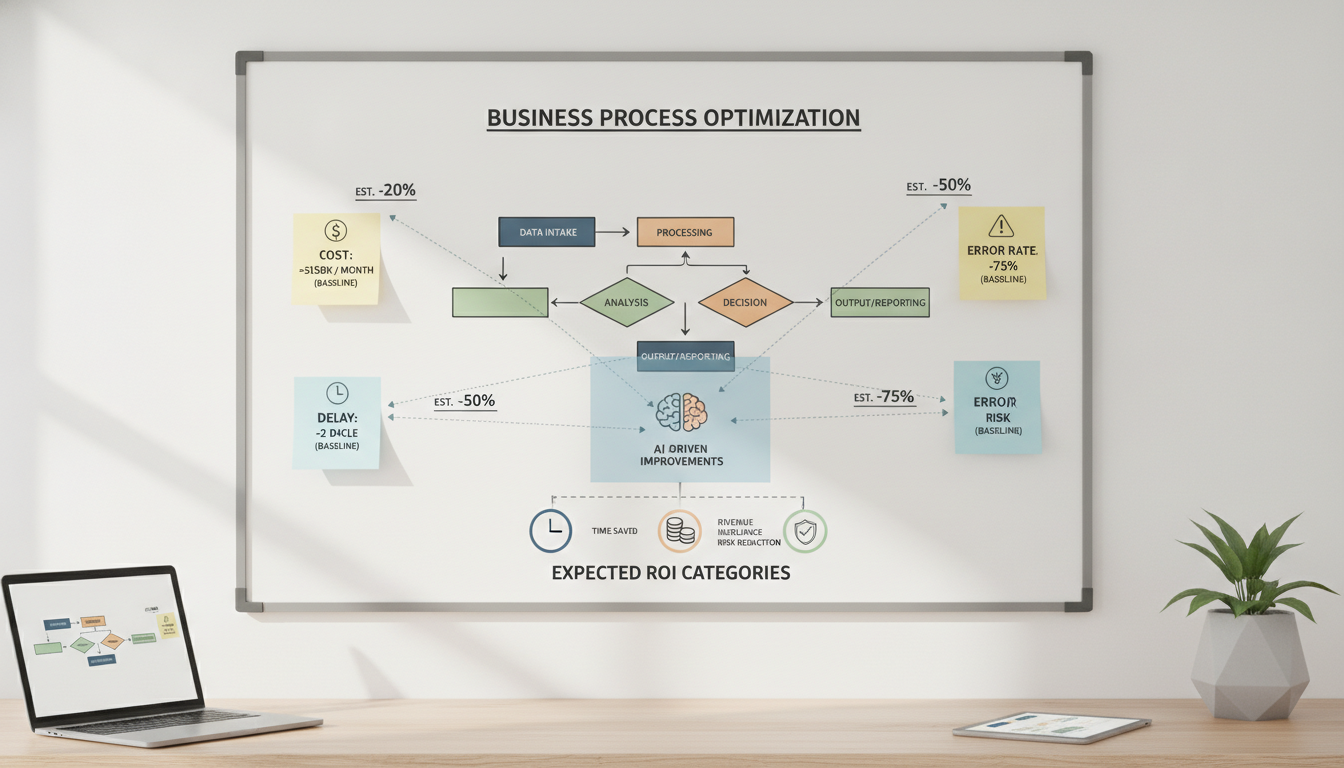
Start with one business process, not a grand transformation story. Define the current cost, delay, error rate, revenue leakage, or service bottleneck. Then estimate how AI could change that metric and what the change would be worth. Useful ROI categories include labor hours saved, faster cycle times, higher conversion, lower churn, fewer defects, reduced manual review, or avoided compliance exposure. The important rule is to tie every expected gain to a baseline your business already tracks.
| ROI input | What to measure before consulting starts | Why it matters |
|---|---|---|
| Business baseline | Current cost, throughput, error rate, SLA performance, or revenue outcome | Without a baseline, “improvement” stays subjective |
| Implementation effort | Data cleanup needs, integration scope, workflow changes, training effort | Many AI projects fail because enablement work was underestimated |
| Success threshold | Minimum KPI lift needed to justify expansion | Gives the pilot a pass/fail standard instead of endless debate |
| Risk cost | Compliance, fairness, brand, and operational failure exposure | Prevents inflated ROI models that ignore downside risk |
A practical buying test is to ask a consulting partner how they define success before any model is built. If the answer is framed only in technical metrics, push harder. Enterprise programs need business KPIs and operating KPIs together: model accuracy may matter, but so do adoption, override rates, processing speed, and exception handling. That discipline is one reason most firms are still moving carefully; McKinsey’s State of AI reports that only 11% of companies have adopted generative AI at scale.
Should you start with a proof of concept, a pilot, or full production?
This decision should be based on uncertainty, not ambition. The right entry point depends on how much you still need to learn about technical feasibility, business value, and operational fit.
| Approach | Best when | Main deliverable | Main tradeoff |
|---|---|---|---|
| Proof of concept | You need to test whether the approach works at all with limited scope | Feasibility evidence and early technical findings | Often too narrow to prove business value |
| Pilot | You believe the use case is viable and need real-world workflow validation | Measured performance in a live but controlled environment | Requires stronger data, stakeholder buy-in, and operational planning |
| Full production rollout | The use case is proven and controls, integrations, and ownership are ready | Scaled deployment with monitoring and governance | Highest cost of mistakes if readiness was overstated |
Use a proof of concept when the core technical question is still unresolved. Use a pilot when the technical path is understood but the business still needs evidence on user behavior, exceptions, and workflow fit. Move to full production only when validation, governance, integration, and ownership are already defined. If a vendor pushes straight to enterprise rollout without that sequence, caution is warranted.
What good consultants will challenge you on
The value of enterprise AI consulting is not that consultants say yes to every idea. The value is that they pressure-test assumptions early enough to avoid expensive mistakes later.
- Data realism: whether the required data exists, is reliable, and can legally be used.
- Workflow fit: whether employees will trust, adopt, and act on the output.
- System constraints: whether existing ERP, CRM, HR, or support platforms can support the integration path.
- Governance obligations: whether the use case needs human review, explainability, audit logs, or restricted deployment.
- Ownership: who will monitor and improve the system once consultants leave.
That last point is often underestimated. AI consulting services do not end at launch, because enterprise systems drift, inputs change, and business rules evolve. If you already know your main issue is fragmented reporting and weak data visibility rather than AI itself, it may be smarter to fix analytics foundations first using best BI tools for small businesses as a reference point for reporting maturity, then expand into more advanced AI use cases later.

How to evaluate an enterprise AI consulting partner
Choosing a partner is less about slide quality and more about operating discipline. The right firm should be able to explain how it will reduce uncertainty at each step, what evidence it needs from your team, and how it handles the parts of AI projects that are usually neglected.
- Ask how they scope readiness. They should mention data, governance, operating model, and integration constraints, not just technology.
- Ask for phase deliverables. If the outputs are unclear, the engagement will be hard to govern.
- Ask how they validate value. They should tie model performance to business KPIs.
- Ask how they handle responsible AI. Fairness, accountability, auditability, and human oversight should be explicit.
- Ask who owns post-launch operations. Monitoring, retraining, and escalation should have named responsibility.
If you want a benchmark for the level of practical support to look for, review how DataCoLab’s expert data science services are positioned around applied analytics and delivery, then compare that standard against any AI strategy consulting provider you shortlist. The useful question is not whether a firm can build models; many can. The useful question is whether it can connect data, governance, implementation, and adoption into one accountable program.
What enterprise buyers should walk away expecting from AI consulting services
You should expect AI consulting services to make the path clearer, not more mysterious. That means a defined business case, a realistic assessment of readiness, a ranked use-case shortlist, a clear decision on proof of concept versus pilot versus rollout, and a deployment plan that includes governance, integration, and change management from the start.
The strongest enterprise AI consulting engagements are disciplined about saying “not yet” when data, ownership, or workflows are not ready. That is not hesitation. It is good judgment. If your next conversation with a consulting partner leaves you with sharper success metrics, named deliverables, and a cleaner go/no-go decision, the engagement is doing its job before the first model is even built.