

Data Science Consulting Services vs Data Science as a Service: Key Differences, Costs, and Use Cases
If you are comparing data science consulting services vs data science as a service, the real question is not which model sounds more advanced. It is which model gets you to a useful outcome with the least waste. In practice, data science consulting is usually the better fit when you need to define a messy problem, design a custom solution, or make a one-time strategic leap. Data science as a service, or DSaaS, is usually the better fit when you already know the recurring outcome you want and need it delivered reliably as an ongoing service.
That distinction matters because AI and analytics projects often take longer than buyers expect. Gartner says nongenerative AI projects take 33.6 weeks on average from idea to production, with 8.1 weeks spent just on idea vetting, as noted in Gartner’s AI project timeline data. If your organization has limited internal data science maturity, a managed model can reduce decision friction and implementation risk. If your challenge is still undefined, though, standardization will not save you.
This guide is built for a decision, not just a comparison. You will see how to evaluate each option, what responsibilities still stay with your team, how to think about 6- to 12-month total cost of ownership, and which model fits different operating realities.
How to evaluate data science consulting and DSaaS
Most articles compare scope, pricing, and delivery model. That is useful, but not enough to choose well. The better way to evaluate data science consulting, managed analytics services, and subscription analytics is to look at five buying criteria that affect real outcomes.
- Problem clarity: Do you know exactly what needs to be built or measured?
- Repeatability: Is this a one-off initiative or an ongoing operational need?
- Internal maturity: Can your team manage data pipelines, validation, stakeholder alignment, and model governance?
- Customization need: Are standard workflows enough, or do you need novel modeling, experimentation, or business logic?
- Operating model: Do you want expert humans embedded in a project, or a service layer that keeps running after setup?
If you score high on uniqueness and low on repeatability, consulting usually wins. If you score high on repeatability and low on appetite for building an in-house machine learning workflow, DSaaS usually wins.
What each model actually is in practice
The labels can blur together because both models may involve external experts, predictive analytics services, and some level of implementation support. The practical difference is what you are buying: expert problem-solving or ongoing capability delivery.
Data science consulting services
Data science consulting is typically project-based and customized to solve a specific business problem. A consulting engagement often includes problem framing, data audits, model development, experimentation, recommendations, and implementation support. Delivery is usually human-led: consultants, analysts, data scientists, and sometimes engineers working alongside the client.
This is the stronger fit when the business question is still taking shape. Examples include diagnosing why churn increased, designing a pricing model, validating whether demand forecasting is feasible, or building a custom machine learning workflow tied to proprietary business rules.
Data science as a service
Data science as a service is typically productized or managed as an ongoing service, with repeatable analytics or machine learning capabilities delivered on a recurring basis. DSaaS often includes ongoing model scoring, hosted prediction APIs, managed pipelines, automated insights, and monitoring and maintenance.
This is the stronger fit when the business outcome is already known and needs steady delivery. Think recurring lead scoring, anomaly detection, demand forecasting, risk scoring, or analytics platform services that support repeated decision-making without rebuilding the workflow every quarter.
Side-by-side comparison that helps you choose
The table below focuses on decision criteria that actually separate good-fit from bad-fit purchases. It is not a feature checklist. It is a fit assessment.
| Criterion | Data Science Consulting Services | Data Science as a Service (DSaaS) |
|---|---|---|
| Best for | Unique, ambiguous, high-customization business problems | Repeatable analytics or ML delivered continuously |
| Delivery model | Human-led project work with collaborative discovery | Productized or managed ongoing service |
| Customization | High | Moderate to lower |
| Time horizon | Short- to medium-term engagement | Ongoing operating model |
| Typical pricing | Labor-based: hourly, daily, milestone, fixed fee, retainer | Subscription, tiered, per-seat, or usage-based charges |
| Internal maturity required | Moderate to high if your team must carry work forward after the project | Lower to moderate if the service provider handles routine operations |
| Main tradeoff | Flexible and tailored, but less efficient for recurring operational delivery | Efficient and scalable, but less suitable for novel or poorly defined problems |
Which model is better for limited internal data science maturity?
This is where many buyers make the wrong choice. If your organization has weak data science maturity, you may assume consulting is safer because it brings in experts. Sometimes it is. Often it is not.
DSaaS is usually the better choice for low-maturity organizations that need a known, repeatable outcome. The reason is operational. Managed analytics services can reduce the burden of pipeline management, model scoring, monitoring, and routine maintenance. If your team does not have strong MLOps, analytics engineering, or model governance muscle, a standardized service can keep the system running without requiring you to build that capability from scratch.
Consulting is usually the better choice for low-maturity organizations only when the problem itself is unclear. If you do not know which use case matters, whether the data is reliable, or whether machine learning is even appropriate, machine learning consulting or AI consulting services can help you frame the problem before you commit to an ongoing service.
A simple rule works well here: if your internal team cannot clearly state the recurring decision the model should support, start with consulting. If your team can state that decision clearly but cannot operate the workflow reliably, start with DSaaS.
What responsibilities remain with the client?
Outsourcing data science does not outsource accountability. Whether you choose data science outsourcing through consultants or a subscription analytics model, some responsibilities stay on your side. The difference is how much day-to-day execution you retain.
What stays with the client in consulting
With consulting, your team usually keeps heavier responsibility for business alignment and follow-through. Consultants can frame the problem, run data audits, build models, and advise on implementation, but the client still typically owns:
- Business objective definition and success criteria
- Access to data, systems, and subject matter experts
- Stakeholder alignment and decision-making authority
- Internal change management and process adoption
- Long-term ownership after the engagement ends, unless a retainer continues
That last point is the hidden issue. Consulting can produce a strong solution, but if your team cannot operationalize it, value stalls after handoff.
What stays with the client in DSaaS
With data science as a service, the provider usually takes on more recurring operational work, but the client still owns governance decisions. In most cases, your team remains responsible for:
- Approving use cases, policies, and acceptable model behavior
- Providing clean enough source data and access permissions
- Reviewing outputs and deciding how they affect business actions
- Monitoring compliance, privacy, and internal control requirements
- Managing vendor oversight and service-level expectations
So DSaaS does not remove governance. It removes more of the execution burden. If your bottleneck is operation rather than strategy, that matters a lot.

How to estimate 6- to 12-month total cost of ownership
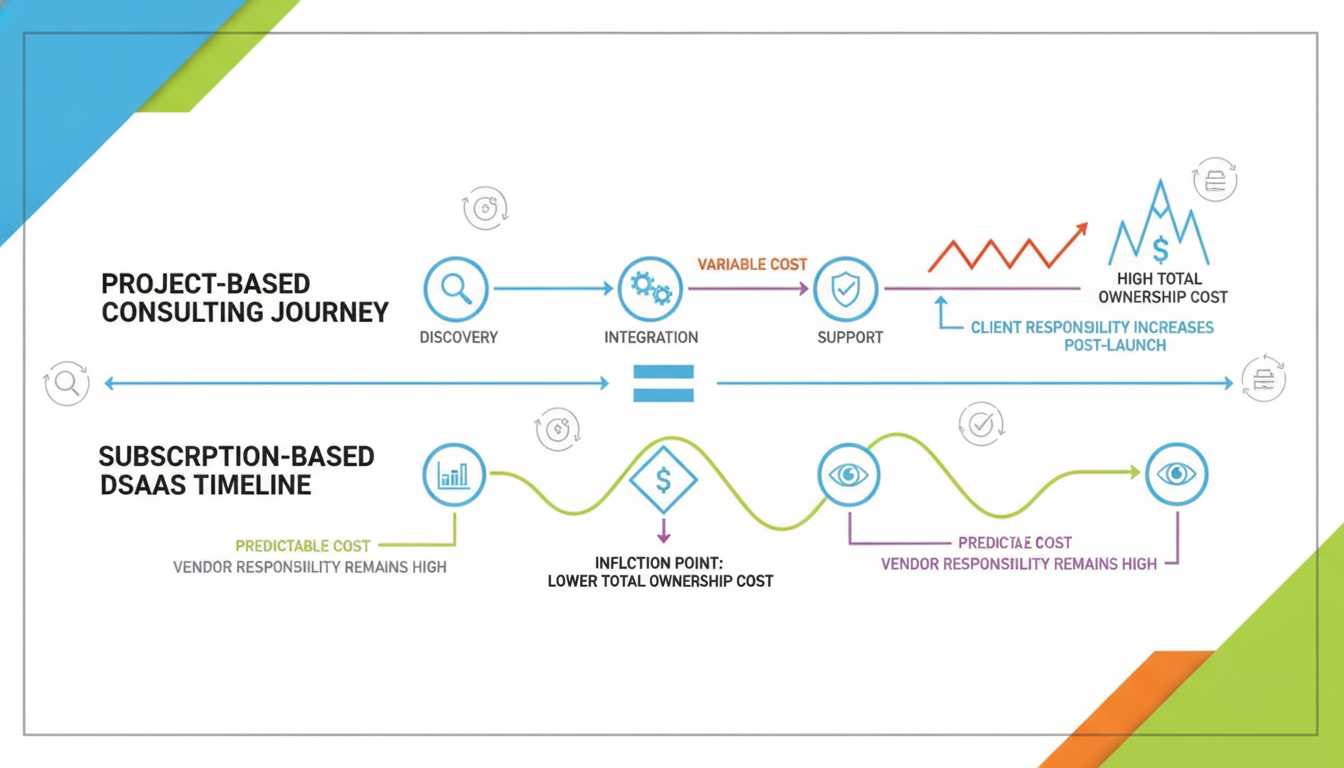
Sticker price rarely tells the truth. Consulting may look expensive up front but end after a project. DSaaS may look affordable monthly but run longer than expected. To compare them fairly, calculate total cost of ownership over the same 6- to 12-month period.
A practical TCO formula
For each option, add four categories:
- Vendor cost: project fees, retainers, subscriptions, or usage charges
- Internal labor cost: time from product, analytics, engineering, legal, security, and leadership
- Infrastructure and tooling cost: storage, compute, integration, monitoring, and support systems
- Risk and rework cost: delays, handoff friction, model fixes, retraining, or missed adoption
That framework is especially important because managed services can shift costs away from internal build and maintenance. As one benchmark, AWS’s SageMaker TCO analysis reported a 54% lower three-year TCO versus certain self-managed cloud ML options. That does not prove every DSaaS engagement is cheaper, but it does support the broader buying lesson: managed service pricing often understates savings if you would otherwise need your own engineering and operational stack.
Where consulting TCO rises
Consulting total cost climbs when your team needs multiple rounds of discovery, custom integration work, or post-project support because no one internally can maintain the outcome. It also rises when the original problem statement is weak. You end up paying for clarification, not just execution.
Where DSaaS TCO rises
DSaaS total cost rises when the service does not match your real workflow and you need heavy customization around a standardized offering. It also rises when data quality is poor and your team spends months cleaning inputs before the service can deliver reliable outputs. In those cases, the subscription may run while value is still delayed.
For a 6-month view, consulting often wins when you need a defined project with a real endpoint. For a 12-month view, DSaaS often wins when you need recurring model outputs, ongoing monitoring, or analytics platform services that become part of day-to-day operations.
Use cases where the wrong choice becomes expensive
Both models can work. The expensive mistake is using the wrong one for the shape of the problem.
Choose consulting when the business question is still open
Use data science consulting when you need diagnosis before delivery. Good examples include customer segmentation redesign, experimentation strategy, fraud pattern discovery, data readiness assessment, or a custom forecasting model for a business with unusual demand drivers. These are not plug-and-play needs. They require problem framing, iteration, and judgment.
Choose DSaaS when the workflow needs to run continuously
Use DSaaS when the value comes from repeatability: regular scoring, managed prediction APIs, automated anomaly alerts, recurring predictive analytics services, or ongoing maintenance of an existing model-driven workflow. If the job is operational and continuous, paying repeatedly for custom consulting effort is usually the less efficient path.
Which option fits your situation
If you are undecided, do not ask which model is better in general. Ask which failure you are trying to avoid. Consulting reduces the risk of solving the wrong problem. DSaaS reduces the risk of failing to operate a known solution consistently.
- Pick data science consulting services if your use case is unique, your data situation is unclear, or you need expert diagnosis before committing to a long-term solution.
- Pick data science as a service if your use case is recurring, your desired output is already understood, and your team lacks the capacity to manage ongoing analytics or ML operations.
- Start with consulting, then move to DSaaS if you need to validate the use case first and operationalize it later. This is often the smartest path for mid-maturity organizations.
Why this data science consulting services vs data science as a service decision usually comes down to operating burden
The biggest decision trigger is not customization alone. It is who will carry the work after the initial setup. If your organization wants outside experts to define, test, and shape a bespoke solution, consulting is the better purchase. If your organization wants an external partner to keep a repeatable capability running month after month, DSaaS is the better purchase.
For most low-maturity teams, DSaaS is the safer answer when the use case is already clear. For teams facing an ambiguous business problem, consulting is the safer first step even if DSaaS may later become the long-term model. That is the practical answer many comparison articles skip: choose consulting for uncertainty, choose DSaaS for continuity, and combine them only when your roadmap genuinely needs both.