
AI Consulting for Business: How to Find and Ship a Valuable Use Case
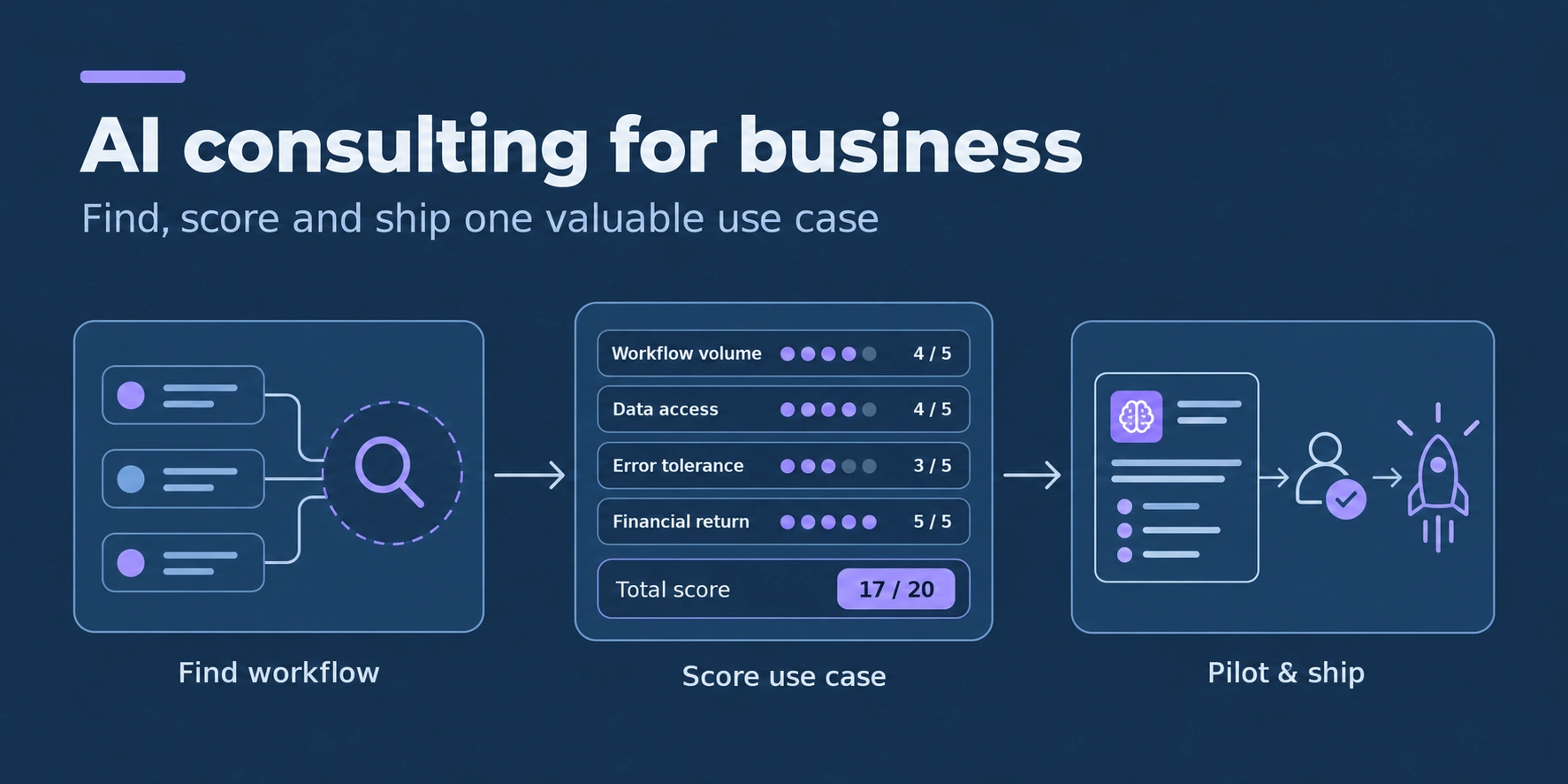
AI consulting for business is most valuable when it helps a team identify a costly workflow, test whether AI can improve it, and put a working solution into everyday use. The right first use case is not necessarily the most advanced: it has a measurable outcome, accessible data, manageable risks, and a realistic route to production.
This guide shows how to find and prioritise AI opportunities, compare AI with simpler automation, estimate potential value, run a bounded pilot, and decide whether to launch. It includes an illustrative 20-point scoring worksheet and a worked financial example. The numbers are decision aids, not evidence of results from a real client project.
AI consulting for business: key takeaways
- The best AI project is not necessarily the most advanced. It is the one that solves a costly, recurring business problem with measurable results.
- A worthwhile AI consulting engagement should identify unsuitable use cases before recommending technology or development work.
- Evaluate potential projects using four factors: workflow volume, data accessibility, consequences of errors, and expected financial return.
- Start with a bounded pilot that uses real business data, fits an existing workflow, and has clear acceptance criteria.
- Measure operational performance and ongoing costs before deciding whether to expand, redesign, or stop the project.
What should an AI consultant actually do for a business?
An AI consultant helps a company identify, evaluate, and implement appropriate uses of artificial intelligence. Depending on the engagement, that can involve process analysis, data readiness assessments, solution design, prototyping, integration planning, and performance evaluation.
However, those activities are valuable only when they support a business decision. A presentation describing dozens of AI possibilities does not establish which ones are financially worthwhile or technically feasible.
At the beginning of an engagement, a consultant should help answer five questions:
- Where is the operational problem? Identify a process with excessive costs, delays, manual effort, or preventable mistakes.
- What would improvement be worth? Establish a measurable outcome, such as fewer handling minutes per request or reduced document processing costs.
- Can AI improve this task reliably? Examine the data, task complexity, output requirements, and consequences of errors.
- What is the simplest viable solution? Compare AI with conventional software, workflow redesign, and existing tools.
- How will the business know it worked? Define a baseline, a pilot scope, success criteria, and an owner responsible for the decision.
The fifth question matters as much as the technical work. If nobody can describe what success looks like before development starts, a demonstration may look impressive without showing whether the underlying problem has improved.
First, rule out AI use cases that do not justify the investment
One of the most valuable services a consultant can provide is explaining why a proposed AI project should not proceed. Rejecting a weak opportunity early protects the budget available for stronger ones.
When conventional automation is the better choice
Consider a finance team that manually copies approved invoice totals into an accounting system. If the fields are already structured and the transfer rules never change, an API integration or ordinary automation script may solve the problem more reliably than an AI model.
AI becomes more relevant when the task requires interpreting varied inputs, dealing with uncertain language, extracting information from inconsistent documents, or identifying patterns that fixed rules cannot easily capture.
The distinction is practical:
- Fixed rules and predictable inputs: Consider conventional software or workflow automation first.
- Unstructured text or varied documents: Consider language-model-assisted extraction, classification, or drafting.
- Predictions from historical patterns: Investigate statistical forecasting or machine learning, provided relevant data exists.
- Answers based on internal documents: Consider retrieval-based search or retrieval-augmented generation (RAG), with testing for factual accuracy and source relevance.
Not every workflow needs artificial intelligence, and not every AI-enabled workflow requires a custom model.
When even a promising AI opportunity should be postponed
A business should investigate further before proceeding if the required data cannot be accessed lawfully, the underlying process has no clear owner, or a wrong output could cause serious harm without adequate controls.
Low workflow volume can also make an otherwise feasible project uneconomical. Automating a task performed twice per month may produce less value than simplifying the process or improving staff guidance.
These are not reasons to reject AI permanently. They are reasons to establish the necessary conditions before investing in a pilot.
How to find a valuable AI use case in your business
A workflow audit establishes how the task operates today and what would need to change. It should focus on observable work rather than relying entirely on management estimates. If you are comparing opportunities across departments, first build an AI strategy roadmap that connects potential use cases to business priorities, available data, budgets, and ownership.
Choose one candidate process and record the following:
- Trigger: What starts the task, such as an incoming customer message, submitted document, or new sales enquiry?
- Inputs: Which documents, databases, emails, or applications provide the required information?
- Current steps: What does an employee actually do from start to finish, including exceptions and approvals?
- Output: What completed result is required, and who relies on its accuracy?
- Baseline: How many cases occur, how long they take, and how frequently corrections are necessary?
- Constraints: What permissions, integrations, privacy requirements, and human reviews are necessary?
Example: reviewing a customer support workflow
Imagine a software company receiving 600 support enquiries each month. Employees repeatedly search internal documentation, draft responses, check customer account details, and send replies.
A preliminary audit might find that searching documentation and preparing a first draft consumes a significant portion of handling time. Instead of building an autonomous support agent, the company could test an assistant that retrieves approved information and prepares a draft for an employee to review.
This narrower design makes the experiment easier to assess. The AI is responsible for information retrieval and drafting, while a person remains responsible for the response sent to the customer.
The important distinction is between automating a clearly defined part of the workflow and attempting to replace the entire workflow before understanding its exceptions.
AI use case Prioritization: a practical scoring worksheet
The following worksheet provides a practical way to compare AI opportunities across departments. It uses four criteria, each scored from 1 to 5, for a maximum of 20 points. Higher scores indicate a stronger initial candidate, not a guarantee of success.
This is a proposed business decision tool, not an externally validated prediction model. Its purpose is to make assumptions visible and help a team agree on what to investigate first.
Step 1: Apply the same scoring rules to each opportunity
| Criterion | Score of 1 | Score of 3 | Score of 5 |
|---|---|---|---|
| Workflow volume | Fewer than 25 cases per month | 100–499 cases per month | 1,000 or more cases per month |
| Data accessibility | Required data cannot currently be accessed or used appropriately | Usable data exists, but exports or preparation are needed | Reliable, permissioned data is accessible through a repeatable integration |
| Error tolerance | Errors could create severe or difficult-to-reverse harm | Errors are consequential but can normally be detected and corrected through review | Errors have minimal consequences and are straightforward to reverse |
| Expected financial return | No credible positive net monthly value | Positive estimated value with a 6–12 month simple payback | Positive estimated value with a simple payback below 3 months |
For intermediate scores, use these boundaries:
- Volume: Score 2 for 25–99 monthly cases and 4 for 500–999.
- Data access: Score 2 when data is fragmented or requires substantial manual preparation; score 4 when an approved, representative dataset is usable but integration work remains.
- Error tolerance: Score 2 for costly, difficult-to-detect errors; score 4 for low-impact, reversible errors.
- Financial return: Score 2 for a positive return with a payback beyond 12 months, and 4 for a payback from 3 months to under 6 months.
The volume thresholds are illustrative and should be adjusted to the business. A task performed only a few times per month might still deserve attention if each occurrence carries substantial cost. Likewise, a high-volume task may be a poor candidate if its outputs are too risky.
If implementation cost, ongoing operating cost, or expected benefit cannot yet be estimated, do not assign an optimistic financial score. Collect the missing evidence first.
Step 2: Score three illustrative AI opportunities
Consider a hypothetical business evaluating three projects. The scores below are assumptions for demonstrating the worksheet; they are not measured results from actual deployments.
| Use case | Volume | Data | Error tolerance | Financial return | Total / 20 |
|---|---|---|---|---|---|
| Human-reviewed customer support drafting | 4 | 4 | 4 | 5 | 17 |
| Invoice categorization with manual exception review | 3 | 3 | 3 | 3 | 12 |
| Fully automated customer refund approvals | 4 | 4 | 1 | 4 | 13 |
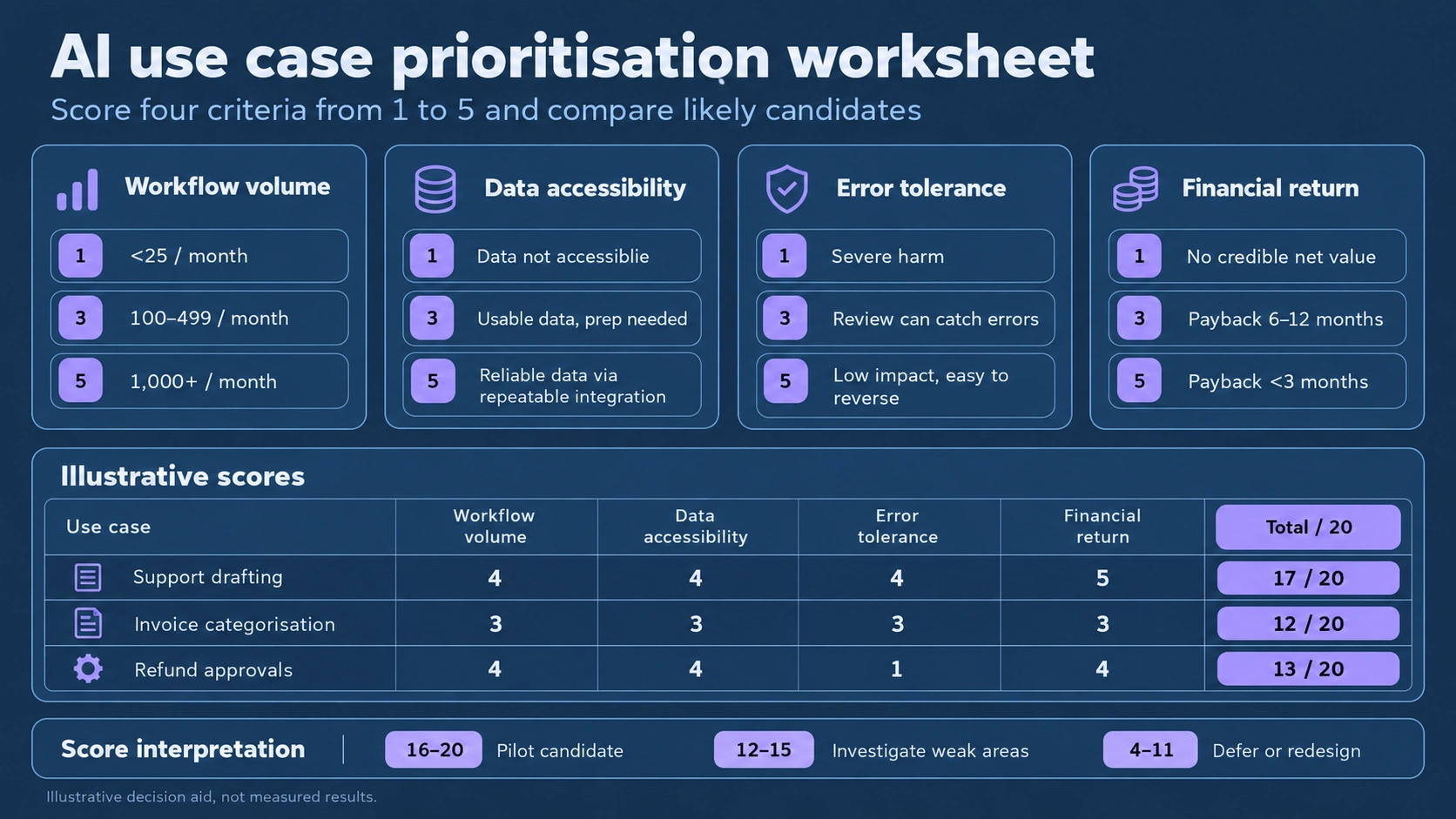
Using this worksheet, a provisional interpretation could be:
- 16–20: Consider a bounded pilot once required permissions, controls, and ownership are confirmed.
- 12–15: Investigate the weak dimensions before committing to implementation.
- 4–11: Defer or redesign the opportunity.
Important: The total score must never override a blocking risk. In this example, fully automated refund approval should not proceed as proposed because its error-tolerance score is 1. A redesigned workflow that drafts recommendations for human approval might be evaluated separately.
The customer support drafting opportunity ranks first because it has substantial recurring volume, accessible data, reversible outputs, and a plausible economic case. It is also sufficiently narrow to evaluate without granting the AI independent authority over customer communications.
Step 3: Estimate the financial case instead of assuming ROI
A high score should be supported by a transparent calculation. For the hypothetical support drafting project, consider these assumptions:
| Input | Illustrative value |
|---|---|
| Monthly support enquiries | 600 |
| Net handling time potentially saved per enquiry | 6 minutes |
| Value assigned to one productive staff hour | $25 |
| Monthly AI, maintenance, and additional quality-review costs | $350 |
| One-time implementation cost | $3,000 |
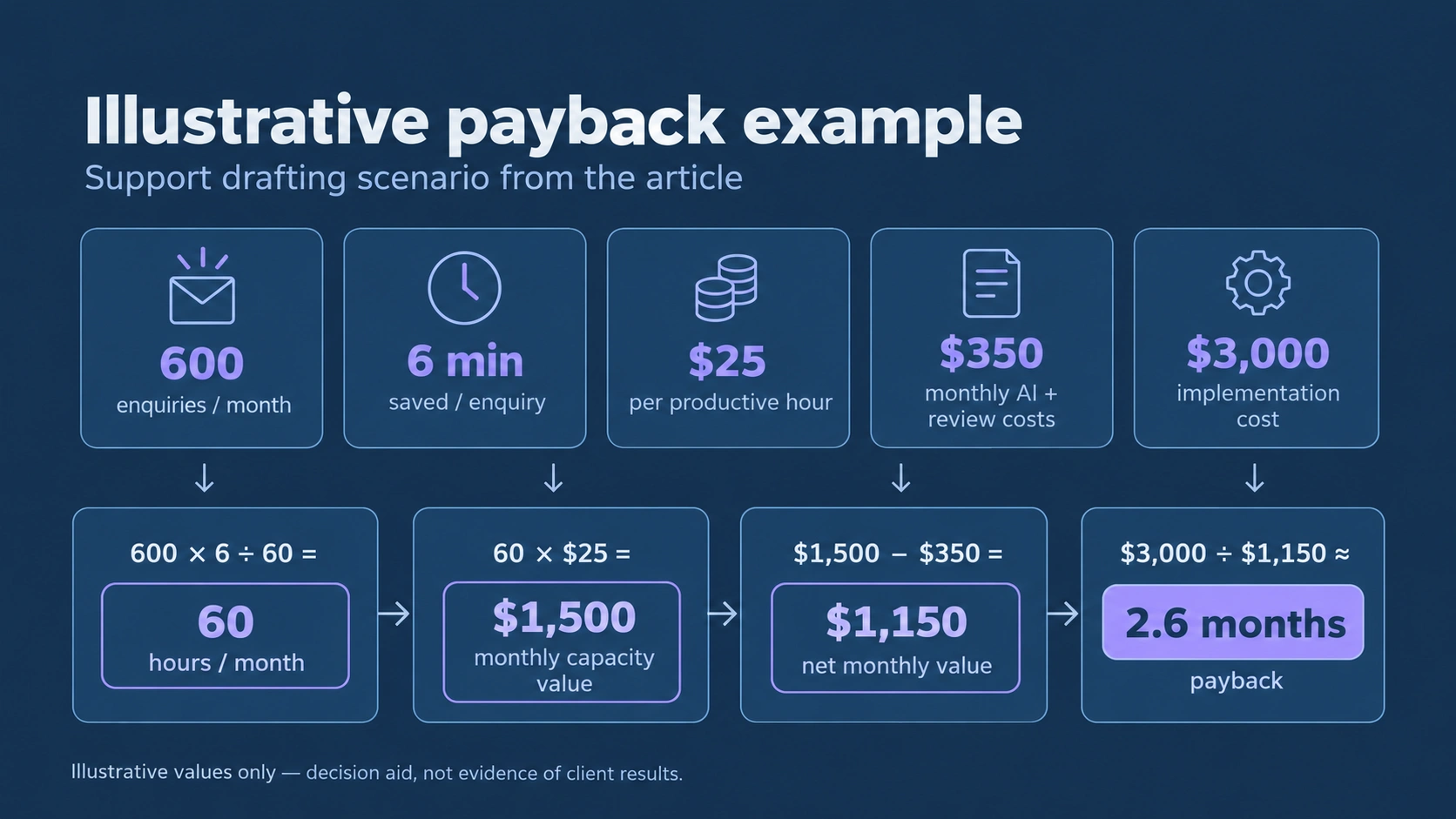
The estimated monthly capacity released would be:
600 enquiries × 6 minutes ÷ 60 = 60 hours per month.
At the assumed value of $25 per hour, that represents $1,500 in monthly capacity value.
After subtracting $350 in ongoing costs, the estimated net monthly value is:
$1,500 − $350 = $1,150.
Dividing the $3,000 implementation cost by $1,150 gives an indicative simple payback period of approximately 2.6 months.
That would justify a financial-return score of 5 under the worksheet’s assumptions, but it would not establish actual savings.
There are two important limitations. First, the six-minute improvement must be demonstrated in testing rather than assumed. Second, freeing 60 hours does not automatically reduce payroll spending. The financial benefit is realized only if the business can use that capacity productively, avoid additional expenditure, or otherwise demonstrate its value.
Implementation overruns, training, integration changes, and costs that continue after the pilot can also lengthen the payback period. Treat the calculation as a hypothesis to validate, not as a promised return on investment.
Test the strongest use case with a bounded AI pilot
Once a promising use case has been selected, the next step is not necessarily a full production deployment. A pilot should answer the remaining questions about technical feasibility, output quality, workflow fit, and financial value using a limited scope.
For the support drafting example, a practical pilot could use historical enquiries and approved knowledge-base articles to test whether an AI assistant can prepare accurate draft replies.
Define what the pilot will and will not do
The pilot’s scope might include retrieving documentation, suggesting response text, and presenting drafts to an employee. It would exclude automatic sending, unsupervised account changes, and independent refund decisions.
Each exclusion reduces ambiguity about responsibility and makes failures easier to detect.
Specify the required data
The team would need an appropriately permissioned collection of representative support enquiries, the documentation used to answer them, and reference answers or evaluations from knowledgeable staff.
Customer information should be minimized or de-identified where appropriate, and the organization must confirm that its chosen providers and systems are permitted to process the data.
When an AI application uses company documents to support answers, test both the information retrieved and the answer it produces. Microsoft’s documentation on RAG evaluators separates retrieval quality (whether useful supporting content is found), groundedness (whether the response is supported by that content), and response relevance (whether it addresses the question). These checks can also guide a simpler manual review process; using Microsoft’s evaluation tooling is not required.
Set measurable acceptance criteria before development
The following is an illustrative pilot specification, not an industry-standard performance threshold.
| Measure | Proposed pilot requirement | How to check it |
|---|---|---|
| Draft accuracy | At least 95% of drafts pass the agreed factual and policy review | Support leads review a representative set of 100 test enquiries using a written rubric |
| Handling time | Demonstrate an average net saving of at least 6 minutes per enquiry | Compare equivalent tasks with and without assistance, including correction time |
| Human control | Every outgoing response requires employee approval | Verify the application cannot send messages without approval |
| Unsupported claims | No known unsupported factual claim may be approved for sending | Review flagged errors, their severity, and whether the approval process catches them |
| Operating cost | Measured net monthly value remains positive under conservative assumptions | Record actual processing, review, maintenance, and support costs |
The thresholds are starting points for discussion. A business handling sensitive or consequential information may need stricter acceptance rules, additional controls, and specialist review. A sample of 100 enquiries can reveal common failure patterns, but it cannot establish that rare failures will never occur.
Compare against the existing workflow
The pilot needs a fair baseline. If employees normally spend 12 minutes on an enquiry, measure the entire assisted process rather than the time the AI takes to generate its draft.
That means including reading the draft, checking cited material, fixing errors, navigating systems, and sending the final response. A fast model that creates unreliable text can increase total workload.
Review difficult cases separately: ambiguous requests, outdated documentation, missing customer details, and situations requiring escalation. These often reveal whether the application can operate outside a controlled demonstration.
How to ship an AI use case into production
Passing a pilot is not the same as shipping an AI application. A production release needs a clear build-or-buy decision, integration into the tools employees already use, access controls, named operational owners, and a way to detect and correct failures. The AI implementation consulting steps provide a related framework for organizing assessment, integration, validation, and rollout. Introduce the system gradually rather than treating a successful demonstration as proof that it is ready for unrestricted use.
Decide whether to build, buy, or use conventional automation
Before writing custom AI software, compare the simplest options capable of meeting the acceptance criteria:
- Use standard automation: Choose rules, an API integration, or workflow software when inputs and decisions are predictable.
- Buy an existing AI product: Consider a configurable tool if it meets the workflow, data access, privacy, and support requirements without substantial custom work.
- Build an AI-assisted application: Consider custom development when your process, approved knowledge, integrations, or review controls cannot be handled adequately by existing tools.
Custom development does not necessarily mean training a model from scratch. It may mean combining an existing model with business rules, retrieval, human approvals, and software integrations. Consider custom software development for business workflows when those integrations and controls are the main requirements, rather than assuming a new AI model is necessary.
Put AI inside the existing workflow
For support drafting, the intended flow might be:
- A customer enquiry arrives in the existing support platform.
- The application retrieves permitted customer context and relevant approved documentation.
- The AI prepares a proposed reply, with supporting information where available.
- An employee checks, edits, approves, or rejects the draft.
- The approved response is sent through the support platform.
- The team records time spent, corrections, exceptions, and quality outcomes.
This may require an API connection, authentication, permission controls, and an interface integrated with the current support application. If the relevant software has no usable integration method, that limitation belongs in the business case before the pilot is funded.
Operational ownership must also be clear. Someone needs responsibility for updating reference documents, responding to failures, controlling access, and deciding when the AI-assisted step should be disabled.
Use an explicit go/no-go decision before launch
Ship only when the pilot meets the agreed quality, operating-cost, security, and human-oversight requirements on representative work. A useful release checklist is:
- Approve the measured outcome: Compare end-to-end handling time and output quality with the original baseline, including corrections and exceptions.
- Confirm permissions and safeguards: Test access controls, appropriate data handling, human approvals, and the escalation path for uncertain or consequential results.
- Assign owners: Name who maintains source information, reviews failures, pays operating costs, and makes go/no-go decisions.
- Roll out in a controlled way: Start with an approved group or limited set of cases, watch for new failure patterns, and retain a manual fallback.
- Monitor after release: Track costs, errors, adoption, workflow performance, and the ability to pause or disable the AI-assisted step.
If the pilot misses a critical acceptance criterion, improve the design and retest it or stop the project. A useful consulting engagement should make that decision easier, not assume every prototype deserves a launch.
How to measure whether AI consulting delivered business value
The correct success measure depends on the original problem. For a document-processing workflow, it might be cost per correctly completed document. For customer support, it could combine resolution time with answer quality and customer outcomes.
Four categories are worth tracking:
- Operational outcomes: Handling time, throughput, backlog, and completion rates.
- Output quality: Error rates, corrections, unsupported claims, and cases requiring escalation.
- Financial outcomes: Realized savings or productive capacity, implementation costs, ongoing expenditure, and net value.
- Reliability and risk: System failures, access problems, privacy incidents, inappropriate outputs, and employee ability to override results.
Measurement should continue after the initial demonstration. Changes in customer enquiries, documentation, or working practices can make an initially successful solution less useful over time.
The NIST AI Risk Management Framework is voluntary guidance intended to help organizations incorporate trustworthiness considerations into AI design, development, use, and evaluation. NIST’s companion playbook offers suggested actions under four functions: Govern, Map, Measure, and Manage. For a business project, these functions provide a useful way to assign responsibility, identify risks, evaluate performance, and respond when conditions change; the framework does not guarantee that a particular system is safe.
What should a business receive from an AI consulting engagement?
A consulting engagement should leave the company with usable decisions and evidence, rather than only a list of recommended technologies.
For a focused opportunity assessment and pilot, useful deliverables include:
- A documented opportunity assessment: The workflow, baseline, expected benefit, alternatives, dependencies, and reasons for proceeding or stopping.
- A prioritization worksheet: Comparable scores and recorded assumptions for the shortlisted use cases.
- A defined pilot specification: Scope, permitted data, success measures, acceptance conditions, owners, and budget boundaries.
- A working prototype or controlled pilot: Evidence of how the proposed system performs on representative business tasks.
- An implementation recommendation: Whether to proceed, which integrations and controls are required, and what ongoing ownership will cost.
The engagement does not have to produce a permanent AI application. Sometimes the most valuable finding is that an inexpensive process improvement will solve the problem, or that the available data cannot support the proposed system.
That is a legitimate consulting outcome when it prevents unnecessary development expenditure.
How to decide whether an AI consultant is worth hiring
External expertise is most useful when a company has a concrete operational problem but lacks the time or specialist knowledge to evaluate technical approaches, data readiness, integration requirements, or implementation risks.
Before committing, ask prospective consultants to explain how they would:
- Identify and reject low-value opportunities rather than recommending AI by default.
- Establish a baseline and estimate total implementation and operating costs.
- Compare an AI solution against conventional automation or existing software.
- Test the application on representative cases, including failures and exceptions.
- Define ownership, data permissions, acceptance criteria, and an exit plan.
- Transfer enough knowledge for the business to operate and assess the solution after handover.
A credible consultant should be comfortable discussing circumstances in which the project is not worth pursuing. Be cautious about promises of guaranteed ROI, universal automation, or predetermined delivery outcomes before the workflow and its dependencies have been assessed.
Next step: shortlist, test, and ship one useful AI use case
Start by listing three recurring business workflows that consume meaningful time or cause preventable errors. Record their monthly volume, required data, potential consequences of mistakes, and estimated economic value. Use the scoring worksheet above to identify the strongest candidate, then examine whether simpler software or process changes would solve the same problem.
For the leading opportunity, define a limited pilot, an internal owner, the data required, and the results that would justify further investment. If the business case remains uncertain, investigate the missing evidence rather than beginning a large implementation.
If your team wants help assessing a real workflow, discuss your project with DataColab. Bring the task, approximate monthly volume, current bottleneck, and available data. The first decision is whether AI is justified; the second is how to test and ship the smallest useful solution.
Pingback:Custom AI vs Off-the-Shelf Tools: A Build-or-Buy ROI Worksheet