
How to Build a Production-Ready Conversational AI Application
A conversational AI demo can look convincing after a handful of successful exchanges. A production application has to do much more: preserve the right context, protect user data, handle ambiguous requests, manage model capacity, recover from dependency failures and remain observable when something goes wrong.
That difference changes the engineering problem. The language model is only one part of the application. The surrounding software must manage identity, conversation state, orchestration, policy enforcement, integrations and operations. If those responsibilities are left inside one growing prompt or one tightly coupled service, every new capability can make the system harder to test and maintain.
This guide explains the architectural decisions that help take conversational AI application development beyond a prototype. It is intended for founders, product leaders and engineering teams deciding what to build, what to separate and what to validate before real users depend on the system.
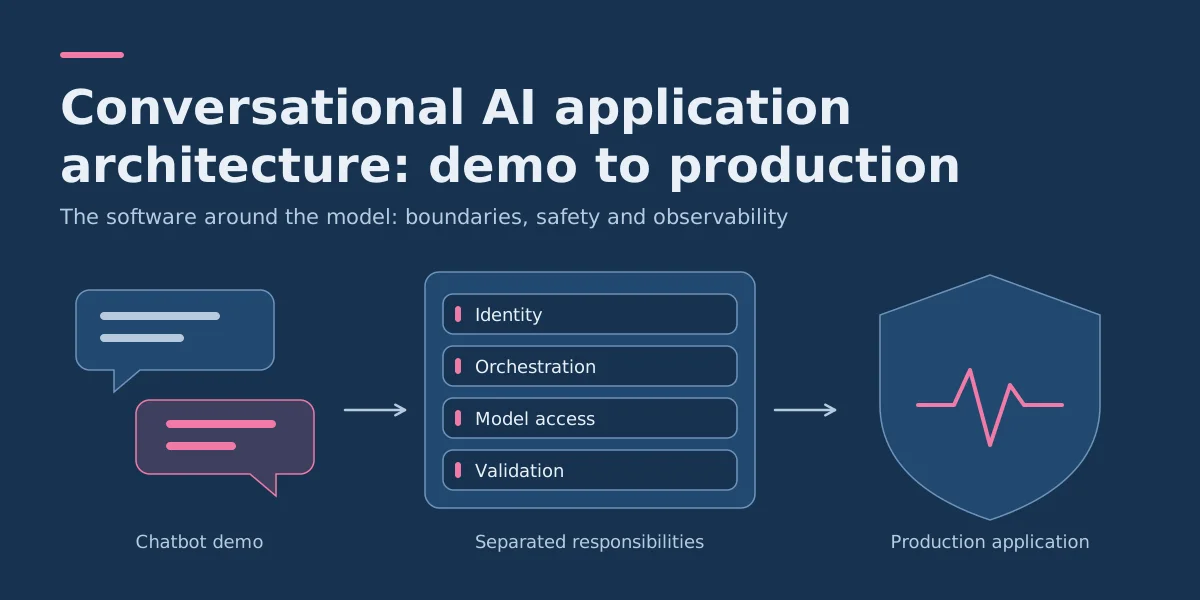
Why a working chatbot demo is not a production application
A demo usually tests a narrow path: a user sends a message, a model generates a plausible answer and the interface displays it. Production introduces conditions that are less predictable:
- Users return to conversations after a delay, refer to earlier messages or expect selected information to persist.
- Requests arrive concurrently, including unusually long or expensive inputs.
- Model providers, internal services and network connections can become slow or unavailable.
- Users may ask for something outside the assistant’s role or provide content that conflicts with its instructions.
- Prompts, models, source data and product requirements change over time.
- Support teams need to understand whether a failure came from the model, application logic, a dependency or a policy check.
These are application-engineering concerns, not problems that can be solved simply by selecting a more capable model. A useful production plan defines the system’s responsibilities and failure behaviour before adding more features.
Separate the responsibilities around the model
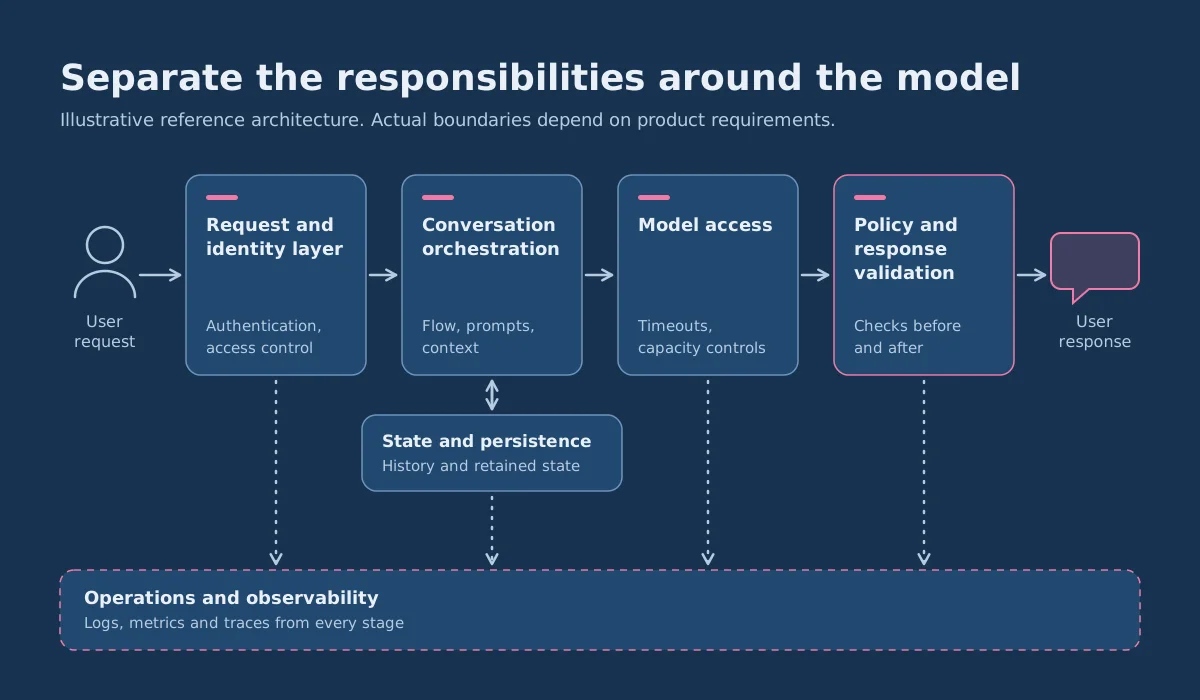
A maintainable conversational application has clear boundaries between the public request path and the logic that decides how a conversation should proceed. The exact number of components depends on the product; the important point is that responsibilities can evolve without forcing unrelated parts of the system to change together.
Can the system establish who is making the request and what they are allowed to access?Conversation orchestrationConversation flow, prompt assembly, context selection and coordination of specialist capabilities.
| Responsibility | What it should own | Design question |
|---|---|---|
| Request and identity layer | Authentication, request validation, session entry and controlled access to application functions. | |
| Can conversation logic change without rewriting the public API? | ||
| State and persistence | Conversation history and explicitly retained application state. | What must persist, for how long and under whose control? |
| Model access | Model requests, timeouts, capacity controls and any provider-specific adaptation. | Can the application handle a slow or unavailable model dependency? |
| Policy and response validation | Checks before and after generation, including whether a response is appropriate to return. | What happens when a response fails a check or the system is uncertain? |
| Operations and observability | Logs, metrics, traces, deployment diagnostics and operational alerts. | Can the team identify where a failed or slow interaction broke down? |
This separation is not a requirement to create a large microservices estate. A small product may implement several responsibilities in one deployable application at first. The goal is to establish clean interfaces and ownership so that components can be separated when independent scaling, release cycles or failure isolation justify the added operational cost.
For teams evaluating a tailored assistant, the distinction matters because a useful chatbot is an application built around information, boundaries and workflows—not just a chat interface. DataColab’s AI chatbot development approach starts with the use case and considers whether a platform, configuration or custom build is the sensible route.
Keep conversation orchestration from becoming one large prompt
Early prototypes often place most behaviour in a single system prompt and a small amount of request-handling code. That can be a reasonable way to test an idea. As requirements grow, however, one prompt can become responsible for too many things: tone, memory, policy, task selection, formatting and specialist behaviour.
The result is difficult to reason about. A change intended to improve one behaviour may affect another. It can also become harder to determine which part of the system should own a defect.
A more sustainable approach is to keep the conversation orchestrator responsible for coordinating the interaction while moving distinct capabilities behind clear interfaces. Each capability can then have its own inputs, outputs, tests and release process where the complexity warrants it.
Before extracting a new service, ask whether it needs to scale independently, has a distinct operational lifecycle, requires a different dependency set or needs stronger failure isolation. If not, a well-defined module inside the existing application may be simpler. Distributed services introduce network failures, deployment overhead and additional observability requirements; modularity should solve a real problem rather than become an architectural goal by itself.
Treat prompts and validators as production code
Prompts influence application behaviour, so they should be managed with the same discipline as other important software artefacts. Keep versions, review changes, record which version is active and test meaningful changes against a repeatable set of conversations.
A useful regression set should include more than ideal examples. It should cover:
- Common requests and expected conversation paths.
- Ambiguous questions, missing information and contradictory context.
- Long conversations and references to earlier turns.
- Requests that fall outside the assistant’s intended role.
- Unexpected model output formats and incomplete responses.
- Cases where the assistant should decline, ask a clarifying question or hand control to a person.
Output validation deserves the same attention. A generated response may be fluent but still be unsuitable for the application. Validation can check structure, permitted content and whether the response meets the application’s requirements before it reaches the user or another system.
Checks also need careful tuning. A validator that rejects too little may allow unsafe or unusable output; one that rejects too much can block ordinary, acceptable conversations. Record validation outcomes in a way that helps engineers diagnose false positives and regressions, while applying appropriate access controls, retention limits and redaction to sensitive information.
Build safety as a layered control system
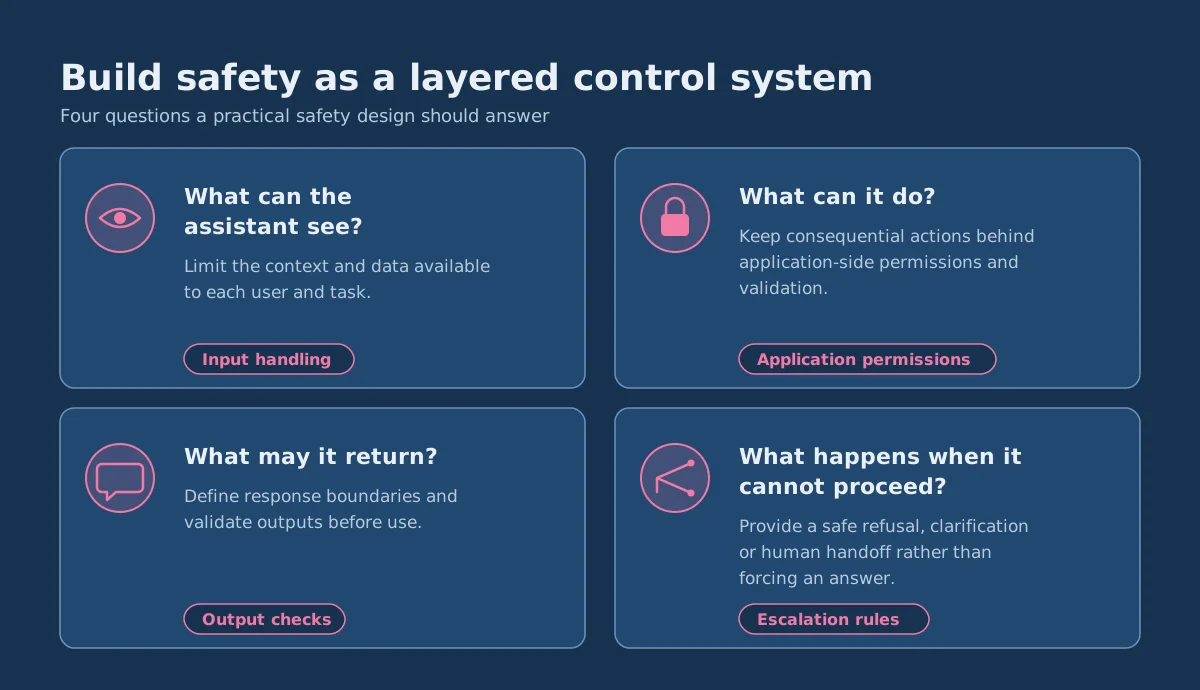
Safety should not depend on a single instruction in a prompt. A production design combines application permissions, input handling, constrained model behaviour, output checks and clear rules for escalation. The controls should be proportionate to what the assistant can access and do.
For example, an assistant that only generates general text has a different risk profile from one that can retrieve private records or trigger actions in another application. In the latter case, the application—not the model’s willingness to comply—must enforce identity, authorisation and action limits.
The OWASP GenAI LLM Top 10 (2026) is a useful threat-modeling reference. It covers risks including prompt injection, sensitive information disclosure, excessive agency, unbounded consumption and improper output handling. Use such guidance to identify relevant threats, then translate those threats into controls and tests for the actual product.
A practical safety design should answer four questions:
- What can the assistant see? Limit the context and data available to each user and task.
- What can it do? Keep consequential actions behind application-side permissions and validation.
- What may it return? Define response boundaries and validate outputs before use.
- What happens when it cannot proceed? Provide a safe refusal, clarification or human handoff rather than forcing an answer.
These controls reduce risk, but they do not establish that a system is secure or compliant by themselves. Security review, privacy assessment and operational testing must reflect the product’s real data, users and deployment context.
Plan for failure and finite model capacity
Model inference is a dependency with real capacity limits. A system can become slow or unstable when too many requests compete for limited compute, when a provider is degraded or when a downstream service stops responding. Retrying every failed request immediately can make the problem worse by increasing pressure on an already unhealthy dependency.
Several familiar distributed-systems techniques help:
- Rate limits: place predictable limits on request volume and expensive operations.
- Backpressure: control how much work enters a constrained part of the system instead of allowing an unbounded queue to build.
- Timeouts: prevent a request from waiting indefinitely for a dependency.
- Bounded retries: retry only failures that may be transient, with limits and suitable delay.
- Circuit breakers: stop repeatedly calling a dependency that is likely to remain unavailable, then test recovery in a controlled way.
- Fallback behaviour: return a safe reduced response, defer work or explain that the capability is temporarily unavailable.
The Circuit Breaker pattern documented by Microsoft explains how closed, open and half-open states can prevent repeated calls to a failing dependency and allow recovery without immediately flooding it with requests.
For conversational products, degradation should be designed around the user journey. If an optional capability is unavailable, can the core conversation continue? If the model cannot respond, should the application preserve the user’s message and offer a retry? If a media operation is expensive, should it use a separate capacity policy? These decisions should be explicit and tested.
Where an assistant also connects to business systems, integration boundaries matter just as much as model capacity. A custom integration should validate data and handle exceptions in the surrounding application rather than trusting generated text to complete a workflow. This is one reason to assess custom software and integration requirements as part of the overall product design.
Observe the conversation, not just the model call
A successful HTTP response does not necessarily mean a successful interaction. The model may return an irrelevant answer, a validator may reject a useful response or a downstream action may fail after generation. Monitoring only server availability can miss these product-level failures.
Start with the basic service signals: latency, traffic, errors and saturation. Google’s guidance on monitoring distributed systems explains why these signals help teams understand both user-visible symptoms and the resource constraints behind them.
For a multi-component application, combine logs, metrics and traces. OpenTelemetry’s documentation on telemetry signals describes how these signals provide complementary views of application behaviour and request paths.
Useful measures for a conversational application may include:
- End-to-end response time, including slow-percentile latency rather than only averages.
- Request volume, concurrency, queue depth and resource saturation.
- Model timeouts, dependency errors, retries and fallback frequency.
- Validation rejection rates and the categories of failures being observed.
- Conversation completion, escalation and user-correction patterns where these can be measured responsibly.
- Operational cost by feature or workload, without collecting more personal conversation content than necessary.
Use correlation identifiers to follow an interaction across components, but avoid turning observability into indiscriminate collection of private messages. Define what may be logged, who can access it, how long it is retained and when content should be redacted. Dashboards should help answer both “what is broken?” and “where should the team investigate next?”
What a real engineering engagement can teach
An anonymised conversational AI engineering engagement illustrates how these concerns tend to emerge over time. The initial work established a separation between the public request layer and the service responsible for conversation logic. As the product’s responsibilities expanded, distinct capabilities were organised behind clearer interfaces rather than allowing every new behaviour to accumulate in one prompt.
The engineering work also treated prompts and response validation as changeable parts of the software, supported by iteration and diagnostics. Centralised operational visibility and controls around model capacity became important as the application grew beyond its first conversation loop. The transferable lesson is not to copy a particular service layout; it is to make boundaries, validation and operations deliberate parts of the product from the beginning.
A practical checklist before production
Use this checklist when reviewing a new conversational AI application or deciding whether an existing prototype is ready for a wider release.
- Scope: Are the assistant’s users, purpose, permitted topics and prohibited actions documented?
- Identity: Does the application enforce authentication and authorisation outside the model?
- State: Is it clear what conversation information is retained, updated and deleted?
- Architecture: Are request handling, orchestration, model access and validation separated by understandable interfaces?
- Prompts: Are prompt changes versioned and tested against representative conversations?
- Safety: Are input and output risks assessed, and are refusal and escalation paths tested?
- Reliability: Are timeouts, rate limits, bounded retries, fallback behaviour and dependency failures covered?
- Observability: Can the team trace a failed interaction without exposing unnecessary personal data?
- Operations: Are deployment, rollback, ownership and post-launch maintenance responsibilities clear?
- Evaluation: Is there a repeatable way to assess answer quality, safety, latency and cost after changes?
Choose the simplest architecture that meets the real requirements
Not every conversational product needs a large distributed architecture, a self-managed model or a custom-built orchestration framework. A managed chatbot platform may be the right choice for a narrow support use case. A custom application becomes more relevant when the product needs specialised conversation behaviour, control over state and permissions, distinct processing paths or integration with existing software.
The right decision depends on the product’s users, data, actions, expected traffic and operational responsibilities. Start with the smallest useful system, define its boundaries and test it against realistic conversations. Add components when there is a clear reason to separate responsibilities—not simply because a particular architecture is fashionable.
If you are planning a conversational AI product or need to move an existing prototype toward a reliable application, contact DataColab. The starting point should be what the product needs to do, what it must protect and how the team will know it is working.