
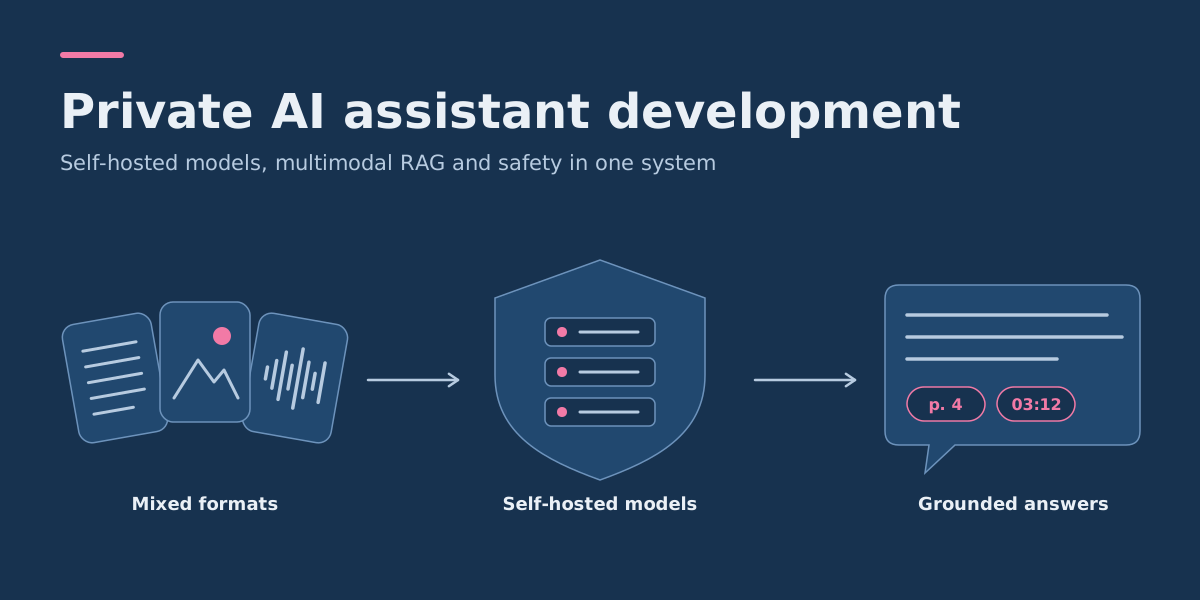
Building a Private Multimodal AI Assistant: Architecture, RAG and Safety
Building a private AI assistant is not simply a matter of choosing a language model and connecting it to a chat interface. The system needs to understand the information it receives, retrieve relevant material, generate useful responses and operate within the organisation’s infrastructure and security requirements.
These challenges become more demanding when an assistant needs to process different content formats, support multiple interaction methods and work with information that should remain under the organisation’s control. Model serving, data processing, retrieval, application orchestration and safety all become part of the engineering problem.
This article explores the technical considerations behind private AI assistant development, from self-hosted model infrastructure and multimodal knowledge processing to retrieval-augmented generation (RAG), source-grounded responses and AI safety. It also examines how these components can work together as part of a larger software system.
Why private AI assistant development is an engineering challenge
Organisations considering an AI assistant often begin with a specific requirement: make internal information easier to access, automate a repetitive interaction or introduce AI capabilities into an existing product.
However, the requirements extend beyond the model itself. Several considerations influence the architecture from the beginning:
- Data control: Some organisations need to run AI models within infrastructure they control rather than depending entirely on external inference services.
- Different information formats: Internal knowledge may exist in PDFs, scanned documents, images, diagrams, audio recordings and structured data.
- Reliable responses: The assistant should retrieve relevant information rather than relying entirely on a language model’s general knowledge.
- Traceability: Users should have a way to identify the source of information used in an answer.
- Safety: The application needs appropriate safeguards against manipulation, inappropriate requests and unauthorised access.
- Integration: The assistant may need to interact with existing applications, databases and business processes.
These requirements are interconnected. For example, introducing a document retrieval system without considering access permissions can expose information to users who should not be able to see it. Similarly, deploying a model locally does not automatically guarantee data privacy or security. Those outcomes depend on the surrounding infrastructure, access controls and operational practices.
Designing a self-hosted model-serving architecture
Self-hosted AI provides an alternative to relying exclusively on third-party inference APIs. It can give organisations greater control over where inference takes place, how models are deployed and how their infrastructure is managed.
However, running models independently introduces additional responsibilities. Different models have different computational requirements, software dependencies and workloads. Language generation, speech processing and image understanding cannot always be treated as interchangeable services.
Separating model-serving responsibilities
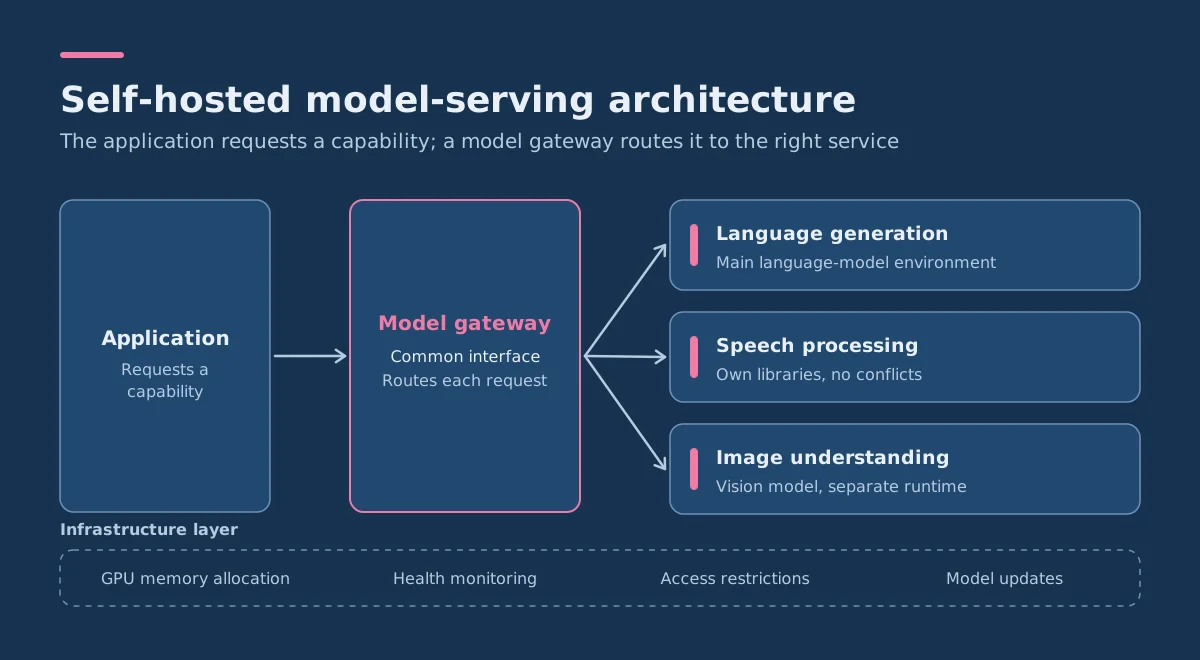
A practical architecture separates different model capabilities into independently managed services. This makes it easier to maintain dependencies, allocate resources and update individual components without affecting the entire application.
For example, speech-processing models may require software libraries that conflict with the main language-model environment. Separating these workloads into independent services avoids forcing incompatible dependencies into a single runtime.
A model gateway can then provide a common interface between the application and the underlying services. Instead of communicating directly with every model endpoint, the application requests a capability and the gateway routes the request to the appropriate service.
This separation also makes future changes easier. Individual models can be replaced or extended without requiring the application to be redesigned around each model provider’s interface.
Infrastructure considerations
Self-hosted AI requires careful attention to several operational factors:
- GPU availability and memory allocation.
- Model loading and inference workloads.
- Service isolation and dependency management.
- Communication between different services.
- Health monitoring and failure recovery.
- Model updates and deployment management.
- Authentication, network security and access restrictions.
The objective is not simply to run a model locally. It is to establish an infrastructure layer that the application can depend on and that the organisation can maintain.
When an AI assistant also needs to interact with existing applications and workflows, the surrounding software architecture becomes equally important. This is one reason to consider how custom software and system integrations fit into the wider implementation.
Turning different content formats into a searchable knowledge base
Retrieval-augmented generation allows an AI assistant to retrieve information from an external knowledge base before generating a response. This makes it possible to work with organisation-specific information that may not be part of a language model’s original training data.
The general process involves three stages:
- Retrieve: Search the knowledge base for information relevant to the user’s question.
- Augment: Provide the retrieved information as context to the language model.
- Generate: Produce a response using the question and supporting information.
This approach is commonly known as RAG. Microsoft’s technical overview of retrieval-augmented generation explains how retrieved content can be used to ground responses and provide references to source material.
However, the quality of a RAG system depends heavily on the information entering the knowledge base. Treating every file as an ordinary text document can discard important information or make relevant content difficult to retrieve.
Processing different content types
A multimodal ingestion pipeline needs appropriate extraction methods for different formats:
- PDF documents: Extracting information while preserving document structure and relevant source information.
- Scanned documents: Applying optical character recognition (OCR) to make image-based text searchable.
- Images and diagrams: Using vision-language models to generate textual descriptions of visual information.
- Audio: Transcribing spoken information into searchable text.
- Text documents: Extracting and preparing existing textual content for indexing.
Although these processing methods produce different outputs, they ultimately contribute to the same searchable knowledge base.
Preserving source information
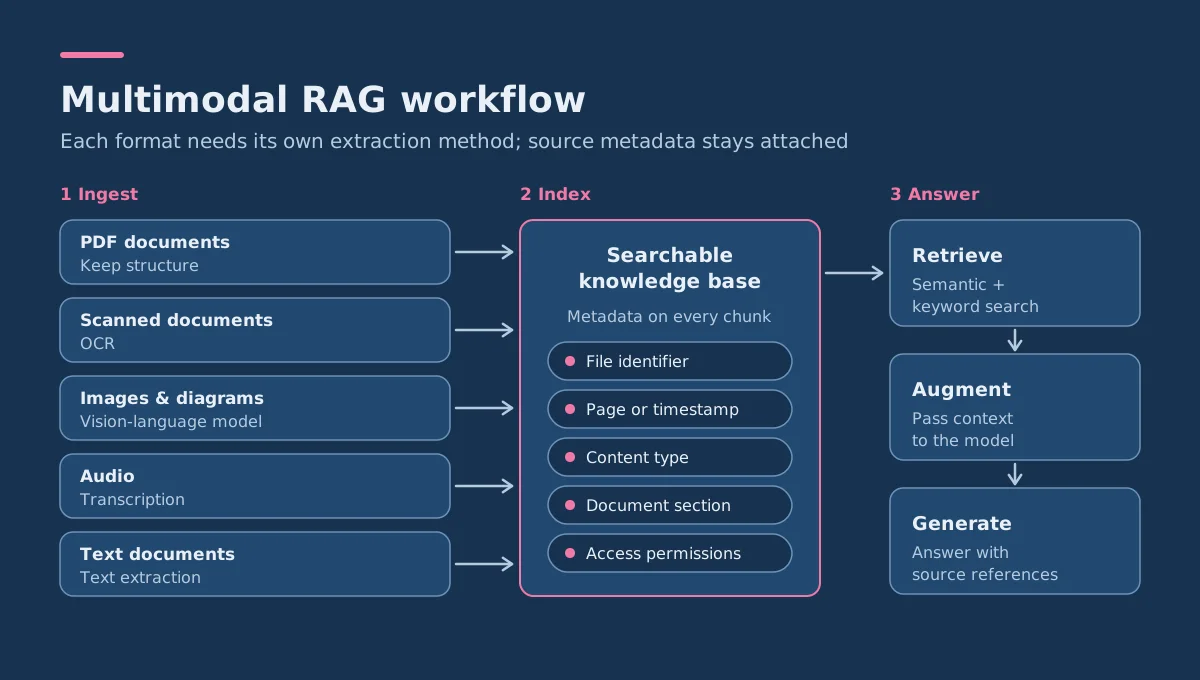
Extracting information is only part of the process. The relationship between the extracted content and its original source should also be preserved.
Useful metadata can include:
- Original document or file identifier.
- Page number or timestamp.
- Content type.
- Relevant document sections.
- Access permissions and other information needed to enforce retrieval boundaries.
This metadata becomes particularly important when the assistant needs to explain where an answer originated. Without it, the system may retrieve useful information but have no practical way to identify its original location.
Depending on the content and search requirements, the retrieval layer may combine semantic search with keyword-based retrieval. These methods can complement one another: semantic search helps identify conceptually related material, while keyword search can be useful when an exact term, identifier or phrase matters.
Grounding responses and evaluating RAG quality
Retrieving relevant information does not automatically guarantee a reliable answer. The assistant still needs to use the retrieved material appropriately, avoid unsupported conclusions and recognise when the available information is insufficient.
A useful RAG implementation should distinguish between three separate questions:
- Did the retrieval system find the right information?
- Did the language model use that information appropriately?
- Did the final answer actually address the user’s question?
These questions require different evaluation approaches. A retrieval system can return relevant documents while the generated response misinterprets them. Conversely, a language model may generate a convincing answer even when the retrieved material does not support it.
Evaluating retrieval and generated answers
A practical evaluation process should include representative questions, expected supporting documents and examples where the knowledge base does not contain enough information to answer.
Important evaluation dimensions include:
- Retrieval relevance: Whether the retrieved documents actually relate to the question.
- Groundedness: Whether the generated answer is supported by the retrieved context.
- Completeness: Whether the answer addresses the important parts of the question.
- Relevance: Whether the answer responds directly to what the user asked.
Microsoft’s RAG evaluation guidance distinguishes retrieval quality from the evaluation of generated responses, including groundedness, relevance and completeness.
It is also important to test questions that cannot be answered using the available material. A useful assistant should be able to recognise insufficient information rather than inventing an answer simply because a response is expected.
Designing safety into the AI workflow
AI safety should not depend entirely on a system prompt instructing the language model to behave appropriately.
Users may submit inappropriate requests, attempt to manipulate instructions or introduce content that causes the assistant to behave outside its intended scope.
Prompt injection is a particularly important consideration. It occurs when malicious instructions influence a model’s behaviour through user input or external content, such as documents and retrieved information.
The OWASP GenAI Security Project’s prompt-injection guidance explains why these attacks require attention beyond ordinary input filtering. RAG does not automatically eliminate the risk because retrieved documents can themselves contain untrusted instructions.
Different safeguards for different risks
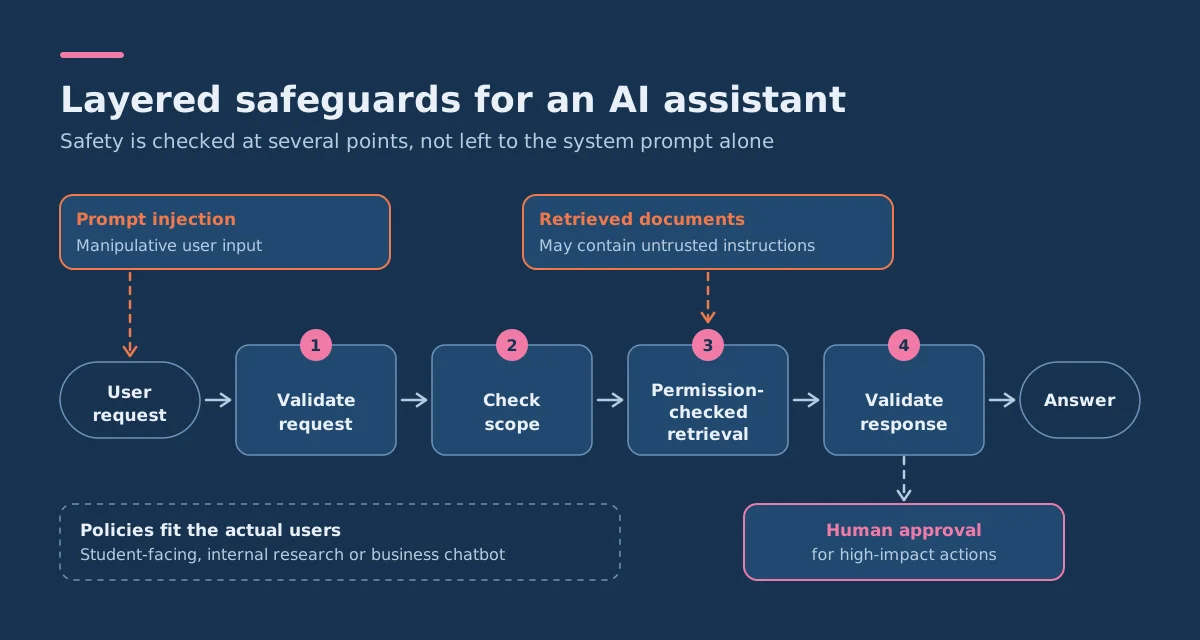
A more robust architecture considers safety at multiple points in the application:
- Validate incoming requests and handle obviously disallowed content.
- Check whether the requested operation falls within the assistant’s intended responsibilities.
- Apply appropriate content and response validation.
- Enforce user permissions before retrieving confidential information.
- Consider conversation context when evaluating potentially manipulative interactions.
- Require human approval for sensitive or high-impact actions where appropriate.
Different applications also require different safety policies. A student-facing assistant, an internal research assistant and a general business chatbot may have different users, responsibilities and acceptable use cases.
The NIST AI Risk Management Framework provides a broader reference for identifying, assessing and managing risks associated with AI systems.
The important engineering principle is to design safeguards around the application’s actual users and responsibilities rather than relying on a single universal moderation rule.
Separating assistant responsibilities
As an AI application grows, one general-purpose assistant may become responsible for too many unrelated tasks.
A more structured approach is to separate responsibilities and route requests to the appropriate capabilities.
For example, an assistant may need to distinguish between questions that require access to an approved knowledge base and general questions about using an application.
These responsibilities can be handled by specialised components with clearly defined roles, data access and boundaries. One component can handle knowledge retrieval while another manages general interactions or coordinates application workflows.
However, multiple agents are not automatically better than a single assistant. Each additional component introduces coordination, testing and maintenance requirements. The architecture should reflect actual workflow needs rather than introducing complexity for its own sake.
A practical example from an education-focused AI project
These engineering considerations came together in an education-sector engagement listed in DataColab’s customer portfolio as Anitech.
The work brought together a private multimodal AI assistant, processing of different educational content formats, knowledge retrieval, source-grounded responses and safety controls. A separate predictive analytics workstream also formed part of the broader engagement.
The important engineering challenge was bringing different AI capabilities together into a coherent application rather than treating the language model, knowledge base and supporting services as independent experiments.
This example illustrates how private AI infrastructure, multimodal knowledge processing and application orchestration can work together to address a specific product requirement.
What to define before starting a private AI project
Before selecting models or frameworks, organisations should establish the requirements that will determine the architecture.
- Use case: What should the assistant help users accomplish?
- Data sources: Which documents, databases and applications should it access?
- Data permissions: Who is authorised to access each information source?
- Infrastructure: Is self-hosting necessary, or would an external inference service be acceptable?
- Interaction methods: Does the application need text, audio, image understanding or a combination?
- Retrieval requirements: Should answers include source references and document locations?
- Evaluation: How will accuracy, groundedness, relevance and failure cases be tested?
- Operations: Who will maintain the system, monitor failures and manage future updates?
These questions help prevent a common mistake: choosing a technology stack before understanding the actual problem.
For a broader assessment of project scope, data readiness, evaluation and delivery responsibilities, see our guide to evaluating custom AI and machine learning development projects.
When does custom AI assistant development make sense?
Not every organisation needs a custom-built AI assistant. An existing chatbot platform or configured product may be sufficient for straightforward FAQs and basic customer support.
Custom development becomes more relevant when the application needs to work with unusual data sources, enforce specific permissions, integrate with existing software or support workflows that standard platforms cannot handle adequately.
The decision should be based on the requirements rather than the complexity of the technology. A simpler solution is often preferable when it addresses the problem effectively.
For organisations considering a tailored solution, custom AI chatbot development can provide a starting point for exploring the right architecture and implementation scope.
Building AI systems around real requirements
Private AI assistants, multimodal knowledge systems and predictive machine learning applications require different technologies, but they share a common engineering challenge: connecting data, models and application workflows into a coherent system.
The right implementation depends on the organisation’s infrastructure, information sources, users and operational requirements. There is no single model or framework that is appropriate for every project.
A successful implementation begins by understanding the problem, establishing the data and infrastructure requirements, and evaluating the proposed solution against realistic use cases.
If you are exploring a private AI assistant, a RAG-based knowledge system or a more complex AI application, discuss your project with DataColab.