
Custom AI vs Off-the-Shelf Tools: A Build-or-Buy ROI Worksheet
Short answer: Buy off-the-shelf AI if it meets your workflow and control requirements without costly changes. Consider hybrid AI when you need custom integrations around existing models or products. Build a custom application when requirements are distinctive and the measurable benefits justify the extra engineering. The custom AI vs off-the-shelf ROI worksheet below compares all three options using the same three-year costs and business-value assumptions.
Key takeaways
- Off-the-shelf AI is often the better starting point when an existing product meets requirements without expensive customisation or integration.
- Custom AI becomes more attractive when the business needs specialised workflows, deeper integrations, greater application-level control, or economics that improve at scale.
- A hybrid approach—combining an existing AI platform or model with custom business software—can offer a useful balance between implementation effort and workflow fit.
- Compare options over at least three years, including implementation, subscriptions, usage, maintenance, oversight, and migration costs—not just initial development expense.
- ROI depends on benefits actually achieved. A lower-cost tool with poor adoption or output quality can produce less value than a more expensive alternative.
Choosing between custom AI and off-the-shelf tools is a financial and operational decision, not simply a technology preference. A ready-made product may be inexpensive to launch but require additional subscriptions, manual workarounds, and integration services. A custom application may cost considerably more upfront but fit the business process better and avoid some recurring limitations.
There is also a third option: build only the software that makes the workflow unique while using an existing AI model or platform for the underlying intelligence.
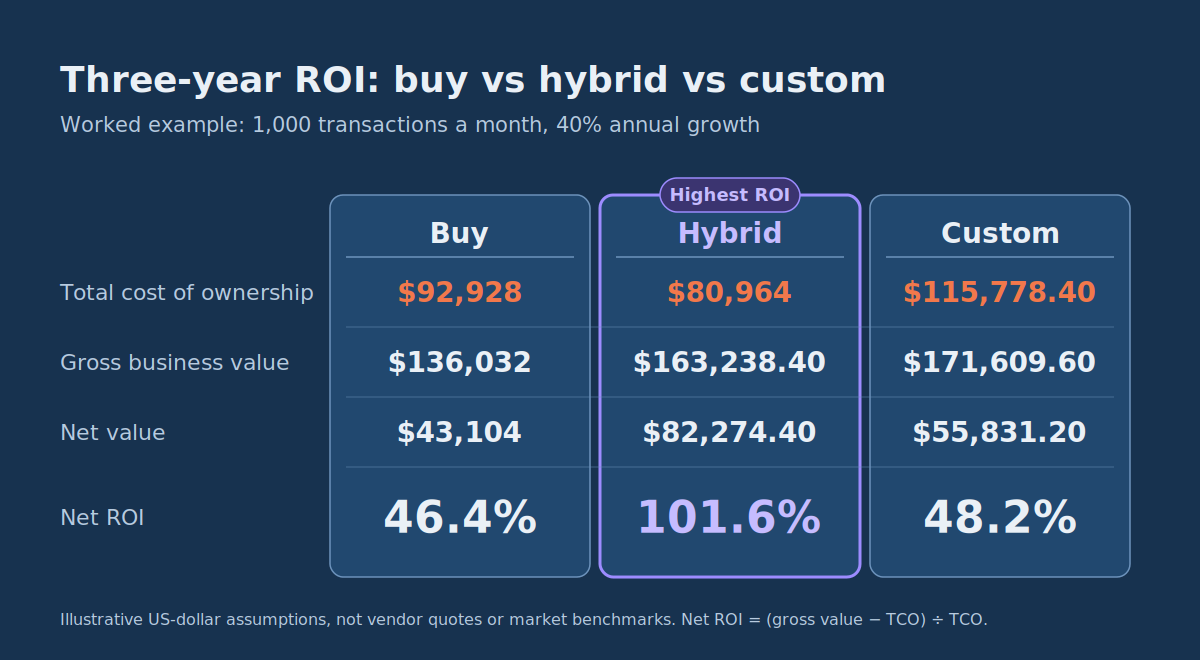
The best way to make an AI build-or-buy decision is to compare business fit, implementation risk, and three-year total cost of ownership (TCO) alongside measurable benefits. This worksheet uses identical workload assumptions and explicit costs for all three options, then calculates net value and return on investment (ROI). In the hypothetical base case, hybrid reaches 101.6% net ROI, compared with 46.4% for buying and 48.2% for custom development. These are illustrative calculations, not market benchmarks or vendor performance claims.
1. Understand the three approaches: buy, custom, and hybrid
Before calculating ROI, establish what each option actually includes. Otherwise, the comparison may incorrectly place a complete business application against an AI API that still requires substantial software development.
Option A: Buy an off-the-shelf AI tool
An off-the-shelf solution is an existing product designed to support a common business need. Examples include AI-enabled customer support applications, document processing products, sales assistants, and enterprise knowledge tools.
The provider typically maintains the main application and supplies its supported features, interfaces, and integration options.
Choose this approach when: The product meets the required workflow, permissions, reliability, and reporting needs with limited modification.
Its advantage is avoiding the cost and responsibility of building the core application. Its limitation is that the business must operate within the product’s available features, pricing structure, integration capabilities, and commercial terms.
Licensing can also become more expensive as the organisation adds users, processes more transactions, or requires additional features.
Option B: Develop a custom AI application
A custom solution is software designed for a particular organisation’s requirements. It can incorporate specialised interfaces, business rules, system integrations, data processing, and AI capabilities.
Custom does not necessarily mean training a proprietary machine learning model from scratch. A business may own its application logic and workflow while using commercially available foundation models through APIs.
Choose this approach when: Existing products cannot meet important requirements without unacceptable compromises, and the expected business value justifies development and long-term support.
The advantage is greater control over the application’s functionality and integration design. The trade-off is the cost of development, testing, maintenance, monitoring, and future changes.
Organisations considering this route can examine the typical requirements involved in custom AI software development services before estimating a project budget.
Option C: Build a hybrid AI solution
A hybrid approach uses existing AI models, platforms, or software capabilities alongside custom-developed components.
For example, a company might use a hosted language model to interpret customer enquiries while building its own application to retrieve approved company information, enforce business rules, and update a legacy CRM.
Alternatively, it might retain a commercial AI product and build a limited integration service around it.
Choose this approach when: Existing AI capabilities perform the core task adequately, but the business needs additional control over integrations, user experience, validation, or workflow execution.
Hybrid development avoids rebuilding capabilities that already exist. However, it still introduces responsibility for custom software and may create dependencies on external providers. When the main need is to connect systems and enforce company-specific processes, much of the work is custom software development for business workflows, rather than training a new AI model.
2. Compare business fit before comparing price
The least expensive solution is not automatically the most economical. It must first be capable of performing the intended task to an acceptable standard.
| Decision factor | Off-the-shelf | Hybrid | Custom |
|---|---|---|---|
| Workflow fit | Strong when requirements match supported product features | Useful when standard AI capabilities need custom workflow logic | Useful when important workflows require specialised software |
| Initial engineering effort | Usually lower for a compatible product | Depends on the integration and custom application scope | Usually higher because more components must be designed and delivered |
| Integration | Limited by supported connectors and APIs | Custom integrations alongside existing capabilities | Integration design can be tailored to the required systems |
| Application control | Depends on vendor features, settings, and contracts | Control over custom components but not all third-party services | Greater control over owned application components |
| Ongoing responsibility | Licensing, configuration, administration, and vendor management | Vendor management plus maintenance of custom components | Maintenance, updates, infrastructure, testing, and support |
| Provider dependency | Potential dependence on the product provider | Potential dependence on both external services and custom integration | Depends on hosting, models, infrastructure, and component choices |
These are typical architectural trade-offs, not guarantees. An off-the-shelf product with well-designed APIs may integrate more effectively than a poorly engineered custom application. Similarly, custom development does not automatically eliminate vendor lock-in.
Before proceeding to a financial comparison, ask whether each option satisfies the organisation’s non-negotiable requirements: data access, security, approval controls, output quality, and supported business actions.
An option that cannot satisfy a critical requirement should be excluded or redesigned, regardless of its projected ROI.
3. Calculate the full three-year cost of ownership
Total cost of ownership includes the expenditure needed to implement, operate, support, and eventually change or retire a solution.
For AI applications, relevant costs extend beyond licence fees or API charges.
Cost categories to include
| Cost category | What to include | Common omission |
|---|---|---|
| Initial implementation | Configuration, development, testing, migration, deployment, and initial training | Internal engineering and project-management time |
| Subscriptions and licences | Platform fees, user seats, purchased modules, and contracted service tiers | Additional licences needed for occasional users or administrators |
| Variable AI usage | Model requests, tokens, document processing, storage, and other usage-related charges | Retries, evaluation traffic, and changes in transaction volume |
| Integration and maintenance | Connectors, application support, security updates, testing, and compatibility changes | Work needed when source systems or provider APIs change |
| Human oversight | Review, correction, quality checks, exception handling, and operational support | Staff time spent checking AI-generated results |
| Migration and exit | Data export, application replacement, retraining, and transition effort | The cost of leaving a provider or retiring custom software |
Variable AI costs deserve particular attention because providers may charge by model, tokens, requests, documents processed, service tier, or other measures. Use the applicable vendor’s written quotation and contract to estimate each candidate solution’s actual charges.
Do not assume that a fixed subscription includes unlimited AI usage, or that a custom application using an API has negligible operating costs.
For a more complete procurement model, include any additional taxes, financing effects, data-migration expenses, contractual commitments, and exit costs that apply to your organisation. These should be explicit estimates rather than hidden assumptions.
Three-year TCO formula
For a simple nominal, undiscounted model:
Three-year TCO = initial implementation cost + Year 1 operating cost + Year 2 operating cost + Year 3 operating cost.
For each year:
Annual operating cost = subscriptions + variable usage + integration and maintenance + human oversight and support.
If workloads grow, variable usage should be calculated independently for each year. If contract prices increase, annual subscription assumptions should also change.
The basic calculation is straightforward; the challenge is gathering realistic inputs. Keep licence and model-usage charges separate, apply the same workload forecast to every option, and avoid counting the same employee review time both as a cost and as a deduction from the estimated benefit.
Blank AI build-or-buy ROI worksheet template
Copy this layout into a spreadsheet or replace its blank entries with your own numbers. Use the same starting monthly workload, annual workload growth, three-year time horizon, and value per successful transaction across all options. Only change those common assumptions when running an explicitly labelled scenario.
| Input or result | Buy | Hybrid | Custom |
|---|---|---|---|
| Initial implementation ($) | Enter | Enter | Enter |
| Annual licence or platform charges ($) | Enter | Enter | Enter |
| Variable cost per transaction ($) | Enter | Enter | Enter |
| Annual integration and maintenance ($) | Enter | Enter | Enter |
| Annual human review and support ($) | Enter | Enter | Enter |
| Share of transactions delivering value (%) | Enter | Enter | Enter |
| Three-year TCO ($) | Calculate | Calculate | Calculate |
| Three-year gross business value ($) | Calculate | Calculate | Calculate |
| Three-year net value ($) | Calculate | Calculate | Calculate |
| Three-year net ROI (%) | Calculate | Calculate | Calculate |
For each year, calculate transactions = previous year’s transactions × (1 + growth rate) (using 12 × starting monthly transactions in Year 1). Calculate annual operating cost = annual fixed charges + (annual transactions × variable cost per transaction). Sum all three annual operating costs and add implementation for TCO. Calculate gross business value from annual transactions × proportion delivering value × value per successful transaction, summed over three years. Then apply the net value and ROI formulas below. Adjust yearly fixed costs if your quotations do not remain flat.
4. Worked example: three-year custom AI vs off-the-shelf ROI worksheet
Consider a hypothetical business choosing how to automate a recurring document-and-request processing workflow.
The business wants to interpret incoming information, prepare structured outputs, and let employees review exceptions before the results enter an existing application.
Three implementation options have passed an initial feasibility screening:
- Buy: Adopt a commercial AI workflow product with available integration features.
- Hybrid: Use an existing AI platform and build a small application to handle company-specific integration and validation.
- Custom: Develop a dedicated application around the company’s workflow, using paid AI inference where appropriate.
All monetary amounts below are illustrative US-dollar assumptions. They are not current vendor quotations, observed customer costs, or guaranteed financial results. Replace the inputs with your own supplier quotations, tested effectiveness rates, and business-value estimates before choosing a solution.
Step 1: Enter the common business assumptions
| Assumption | Value | Meaning |
|---|---|---|
| Starting monthly workload | 1,000 transactions | Number of relevant tasks in the first year |
| Annual workload growth | 40% | Assumed transaction growth between years |
| Value per successfully assisted transaction | $4 | Estimated incremental business value before the separately modelled solution and oversight costs |
| Evaluation period | 3 years | Comparison horizon |
| Currency | USD | All costs and benefits use the same currency |
| Discounting | None | Illustrative nominal comparison rather than discounted cash-flow analysis |
The $4 benefit is an estimate of incremental productivity or other attributable business value, not gross revenue or automatic cash savings. Any employee review and operational costs counted separately must be excluded from this per-transaction benefit to avoid double-counting.
The annual transaction volumes become:
- Year 1: 12,000 transactions.
- Year 2: 16,800 transactions.
- Year 3: 23,520 transactions.
The business expects to process 52,320 transactions across the three-year horizon.
Step 2: Enter the costs and expected effectiveness of each option
Effectiveness in this example means the proportion of transactions that deliver the specified $4 incremental business benefit after using the proposed solution. It is not a generic model accuracy score.
| Input | Buy | Hybrid | Custom |
|---|---|---|---|
| One-time implementation | $3,000 | $18,000 | $60,000 |
| Annual software licence | $15,000 | $6,000 | $0 |
| Variable cost per transaction | $0.40 | $0.20 | $0.12 |
| Annual integration and maintenance | $3,000 | $5,500 | $8,000 |
| Annual review and support | $5,000 | $6,000 | $8,500 |
| Share of transactions delivering the defined benefit | 65% | 78% | 82% |
The higher assumed effectiveness of the hybrid and custom options represents a hypothesis about workflow fit. It must be validated with representative business tasks before being used for procurement approval.
The custom solution’s zero licence assumption refers to its own application licence. It does not mean free AI models or free infrastructure: the example includes variable inference charges and ongoing maintenance. The model also assumes fixed annual support costs across the three years; actual costs may increase as workloads grow.
Step 3: Calculate operating costs for each year
For the off-the-shelf option, Year 1 cost is:
$3,000 implementation + $15,000 licence + (12,000 × $0.40) usage + $3,000 maintenance + $5,000 oversight = $30,800.
Apply the same formula to each option and repeat it for Years 2 and 3 using the increased transaction counts.
| Cost period | Buy | Hybrid | Custom |
|---|---|---|---|
| Year 1, including setup | $30,800 | $37,900 | $77,940 |
| Year 2 | $29,720 | $20,860 | $18,516 |
| Year 3 | $32,408 | $22,204 | $19,322.40 |
| Three-year TCO | $92,928 | $80,964 | $115,778.40 |
At this point, hybrid has the lowest modelled total cost, even though buying is considerably cheaper in the first year.
Custom development has the largest initial expense but relatively low modelled annual variable costs. Whether that advantage becomes important depends on future workload, effectiveness, maintenance expenditure, and the planning horizon.
Step 4: Calculate gross business value
Use the same value per successful transaction for each option so that the benefit comparison does not favour one implementation arbitrarily.
Annual gross business value = annual transactions × effectiveness × $4.
For the hybrid option in Year 1:
12,000 × 78% × $4 = $37,440.
Repeat the calculation for the three years and sum the results.
| Measure | Buy | Hybrid | Custom |
|---|---|---|---|
| Three-year transactions | 52,320 | 52,320 | 52,320 |
| Effective share | 65% | 78% | 82% |
| Three-year gross business value | $136,032 | $163,238.40 | $171,609.60 |
Custom AI produces the highest estimated gross benefit under these assumptions. That does not make it the best financial choice, because it also requires a substantially larger investment.
Step 5: Calculate net value and ROI
Use two complementary measures:
Three-year net value = three-year gross business value − three-year TCO.
Three-year net ROI = (gross business value − TCO) ÷ TCO × 100.
The numerator is the three-year net benefit; the denominator is total spending over the same period. For a meaningful comparison, use one definition of value and the same evaluation horizon for buy, hybrid, and custom AI.
Net value measures the estimated monetary benefit remaining after costs. ROI expresses that net benefit relative to the amount invested and spent.
| Three-year result | Buy | Hybrid | Custom |
|---|---|---|---|
| Total cost of ownership | $92,928 | $80,964 | $115,778.40 |
| Gross business value | $136,032 | $163,238.40 | $171,609.60 |
| Net value | $43,104 | $82,274.40 | $55,831.20 |
| Net ROI | 46.4% | 101.6% | 48.2% |
Result: under these hypothetical assumptions, hybrid has the highest three-year net value and ROI.
It combines lower recurring costs than the purchased application with a higher assumed effectiveness rate, without requiring the full upfront investment of a custom system.
This is not evidence that hybrid solutions generally outperform purchased or custom AI. It is the outcome of the explicitly stated assumptions. Different licences, implementation estimates, workloads, or observed effectiveness can change the winner.
5. What happens to AI ROI as usage grows?
Workload growth changes the economics because each option has a different balance of fixed and variable costs.
Off-the-shelf products may offer lower initial costs but accumulate subscription and usage charges. Custom applications may spread their initial development expenditure over more transactions, although infrastructure and support requirements can also increase with scale.
Test a higher-volume scenario
Using the same worksheet, suppose transaction volumes are four times the base scenario in every year. Keep the original effectiveness and per-transaction value assumptions unchanged for illustration.
| Measure at 4× volume | Buy | Hybrid | Custom |
|---|---|---|---|
| Three-year transactions | 209,280 | 209,280 | 209,280 |
| Three-year TCO | $155,712 | $112,356 | $134,613.60 |
| Three-year net value | $388,416 | $540,597.60 | $551,824.80 |
In this higher-volume scenario, custom development produces slightly greater net value than hybrid under the model’s unchanged annual overhead assumptions.
That difference is important because it demonstrates how the preferred option can change with scale. It does not establish that the business should choose custom development immediately.
The higher-volume scenario assumes that effectiveness, unit economics, and annual maintenance and review costs remain unchanged. In reality, additional support staff, infrastructure capacity, licence tiers, and data-processing requirements may alter those inputs.
Before changing a procurement decision, request updated vendor quotations and estimate the additional operating costs required at the proposed scale.
Test more than one sensitivity
Workload growth is not the only uncertainty worth modelling. At minimum, recalculate the three-year comparison under changes to:
- Adoption and effectiveness: What if fewer employees use the tool or fewer transactions deliver the expected improvement?
- Model usage: What if inputs become longer, tasks require additional model calls, or retries increase?
- Vendor prices: What if a subscription renews at a higher price or moves into a different usage tier?
- Custom development cost: What if implementation takes longer or requires another integration?
- Operating effort: What if errors require more human review than expected?
- Requirements: What if new workflows, regulations, or business systems require changes during the three-year period?
One useful stress test is to reduce the expected effectiveness rate of the preferred option and increase its operating costs simultaneously. If its economic advantage disappears under modest changes, further pilot evidence may be more valuable than an immediate commitment.
6. Integration risk can change the build-or-buy decision
Two solutions may demonstrate similar AI output quality while differing substantially in their ability to operate inside existing business systems.
Suppose the business needs to read customer records, retrieve internal documents, prepare recommendations, and update a CRM after employee approval.
A purchased tool may work well as a standalone application but lack a supported way to enforce the required approval process. A custom application may support that process but require more engineering. A hybrid approach may reuse the purchased AI capability while building only the missing integration layer.
Evaluate the complete workflow before awarding points for technology features.
Integration due-diligence checklist
- Input access: Can the solution retrieve required information using documented, supported interfaces and appropriate permissions?
- Output destinations: Can it write to the correct records without granting unnecessarily broad privileges?
- Approval controls: Can consequential actions be blocked until an authorised person approves them?
- Failure recovery: What happens when the AI service or destination application becomes unavailable?
- Duplicate prevention: Can repeated requests be identified so that retries do not duplicate business actions?
- Monitoring: Can administrators investigate errors, processing costs, and relevant workflow outcomes?
- Portability: Can the organisation export its business data and migrate to another solution?
If a purchased product requires substantial bespoke development to satisfy these requirements, include that work in its implementation and maintenance estimates. Otherwise, the comparison will understate the true cost of buying.
Equally, a custom application should not be assumed to satisfy these requirements automatically. Each control must be designed, implemented, and tested.
7. Compare reliability and governance, not just financial returns
AI output errors can reduce business value and introduce risks that are not fully captured by expected productivity savings.
For example, incorrect document extraction might create rework, while an unsupported recommendation in a consequential workflow could cause a much more serious problem.
The NIST AI Risk Management Framework is intended for voluntary use and aims to help organisations consider trustworthiness while designing, developing, using, and evaluating AI systems. Use it to structure questions about risk, accountability, and monitoring for all three procurement models. Referring to the framework does not, by itself, prove a product is safe or compliant.
Apply the same risk questions to all three options:
- Who is accountable for the application’s outputs and resulting business actions?
- What data may the system process, retain, or transmit to third parties?
- Which errors can be detected automatically and which require specialist review?
- What evidence establishes that the solution meets the required quality standard?
- How will performance be monitored after business data, models, or workflows change?
- Can the organisation disable or replace the system without interrupting essential operations?
Evaluate the type of AI application being purchased or built
A document extraction application needs tests for field accuracy, consistency, missing values, and exception handling.
A retrieval-augmented generation (RAG) chatbot also needs tests for whether it retrieves useful documents and produces answers supported by those documents. Microsoft’s RAG evaluator guidance distinguishes retrieval evaluation (quality of retrieved context) from response evaluation (groundedness, relevance, and completeness). Its response-completeness evaluator is marked as preview and compares the response with expected ground truth; do not treat one generic score as proof that the chatbot works for your business.
The appropriate evaluation method should follow the business task. A vendor’s generic benchmark or model score is not proof that its solution meets an organisation’s specific operational requirements.
Use representative pilot results to replace the hypothetical effectiveness assumptions in the financial worksheet. Until those measurements exist, treat the calculated ROI as a forecast with uncertainty.
8. Use this decision tree to choose buy, hybrid, or custom
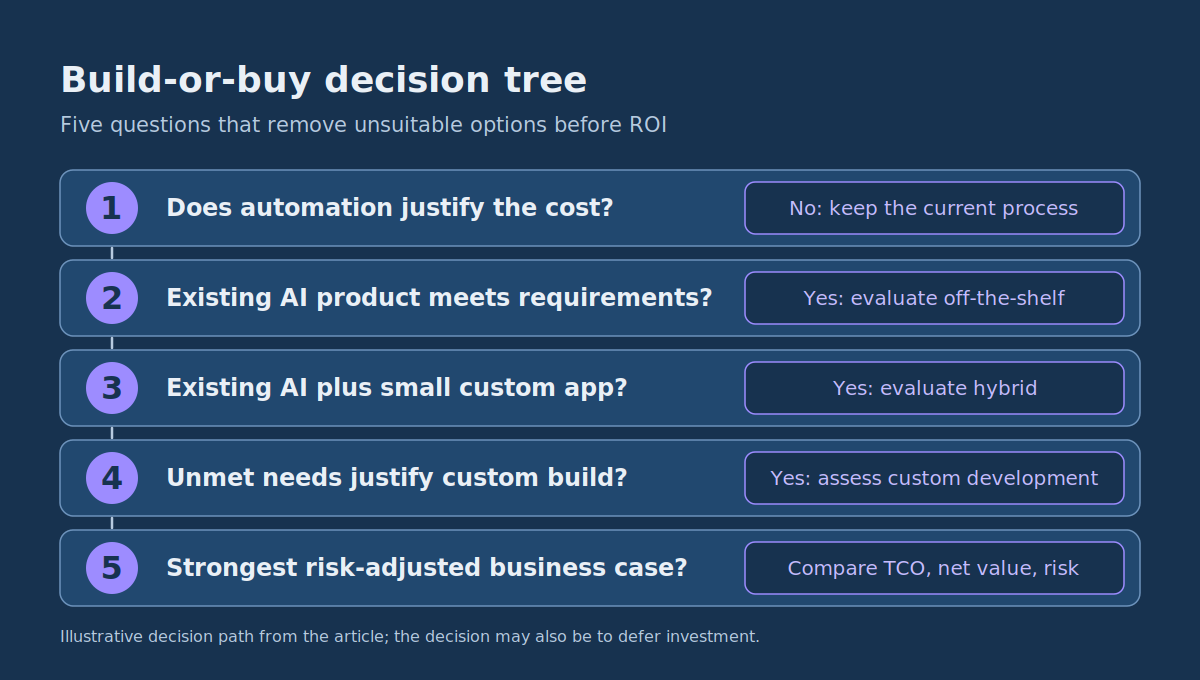
A decision tree is most useful when it eliminates unsuitable options before considering which one promises the highest return.
- Does the workflow justify automation?
If the expected benefit does not justify implementation, operating costs, and risk, retain the current process or investigate simpler automation. Otherwise, continue. - Can an existing AI product satisfy critical requirements?
If it supports the workflow, integrations, permissions, and required quality, evaluate the off-the-shelf option first. If it cannot, investigate hybrid development. - Can existing AI capabilities be combined with a limited custom application?
If the missing requirements mainly involve business rules, interfaces, or integration, evaluate a hybrid approach. Include both external service fees and custom maintenance costs. - Are the unmet requirements strategic enough to justify custom development?
If existing solutions cannot meet essential needs, assess whether a custom application can deliver sufficient benefits to cover implementation and long-term support. Custom development should address a demonstrated requirement rather than be chosen for its own sake. - Which viable option produces the strongest risk-adjusted business case?
Compare three-year TCO, net value, pilot evidence, operational risk, and sensitivity to changing requirements. Exclude options with unresolved critical security, permission, or quality failures.
The decision may also be to defer investment. A company with incomplete data, unresolved system access, or poorly defined business requirements may benefit more from addressing those issues before selecting an AI supplier or development approach.
9. What if requirements change after the AI solution is deployed?
Requirements rarely remain fixed throughout a multi-year software investment. New applications, reporting requirements, data sources, or business policies may introduce costs that the original proposal did not include.
With off-the-shelf tools
The organisation depends on the vendor’s supported features, customisation options, product roadmap, and commercial terms.
A new requirement may be satisfied through configuration or an additional module, but it may also require an unsupported workaround or a move to another product.
Before signing, investigate contractual terms for data export, integrations, renewals, feature limitations, and cancellation.
With custom software
The organisation may be able to modify the application to match changing processes, provided it has access to the necessary source code, technical documentation, and people capable of maintaining it.
Changes still have a cost. A new workflow can require architecture changes, integration work, testing, and migration. Ownership of the application does not automatically make modifications inexpensive.
With a hybrid approach
The business can often modify its own integration or workflow components while continuing to rely on established AI capabilities.
However, it must also manage changes in the external models, APIs, products, or service terms it uses.
For all three options, include a change budget in the financial model when future requirements are likely to evolve substantially.
10. How to make a defensible AI investment decision
Before approving a purchase or development contract, replace estimates with the strongest evidence available.
A practical AI build-or-buy procurement review should contain four items:
- Comparable scope: Confirm that all options are being evaluated against the same workflow, approved actions, quality requirements, and expected usage.
- Three-year cost model: Include implementation, licences, usage, integration, maintenance, oversight, and material migration or exit expenses.
- Measured benefit: Run representative tests and measure the actual improvement, including corrections and employee review.
- Decision conditions: Identify the circumstances under which the preferred option would change, including volume growth, provider pricing, or new requirements.
Where future cash flows and timing differences materially affect the investment decision, a finance team should extend the nominal worksheet into a discounted cash-flow model using an appropriate discount rate. The three-year comparison here is intentionally simpler and does not calculate net present value.
A high forecast ROI is not sufficient if its underlying effectiveness assumptions remain untested. Conversely, a lower forecast ROI may still justify consideration where a solution provides essential functionality or risk controls that cannot be delivered another way.
Frequently asked questions
How do you calculate ROI for custom AI versus off-the-shelf software?
First, calculate each option’s three-year TCO from implementation, licences, usage, integration, maintenance, oversight, and relevant exit costs. Estimate attributable business value using the same workload and value-per-successful-transaction assumptions. Then calculate net ROI = (gross business value − TCO) ÷ TCO × 100. Base the effectiveness assumptions on representative tests rather than vendor demonstrations alone.
Does custom AI development always deliver better ROI than off-the-shelf tools?
No. Custom development can provide better workflow fit and different long-term economics, but it also requires initial investment and ongoing technical responsibility. Off-the-shelf tools may deliver stronger returns when their existing capabilities meet requirements with limited integration work. A fair comparison uses the same business baseline and evaluates several years of costs and benefits.
Which cost factors have the biggest effect on AI ROI?
The most influential factors depend on the workflow. Common drivers include initial implementation, recurring licences, transaction volume, model usage, integration complexity, employee review effort, and the proportion of work that produces genuine business value. Changes in adoption or effectiveness can be more important than small differences in API pricing.
When should a business choose hybrid AI development?
Hybrid development is worth investigating when existing models or products can handle the core AI task, but the organisation needs additional business rules, integrations, interfaces, or permission controls. It is particularly attractive when a relatively small custom application can address the limitations of an otherwise suitable service.
Is custom AI cheaper as usage increases?
It can become more economical when its upfront development cost is spread over a large workload and its variable operating cost remains lower than alternatives. But higher volume can also increase infrastructure, human review, and maintenance costs. The answer depends on actual scaling behaviour and the total planning horizon.
How should companies evaluate a vendor before committing?
Request a clear pricing schedule, implementation scope, integration documentation, security and data-processing terms, support responsibilities, and exit provisions. Test the solution using representative business tasks and agree on acceptance criteria. A successful demonstration should be followed by evidence that the product works inside the intended operational process.
Make the build-or-buy decision with evidence, not assumptions
Start with the workflow your organisation wants to improve. Obtain a comparable quotation for an existing product, a hybrid integration, and a custom implementation where those options are technically feasible. Record the costs using a three-year horizon, estimate benefits conservatively, and test how the results change when transaction volume or effectiveness varies.
The worked example shows why there is no universal winner. Buying has the lowest upfront cost, hybrid delivers the strongest financial outcome in the base scenario, and custom development becomes more competitive at significantly higher volume under the model’s assumptions.
If your business needs help comparing those alternatives, a focused AI consulting assessment to transform business workflows can establish the required process, technical constraints, realistic cost assumptions, and evidence needed to choose an implementation approach. DataColab can help assess the buy, hybrid, and custom options without assuming in advance that custom development is the right answer.
The objective is not to buy or build the most sophisticated AI system. It is to select the least complicated solution that meets the business requirements, operates within acceptable risks, and produces sufficient value to justify its total cost.
Pingback:How to Build an AI Strategy Roadmap: A 90-Day Plan for Business Leaders
Pingback:Custom AI & ML Development Services: Buyer's Guide