

How Should Leaders Build an AI Strategy Roadmap with AI Strategy Consulting?
Leaders build an effective roadmap by starting with business problems, not software. AI strategy consulting helps them connect opportunities to measurable goals, prepare data and people, manage risk, and learn through small releases. First, identify where performance must improve. Then test whether artificial intelligence can help. Choose practical use cases, set ownership, fund the work, and review results. A roadmap is not a fixed technology shopping list; it is a living plan that links strategy, delivery, governance, and learning. This keeps decisions clear, useful, and accountable for the whole organization over the longer term safely.
What business outcomes should guide the roadmap?
Begin with the organization’s priorities: growth, cost control, quality, safety, service, or resilience. Meet department leaders and ask where delays, errors, or weak decisions hurt most. Describe the current process before proposing a model. For example, a retailer may need fewer stockouts, while a service team may need faster, more consistent answers. Turn each need into a clear outcome and a baseline measure. Do not treat AI as the answer by default. Sometimes better workflow design, cleaner rules, or staff training solves the problem faster. Good alignment protects budgets and gives every project a credible reason to exist from the start clearly.
How do leaders discover worthwhile AI use cases?
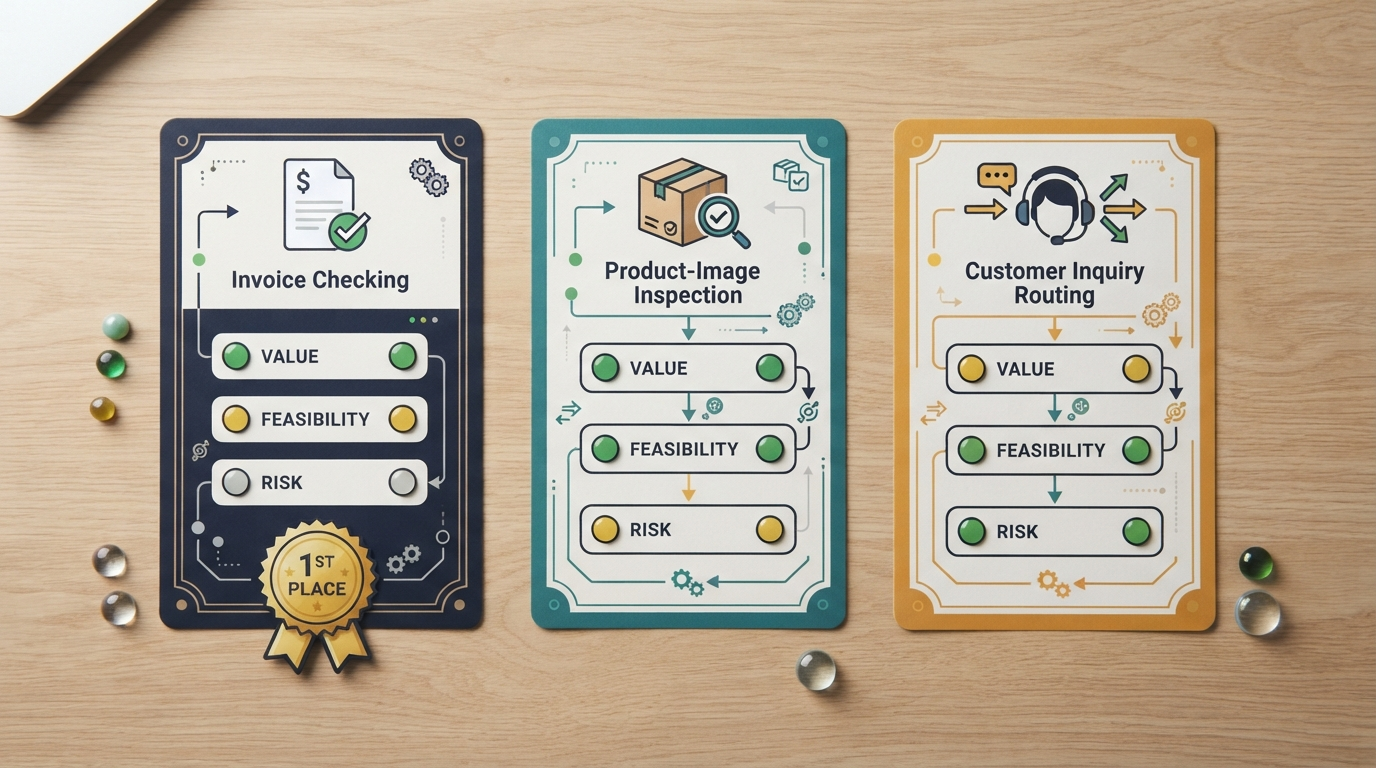
Explore technologies, but keep the discussion tied to work. Generative AI creates or revises content. Machine learning finds patterns in data. Natural language processing handles text and speech, while computer vision interprets images. Agentic AI can carry out linked tasks. Research how peers use these approaches, then speak with teams that know the friction. Map affected departments, benefits, dependencies, and roadblocks. A finance team might automate invoice checks; a manufacturer might inspect product images. Record alternatives. A roadmap compares AI with process changes and automation, choosing the simplest method that produces value.
How should teams prioritize projects?
Score each candidate against value, feasibility, risk, and time to impact. Value can include revenue, productivity, decision quality, customer experience, or avoided cost. Feasibility covers available data, integration effort, skills, and operational ownership. Risk includes privacy, security, compliance, and the harm caused by wrong outputs. Select a balanced portfolio: one quick win, one capability-building project, and one larger opportunity. Early successes prove delivery discipline and reveal hidden constraints. Avoid pilots that cannot expand because no team owns the process or budget. Rank work openly, using agreed criteria rather than executive enthusiasm. Choose a first project.
What data and technology foundations are required?
Data determines whether a promising idea can work. Inventory data sources, owners, quality, access rules, retention, and gaps. Check whether labels are accurate and whether records represent the people or events involved. Establish data governance: named owners, standards, permissions, lineage, and quality checks. Next, define technical needs. Decide which models, algorithms, interfaces, and integrations fit the use case. A chatbot may use a hosted large language model; demand forecasting may need specialized internal data pipelines. Compare cloud platforms with internal infrastructure, including security, scalability, cost, and recovery needs. Assign model monitoring ownership early.
Who will deliver and govern the work?
Assess people before making delivery promises. Review the IT function and identify gaps in data engineering, model development, product management, security, legal review, and change leadership. Decide what employees can learn, what specialists must be hired, and what a qualified partner can supply. Outsourcing may speed a narrow build, but internal owners still need enough knowledge to challenge decisions and run operations. Give each initiative a business owner, technical owner, and risk owner. Provide training for affected employees, not only experts. Explain how the tool changes decisions and escalation paths. Invite feedback regularly.
How can responsible AI stay practical?
Responsible AI belongs in the roadmap from the beginning. Set rules for privacy, security, fairness, transparency, and human oversight. Document the purpose of each system, the data it uses, and the decisions it can influence. Test for bias, especially when outputs affect hiring, pricing, access, or service. Provide a clear route for people to question or correct automated results. Governance is not paperwork alone. It establishes accountability through approval gates, monitoring, incident response, and regular reviews. For high-impact decisions, keep humans accountable and able to override the system. These safeguards enable sustainable scale responsibly.
How should leaders secure support and funding?
Present the roadmap as a business case rather than a technology wish list. Show the problem, baseline, proposed approach, expected benefits, costs, dependencies, risks, and decision owner. Explain which resources are needed now and what later phases may require. Include vendor choices only after comparing industry experience, reputation, pricing, delivery timing, security, and contract terms. Stakeholders should see how the work supports strategic priorities and what will happen if results disappoint. Ask for budget, governance decisions, and named sponsors. Honest trade-offs build more trust than inflated promises. Schedule updates so leaders remove barriers.
What should an implementation timeline include?
Use phases instead of pretending every uncertainty is known. In discovery, validate the problem, users, data, and constraints. In design, select the solution, controls, architecture, and measures. In pilot, test with a limited group and compare results with the baseline. In deployment, integrate the workflow, train users, and set support procedures. Finally, in scale, extend only after performance and controls remain sound. Each phase needs a decision point, accountable owner, budget boundary, and exit criteria. Build time for procurement, security review, data preparation, user testing, and change communication. Timelines should show dependencies clearly. Adapt.
How do you measure meaningful results?
Choose metrics before development begins. Tie them to the original business problem. A service assistant might be measured by resolution time, answer quality, escalation rate, and customer feedback. A forecasting tool might be measured by error reduction, inventory availability, and planner adoption. Include financial and operational measures, but do not ignore responsible-use signals. Monitor data quality, security incidents, compliance, transparency, and bias findings. Review results against the baseline at planned intervals. If a project misses its target, investigate the cause rather than hiding it. Learning can justify redesign, retraining, a different workflow, or closure.
How can the roadmap adapt over time?
AI capabilities and market conditions will change, so review the roadmap regularly. Watch for new regulations, supplier changes, model limitations, and emerging opportunities. Gather feedback from users, customers, technical teams, and risk teams. Compare actual outcomes with forecasts and revise priorities when evidence warrants it. Keep a record of decisions, assumptions, and lessons. This makes later investments easier to explain and prevents repeated mistakes. Retire tools that no longer deliver value. Refresh training as roles and systems change. A roadmap stays useful when leadership treats it as a managed portfolio, not a document.
What mistakes can derail an AI roadmap?
Common failures begin with solution-first thinking. Buying a tool before defining a problem creates activity without value. Another mistake is treating a pilot as a strategy. Pilots need owners, measures, integration plans, and a path to scale. Leaders also fail when they underestimate data cleanup, change management, or legal review. Avoid opaque accountability where business teams assume technology teams own every outcome. Finally, do not promise full automation when people must remain responsible for consequential choices. A candid roadmap states limits early and protects confidence when results are mixed or slower than expected.
FAQ About AI Strategy Consulting
When should a company seek outside help?
Outside support helps when leaders need an independent assessment, scarce technical expertise, or a faster start. Consultants should transfer knowledge, clarify choices, and leave internal owners capable of governing the work.
How long should the first AI pilot last?
Set the length by learning goals, data preparation, and workflow risk. A pilot ends when evidence supports scaling, redesign, or stopping; it should not continue merely because the technology is interesting.
Who owns AI roadmap decisions?
Business leaders own outcomes, while technical, legal, and risk teams share delivery and oversight responsibilities across each initiative.