

Machine learning explained with simple examples and key terms: a practical machine learning definition
If you want a usable machine learning definition, start here: machine learning is a subfield of artificial intelligence in which computers learn patterns from data instead of being explicitly programmed with every rule. That sounds simple, but the real value is in knowing when that approach helps, how machine learning works in practice, and where it fails. This guide goes past surface-level machine learning basics so you can understand the logic behind supervised learning, unsupervised learning, reinforcement learning, training data, classification, and overfitting without needing a technical background.
A good mental model is this: traditional software follows instructions written by humans, while a machine learning model discovers statistical relationships from examples. If you show a model past transactions, medical images, customer messages, or sensor logs, it can learn to predict, sort, flag, or recommend on new data. That is why machine learning shows up in recommendations, fraud detection, chatbots, translation, image analysis, and medical diagnostics. The important question is not whether machine learning is “smart.” The important question is whether the pattern you care about can be learned reliably from data.
Machine learning definition, in plain English
The shortest useful definition is not enough for deep understanding, so it helps to break the idea into parts. Machine learning is about learning from examples, generalizing to new cases, and making decisions under uncertainty.
Suppose you want to identify spam emails. A rule-based program might say: if the subject contains certain phrases, mark it as spam. That works until spammers change wording, formatting, or language. A machine learning system learns from many past emails labeled spam or not spam, then estimates the probability that a new email belongs in one class or the other. It is not memorizing one phrase. It is learning a pattern across many signals.
This matters because many real problems are too messy for hand-written rules. Human language varies. Fraud changes shape. Images differ by angle, lighting, and quality. Customer behavior is noisy. Machine learning is especially useful when you have a lot of data and the pattern is too complex, too subtle, or too expensive to code manually.
When machine learning is the right tool — and when it is not
Many beginners ask the wrong first question: “Which algorithm should I use?” The better first question is whether the problem should use machine learning at all. This decision saves more time than any model tweak later.
Choose machine learning when the pattern is hard to write as rules
Machine learning is a strong fit when inputs vary widely but still contain learnable patterns. Think of handwriting recognition, product recommendations, fraud detection, or predicting whether a customer support message is urgent. In each case, there may be thousands of subtle combinations that matter. Writing rules for all of them would be brittle and expensive.
It also helps when performance can improve as more data arrives. If your system learns from new examples over time, machine learning can keep adapting. That is one reason teams often use it when they want to create your own machine learning model for a recurring prediction problem rather than maintain an ever-growing list of exceptions.
Choose rule-based programming when the logic is stable and explicit
If a decision can be expressed clearly as fixed rules, plain programming is often better. Calculating sales tax from a defined rate table is not a machine learning problem. Validating that a password contains at least one number is not a machine learning problem. Checking whether an order total exceeds a set approval threshold is not a machine learning problem.
Rule-based systems are preferable when you need exact behavior, legal traceability, or guaranteed consistency. They are easier to audit because you can point to the rule that triggered the outcome. With machine learning, you usually get probabilities and patterns rather than simple yes-or-no logic.
A practical decision test for beginners
If you are unsure, ask four questions:
- Do I have enough historical examples of the problem?
- Would writing and maintaining explicit rules be difficult?
- Is an occasional imperfect prediction acceptable?
- Can I measure whether the system is getting better or worse?
If the answer is mostly yes, machine learning may be appropriate. If the answer is mostly no, a rules engine, spreadsheet logic, or standard software may be more sensible.

How machine learning works from raw data to prediction
Most explanations stop at “the model learns from data.” That is true, but too compressed to be useful. In practice, machine learning is a workflow with distinct stages, and each stage can introduce its own errors.
- Collect data. This can be text, images, transactions, sales records, clicks, logs, or sensor readings.
- Prepare the data. Clean errors, handle missing values, define labels if needed, and make sure the data matches the real task.
- Train the model. The model finds patterns that connect the inputs to an outcome or to hidden structure.
- Validate and test it. You check whether the learned pattern works on data the model has not already seen.
- Use it on new data. The trained model makes predictions, classifications, or recommendations in real situations.
- Monitor performance. If data changes over time, the model may become less accurate and need retraining.
Take a bank fraud example. The training data may include past transactions with information such as amount, merchant type, location, time, and whether fraud was later confirmed. The model learns relationships between those signals and the outcome. When a new transaction arrives, the model estimates the chance of fraud and supports a decision, such as approving, declining, or sending the case for review.
Notice what is doing the work here: examples, not handcrafted instructions. That is the core of how machine learning works.
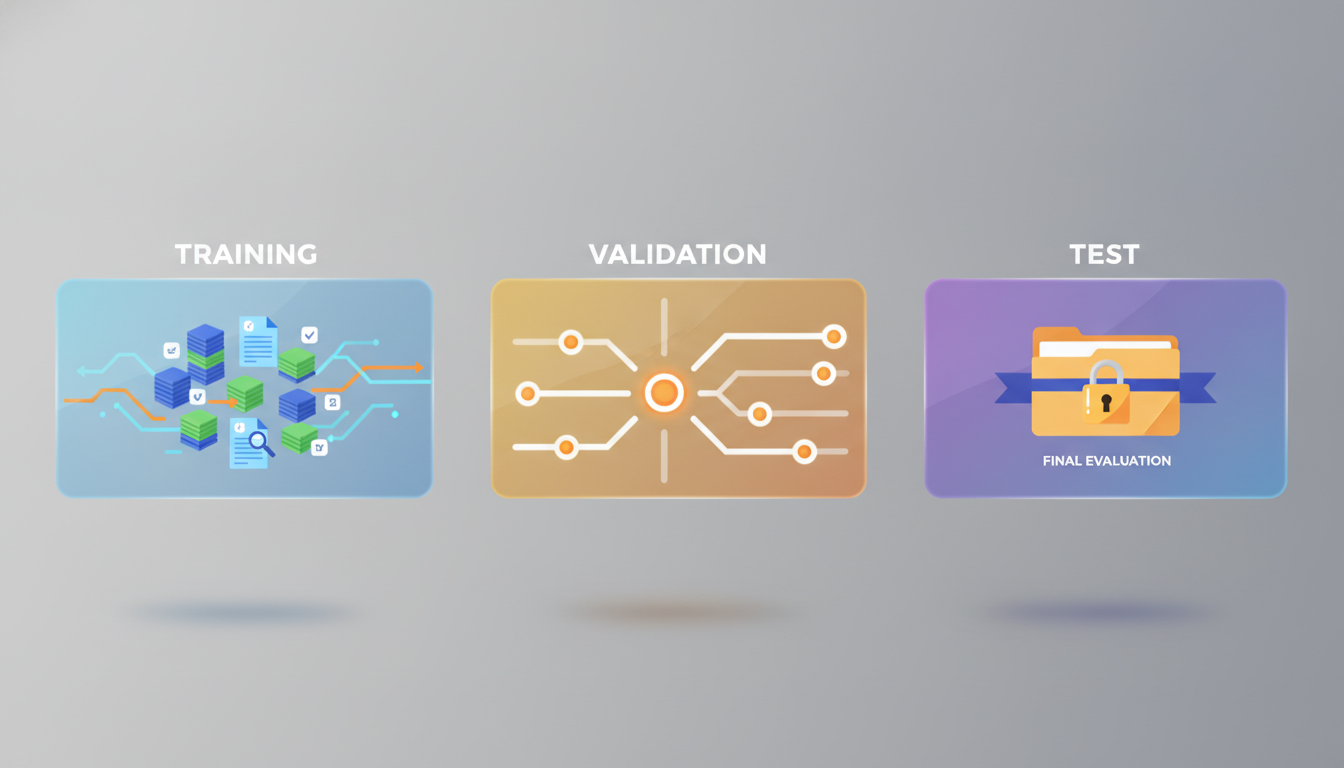
Training data, validation data, and test data are not the same thing
This distinction is one of the most important machine learning basics, and many articles blur it. If you only remember one technical concept from this guide, remember this one: different data splits exist to prevent you from fooling yourself.
Training data teaches the model
Training data is the portion used to learn the pattern. If you are building an email classifier, the training set contains past emails and, in supervised learning, their labels such as spam or not spam. The model adjusts itself based on this data. It is the study material.
Validation data helps tune choices
Validation data is separate from training data and is used during development to compare versions of the model. You might use it to choose between two approaches, stop training before the model starts memorizing noise, or decide which settings work best. The validation set is not for final bragging rights. It is for model selection.
Test data is the honest exam
Test data is held back until the end so you can estimate how the model performs on truly unseen cases. A common starting point is reserving most data for training and a smaller share for testing; the standard train-test split range described by ScienceDirect puts the training set at roughly 70% to 90% of the original data. The exact split can vary, but the principle does not: if you test on data the model has already influenced, your results look better than reality.
A simple analogy helps. Training data is what a student studies. Validation data is a set of practice exams used to choose the best study strategy. Test data is the final exam taken once. Mixing them weakens the whole process.
The three main types of machine learning, with examples that show the difference
Supervised learning, unsupervised learning, and reinforcement learning are the standard categories, but the useful question is not just what they are. It is what kind of problem each category is trying to solve.
Supervised learning: learning from labeled examples
In supervised learning, the correct answer is included during training. You show the model inputs and the known outcome. The task is to learn the relationship between them.
Example: classifying support tickets as urgent or not urgent. Each past ticket has text plus a label. The model learns patterns in wording, issue type, and account history that correlate with urgency. Spam detection, credit risk scoring, disease detection from images, and sales forecasting often use supervised learning.
Two common supervised tasks are:
- Classification: predicting categories such as fraud/not fraud or positive/negative review.
- Regression: predicting a numeric value such as price, demand, or temperature.
Unsupervised learning: finding structure without labels
In unsupervised learning, there is no correct answer column in the data. The model looks for patterns, groupings, or relationships on its own.
Example: a retailer groups customers by purchasing behavior without pre-labeled segments. The model may find clusters such as frequent discount shoppers, seasonal buyers, or high-value repeat customers. No one told it those groups in advance. It discovered structure in the data.
This approach is useful for segmentation, anomaly detection, pattern discovery, and simplifying large datasets. It is powerful, but interpretation matters. An unsupervised result may be statistically neat while still being operationally useless if the discovered groups do not support a real decision.
Reinforcement learning: improving through rewards and penalties
Reinforcement learning is different from both of the above. An agent takes actions, receives rewards or penalties, and gradually learns a strategy that improves outcomes over time.
Example: a system learning how to allocate energy usage across changing conditions, or software learning better move sequences in a game. It is not usually the first tool for everyday business prediction tasks. It is best understood as learning by trial and error in an environment rather than learning from a static table of past examples.
| Type | What data looks like | Main goal | Simple example |
|---|---|---|---|
| Supervised learning | Labeled inputs and outputs | Predict a known target | Classify email as spam or not spam |
| Unsupervised learning | Unlabeled data | Find hidden structure | Group customers by behavior |
| Reinforcement learning | Actions, rewards, environment feedback | Learn a good strategy over time | Improve game or control decisions |
Key machine learning terms that actually matter in practice
Definitions are useful only when they change how you read a real machine learning workflow. The terms below are the ones that keep showing up because they map directly to decisions teams make.
Model
A machine learning model is the learned mathematical pattern that turns inputs into outputs. In plain terms, it is the thing that has absorbed information from training data and can now make a prediction on new data.
Feature
A feature is an input signal the model uses. In a fraud system, features may include transaction amount, time of day, country, device type, or recent account behavior.
Label
A label is the correct answer in supervised learning. For spam detection, the label may be spam or not spam. Without labels, the task is not supervised learning.
Prediction
A prediction is the model’s output for a new case. It may be a category, a score, or a numeric estimate.
Classification
Classification is a supervised learning task where the output is a category. Many beginner examples use classification because it is intuitive: approve or deny, spam or not spam, defective or not defective.
Overfitting
Overfitting happens when the model learns the training data too specifically, including noise and quirks that do not generalize. It then performs well on seen data but poorly on new data. Overfitting is one reason separate validation and test sets matter.
Generalization
Generalization is the real goal: the model should perform well on new, unseen data, not just on the examples it studied.
Simple machine learning examples, examined more carefully
Common examples are helpful, but they often get presented as magic tricks. Looking at them more closely shows what the model is really learning and where things can go wrong.
Recommendation systems
A streaming or shopping platform recommends items by learning patterns from behavior: what users viewed, skipped, bought, rated, or watched together. The model is not “understanding taste” in a human sense. It is estimating what similar users or similar items suggest about the next likely choice.
Fraud detection
Fraud detection works because fraudulent behavior leaves traces across many weak signals. One small signal might mean nothing, but several combined can point to elevated risk. The challenge is that fraud evolves. A model trained on old fraud patterns can decay if criminals change tactics.
Medical image analysis
In image analysis, a model may learn patterns associated with a diagnosis from labeled scans. This can support clinicians by prioritizing cases or flagging suspicious regions. It should not be described casually as replacing medical judgment. Real-world use demands validation, careful data quality controls, and awareness that errors carry high stakes.
Chatbots and translation
These systems learn from large amounts of text and interaction data. Their strength is handling variation in language that would defeat fixed rules. Their weakness is that fluent output can sound confident even when the underlying answer is wrong, incomplete, or based on outdated patterns.
Limits and risks that matter beyond bias and overfitting
Bias and overfitting get a lot of attention, rightly so. But non-technical readers should understand several other limitations because these are often what break projects in practice.
- Data drift: the world changes, so old patterns stop matching new reality. Customer behavior, fraud methods, and product catalogs all shift.
- Weak problem framing: if you predict the wrong target, even a highly accurate model can be useless. Predicting clicks is not the same as predicting value.
- Poor data quality: duplicated records, missing values, inconsistent labels, and outdated sources quietly damage performance.
- False confidence: a model can produce precise-looking scores that encourage people to trust outputs more than they should.
- Operational mismatch: a technically strong model may still fail if nobody can act on its output fast enough or if the workflow around it is broken.
- Explainability limits: some models are harder to interpret, which matters in regulated, safety-critical, or customer-facing decisions.
This is where many teams seek machine learning project help, not because the concept is mysterious, but because turning a model into a reliable decision process requires data discipline, testing, and operational judgment.
One practical lesson stands out: machine learning does not remove human responsibility. It shifts it. Instead of writing every decision rule by hand, people must decide what data to use, what outcome to optimize, what errors are acceptable, and how to monitor the system after deployment.

What strong machine learning work looks like in the real world
A useful machine learning system is not defined by novelty. It is defined by fit. The best systems solve a clear prediction problem, use data that reflects the real environment, and are measured against outcomes that matter.
That usually means starting narrower than people expect. Rather than “use AI in customer service,” a better project is “classify incoming support requests by urgency” or “predict which tickets should be routed to billing specialists.” Narrow tasks are easier to label, test, and improve. They also make failure visible sooner.
It also means accepting that machine learning is probabilistic. A model usually does not give certainty; it gives likelihoods. The downstream workflow matters just as much as the score. A high-risk fraud prediction may trigger manual review, while a moderate-risk prediction may simply request extra verification. Good implementation uses model outputs as part of a decision system, not as a magical final answer.
How to read machine learning claims without getting misled
Once you understand the basics, the next skill is skepticism. Many claims about machine learning sound impressive because they hide the setup.
Ask what data the system learned from. Ask whether results were measured on held-out test data. Ask what the model is actually predicting, and whether that target matches the business or human goal. Ask what happens when the model is wrong. If nobody can answer those questions clearly, the system may be less mature than the language around it suggests.
Also pay attention to baseline comparisons. If a simple rule or spreadsheet performs nearly as well, the more complex machine learning approach may not be worth the added cost and maintenance. Better is not enough. It must be better enough to justify the workflow, monitoring, and risk.
Why this machine learning definition should change how you think about AI
The shallow version of machine learning makes it sound like automated intelligence. The useful version is more grounded: machine learning is pattern learning from data for a defined task under uncertainty. That framing is less flashy, but far more powerful. It helps you spot where machine learning can create real value and where a conventional system is the better engineering choice.
If you remember the core ideas, remember these: machine learning needs examples, not just ambition; supervised learning, unsupervised learning, and reinforcement learning solve different kinds of problems; training, validation, and test data serve different purposes; and the real goal is not to perform well on old data, but to generalize on new data reliably. Once you see machine learning that way, you can evaluate tools, projects, and claims with much sharper judgment.