

How to Choose a Data Science Consulting Partner for Enterprise Analytics
Choosing a data science consulting partner is rarely about finding the smartest modelers. It is about finding the firm that can turn business goals into production-grade analytics that executives will trust and teams will actually use. That distinction matters because many initiatives stall after the demo stage; in fact, Gartner’s data on AI prototypes reaching production shows only 41% of generative AI prototypes and 42% of non-generative AI prototypes made it into production.
If you are comparing options, start with a blunt rule: eliminate any data science consulting firm that cannot clearly connect your commercial, operational, or risk objectives to specific enterprise analytics use cases. Technical depth still matters. So do data engineering, MLOps, data governance, responsible AI, and domain knowledge. But the partner that is right for you is the one that can combine those capabilities into decisions, workflows, and systems that survive beyond the pilot.
The fastest way to narrow your options
Most enterprise buyers do not need a longlist of ten firms. They need a way to remove bad fits quickly. The most useful first cut is to match the consulting partner to the kind of analytics problem you actually have.
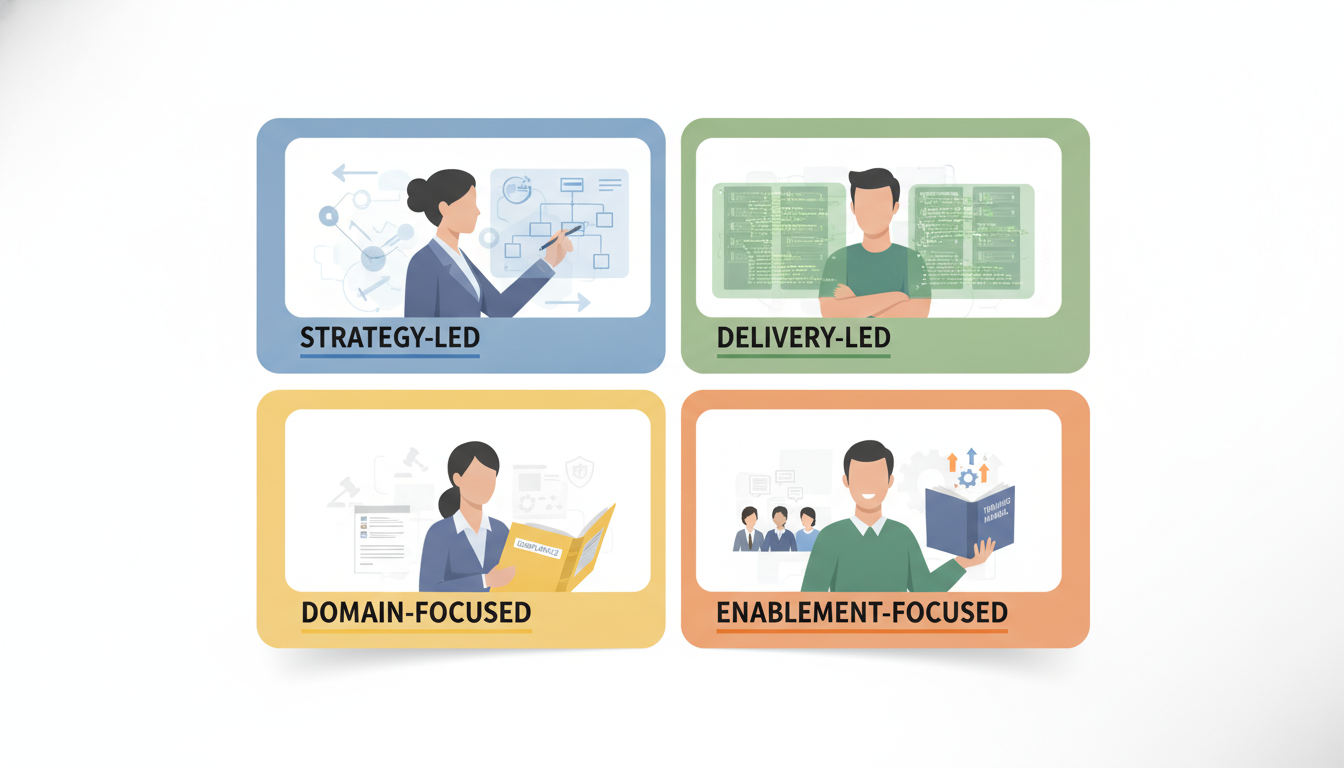
| Your situation | Best-fit consulting profile | Main advantage | Main tradeoff |
|---|---|---|---|
| You need executive alignment, portfolio prioritization, and analytics roadmap decisions | Strategy-led analytics consulting partner with strong senior stakeholder facilitation | Better at shaping business cases and sequencing use cases | May rely on partners or subcontractors for deep implementation |
| You already know the use case and need model deployment into enterprise systems | Delivery-led data science consulting firm with strong data engineering and MLOps | Higher chance of moving from prototype to production | May be weaker at business change management if not explicitly staffed for it |
| You operate in a regulated or specialized environment | Domain-focused partner with governance, compliance, and responsible AI experience | Fewer surprises around controls, validation, and acceptable metrics | Can be less flexible outside its core industries or functions |
| You want to build internal capability, not stay dependent on consultants | Enablement-oriented partner with training, documentation, and handoff discipline | Stronger internal maintainability over time | May move more slowly than a firm optimized purely for rapid delivery |
This table is not a ranking. It is a filter. Once you know which profile matches your need, your vendor evaluation becomes much sharper because you stop rewarding firms for strengths you do not actually need.
How to evaluate data science consulting firms without being dazzled by presentations
The cleanest way to compare firms is to use a weighted scorecard. That pushes the conversation away from polished demos and toward repeatable buying criteria. Gartner’s supplier scorecard framework explicitly evaluates vendors across multiple dimensions including cost, delivery, quality, flexibility, partnership, and risk, and that same discipline works well for enterprise analytics partner selection.
For most enterprise analytics projects, this weighting is a practical starting point:
- 25%: business translation ability — Can the firm map business goals to use cases, decision points, and measurable outcomes?
- 20%: implementation capability — Can it deliver data pipelines, model deployment, validation, monitoring, and lifecycle management?
- 15%: enterprise data architecture fit — Has the team worked with large, messy, multi-source environments, not just clean sandbox data?
- 15%: governance and risk controls — How mature are its practices for privacy, access control, compliance, and responsible AI?
- 10%: domain expertise — Does the firm understand your industry metrics, operating constraints, and regulatory realities?
- 10%: stakeholder communication — Can the team explain tradeoffs to executives, legal, operations, and technical teams?
- 5%: capability transfer — Will your internal team be able to run and improve the solution after handoff?
That weighting is an editorial recommendation, not a universal benchmark. Still, it reflects a hard truth: enterprise analytics fails more often from weak translation, weak implementation, or weak governance than from lack of algorithmic sophistication.
What specific questions belong in your RFP or vendor interview?
Most RFPs ask broad questions and get polished, non-comparable answers back. To compare data science consulting providers objectively, ask for evidence tied to the exact delivery points where enterprise projects usually break.
Questions that reveal business translation ability
These questions expose whether the firm can connect analytics work to decision-making rather than just to model accuracy.
- Describe how you would convert our business goals into a prioritized set of analytics use cases in the first 30 days.
- What business decisions would each proposed use case improve, and how would you measure that improvement?
- Show an example of where you advised a client not to build a model because the workflow or decision process was not ready.
Questions that reveal enterprise technical depth
Strong machine learning consulting is broader than model building. Enterprise delivery requires competence across statistics, experimentation, data engineering, deployment, and monitoring.
- Which roles on your delivery team own feature engineering, data pipeline reliability, model validation, and monitoring?
- How do you handle model drift, retraining triggers, and rollback in production?
- What changes in your approach when data comes from multiple operational systems plus unstructured sources such as documents or call transcripts?
Questions that reveal governance and maintainability
This is where firms often become vague. Do not let them.
- How do you document lineage, assumptions, validation logic, and model limitations for auditability?
- What is your approach to privacy, access control, and responsible AI reviews before model deployment?
- What does handoff include: code documentation, runbooks, training, architecture diagrams, or support periods?
Questions that reveal whether the case studies are real delivery evidence
Ask these in exactly this spirit: less theater, more proof.
- What percentage of your prototypes in comparable enterprise settings reached production?
- Who from the proposed delivery team worked on the reference projects you are presenting?
- What measurable outcome changed after implementation, and what part of that outcome can reasonably be attributed to the analytics solution?
Warning signs that a consulting partner is strong in pitch meetings but weak in production
Some firms are excellent at selling analytics transformation and weak at shipping reliable systems. The warning signs are visible early if you know where to look.
- The case study stays at the prototype layer. You hear about dashboards, proof-of-concepts, or model accuracy, but not about integration, validation, monitoring, or adoption.
- The delivery team is hidden behind senior sales talent. If you cannot meet the actual data scientists, engineers, and product leads, assume the bench may be thinner than the pitch suggests.
- The firm talks about AI broadly but not your data specifically. Enterprise data architecture is messy. A credible partner asks detailed questions about source systems, quality issues, permissions, latency, and downstream workflows.
- Governance answers sound generic. “We take security seriously” is not an answer. You want specifics on controls, review steps, documentation, and accountability.
- There is no clear view of operating model after launch. If ownership, support, retraining, and maintenance are fuzzy, the partner is likely optimizing for the project end date, not business continuity.
The most revealing pattern is this: weak firms over-index on frameworks, innovation language, and aspiration. Strong firms talk concretely about constraints, implementation sequencing, model deployment, and internal adoption.

The delivery team matters more than the logo on the slide
Enterprises often buy a brand and receive a different reality. That is why team composition should be evaluated as carefully as the firm itself. A credible enterprise analytics team usually includes senior business leadership, data scientists, data engineers, analysts, and someone accountable for product or delivery coordination.
Ask for named roles, approximate allocation, and the responsibilities of each role across discovery, build, deployment, and support. If a partner proposes a strategy-heavy team with almost no data engineering capacity, that may be fine for roadmap work but not for implementation. If a partner proposes strong technical staff but little senior business coverage, expect friction with executive alignment and adoption. The right mix depends on your scenario, but a mismatch is easy to spot once you insist on role-level clarity.
Which option fits your situation?
At this point, you should be able to move from “who looks good?” to “who is right for my enterprise?” Use these decision rules to make the final call.
Choose a strategy-led partner if your problem is prioritization
If your executives are still debating where analytics should create value, choose the firm that is best at framing decisions, use cases, and operating model changes. Do this even if another vendor looks stronger technically. Building the wrong model faster is still the wrong project.
Choose a delivery-led partner if the use case is clear and the bottleneck is execution
If you already know the use case and success metric, prioritize implementation capability over ideation. That means data engineering, MLOps, validation, and maintainable deployment should outweigh inspirational strategy language.
Choose a domain-focused partner if compliance or workflow nuance can break the project
In regulated functions or industry-specific operations, domain expertise is not a nice-to-have. It changes feature design, acceptable error thresholds, model review requirements, and rollout strategy. In these cases, a generalist analytics consulting firm may create avoidable risk.
Choose an enablement-focused partner if you want your team to own the capability
If dependence on outside consultants is your biggest concern, pick the firm that is willing to document deeply, train internal staff, and design for maintainability. This may not be the fastest route to a flashy first launch, but it is often the better enterprise decision.
The decision hinge in enterprise data science consulting
The best data science consulting partner is not the one with the broadest claims. It is the one whose strengths match the failure mode you most need to avoid. If your biggest risk is choosing low-value use cases, hire for business translation. If your biggest risk is getting stuck between pilot and production, hire for data engineering and MLOps depth. If your biggest risk is regulatory friction or model trust, hire for governance and domain discipline.
Make the final decision with a weighted scorecard, insist on meeting the actual delivery team, and ask for proof that the firm has taken enterprise analytics through model deployment and ongoing support. That is how you stop buying presentations and start selecting a partner that can deliver durable enterprise analytics.