

Choosing Between Data Science and Analytics for Your Career Goals
If you are stuck on the question of data science or data analytics for career planning, the fastest useful answer is this: choose data analytics if you want to solve business questions with data right away, and choose data science if you want to build predictive systems and are comfortable with heavier coding, math, and experimentation. The two paths overlap, but they do not demand the same working style.
That distinction matters because many beginners waste months learning the wrong things first. A sensible starting point is the shared base: SQL, spreadsheets, basic statistics, and data visualization. That is not just a course-provider talking point; Coursera’s Global Skills Report 2025 draws on 170M+ learners, which makes the common foundation hard to dismiss as a niche training trend.
This article is not a neutral tour of both careers. It is a decision guide for someone who wants a clear direction. You will see how the work differs in practice, what skills to learn first without locking yourself in too early, and which entry-level roles usually lead into each path.
How to evaluate data science vs data analytics for a career decision
The best comparison is not “which job sounds cooler” or “which pays more.” It is whether the day-to-day work matches your strengths, patience, and preferred kind of problem-solving. The criteria below are the ones that most often determine whether people thrive or stall.
| Decision criterion | Data analytics | Data science |
|---|---|---|
| Core purpose | Examine existing data, explain what happened, and support business decisions | Build models, algorithms, and data-driven systems that predict or optimize outcomes |
| Typical work | Dashboards, KPI tracking, reports, campaign analysis, sales trend analysis | Machine learning, forecasting, experimentation, feature engineering, model development |
| Coding demand | Usually moderate; SQL is central, spreadsheets still matter | High; Python or R is central, often with stronger engineering expectations |
| Data complexity | More often structured business data | Often larger, messier, or less structured datasets |
| Best fit for | People who like business context, clarity, and visible decision impact | People who enjoy abstraction, modeling, experimentation, and technical depth |
| Entry path | Often accessible from undergraduate STEM backgrounds or adjacent business roles | More often favors advanced degrees or stronger computer science and statistics training |
If one column already feels more energizing than the other, pay attention. Career fit is often less about job titles than about whether you want to explain reality or simulate it.
What the jobs feel like in real work
Most comparisons stop at duties and tools. That is useful, but it does not help enough when you are deciding where you personally belong. The better question is what kind of pressure each job creates during a normal week.
Data analytics feels like decision support
Data analytics focuses on examining existing datasets to identify trends, summarize performance, and support business decisions. In practice, that often means a marketing lead wants to know why conversions dropped, a sales manager wants pipeline visibility, or an operations team wants KPI tracking cleaned up before a quarterly review.
Data analysts commonly work on dashboards, reports, stakeholder requests, and recurring metrics. The pressure is less about inventing a model and more about being accurate, fast, and clear. You need SQL for data analytics, comfort with spreadsheets, basic statistics, data visualization, and the ability to explain findings to non-technical people without turning every answer into a lecture.
Data science feels like building and testing
Data science focuses on building predictive models, algorithms, and data-driven systems to solve more complex problems. A data scientist is more likely to ask: can we forecast demand, detect churn earlier, rank recommendations better, or design an experiment that isolates causal impact?
That is why data scientist skills usually include Python for data science, statistics and probability, machine learning, and some software engineering knowledge. The role is more coding-heavy, and the work often involves ambiguity that analytics roles do not always face. One model underperforms, a feature pipeline breaks, or an experiment gives mixed results. If that sounds stimulating rather than exhausting, data science may be the better fit.
Start with these beginner skills before choosing too early
A lot of career changers think they must commit to one lane immediately. They do not. There is a smart first phase that keeps both paths open while exposing you to the kind of work each one requires.
- SQL: learn filtering, joins, aggregations, and window functions. SQL is immediately useful in analytics and still valuable in data science.
- Spreadsheets: not glamorous, but still common in business reporting, validation, and stakeholder workflows.
- Basic statistics: averages, distributions, variance, correlation, sampling, and hypothesis testing.
- Data visualization: build charts that answer business questions, not just decorate slides.
- Data cleaning: missing values, duplicates, inconsistent categories, and messy source logic affect both careers.
After that shared foundation, branch based on what you enjoy. If you like answering business questions with clean, interpretable outputs, deepen analytics. If you keep wanting to automate decisions, predict outcomes, or experiment with models, move into data science. This sequence reduces the risk of choosing the wrong path too early because none of the first five skills are wasted.

Choose based on personality, learning style, and coding tolerance
This is where the decision usually becomes obvious. Not everyone who likes data likes the same kind of data work, and that mismatch is where frustration starts.
If you should lean toward data analytics
Pick data analytics if you learn best through concrete business problems. You probably prefer visible questions with practical answers: which campaign performed best, why sales changed, where a funnel leaks, which region missed target. You may still enjoy coding, but you do not want code to dominate your day.
Analytics is also the better fit if you like fast feedback. You build a dashboard, answer a stakeholder question, and see the result used in a meeting or decision. People who enjoy structure, communication, and business context often grow faster here than in machine learning careers that demand longer cycles and more technical uncertainty.
If you should lean toward data science
Choose data science if you are comfortable learning through abstraction and iteration. You do not mind spending time on Python, probability, modeling assumptions, and debugging. You can tolerate slower payoff because the work may take weeks before a result is usable.
Compensation helps explain why the bar is often higher. Coursera’s overview of data science notes that data scientist mean annual pay was $108,020 as of May 2023 using U.S. Bureau of Labor Statistics figures, and that premium aligns with the role’s greater technical specialization. Editorially, that does not mean you should chase data science for salary alone. It means the market often expects stronger coding, modeling, and experimentation skills in return.
A blunt rule for people who dislike coding
If you actively dislike coding, do not force yourself into data science because the title sounds more advanced. Data science is generally more technically demanding and more coding-heavy than data analytics. You can still have a strong, well-paid, credible career in analytics. If you merely feel intimidated by coding but are curious enough to push through it, that is different. Intimidation fades; dislike usually does not.
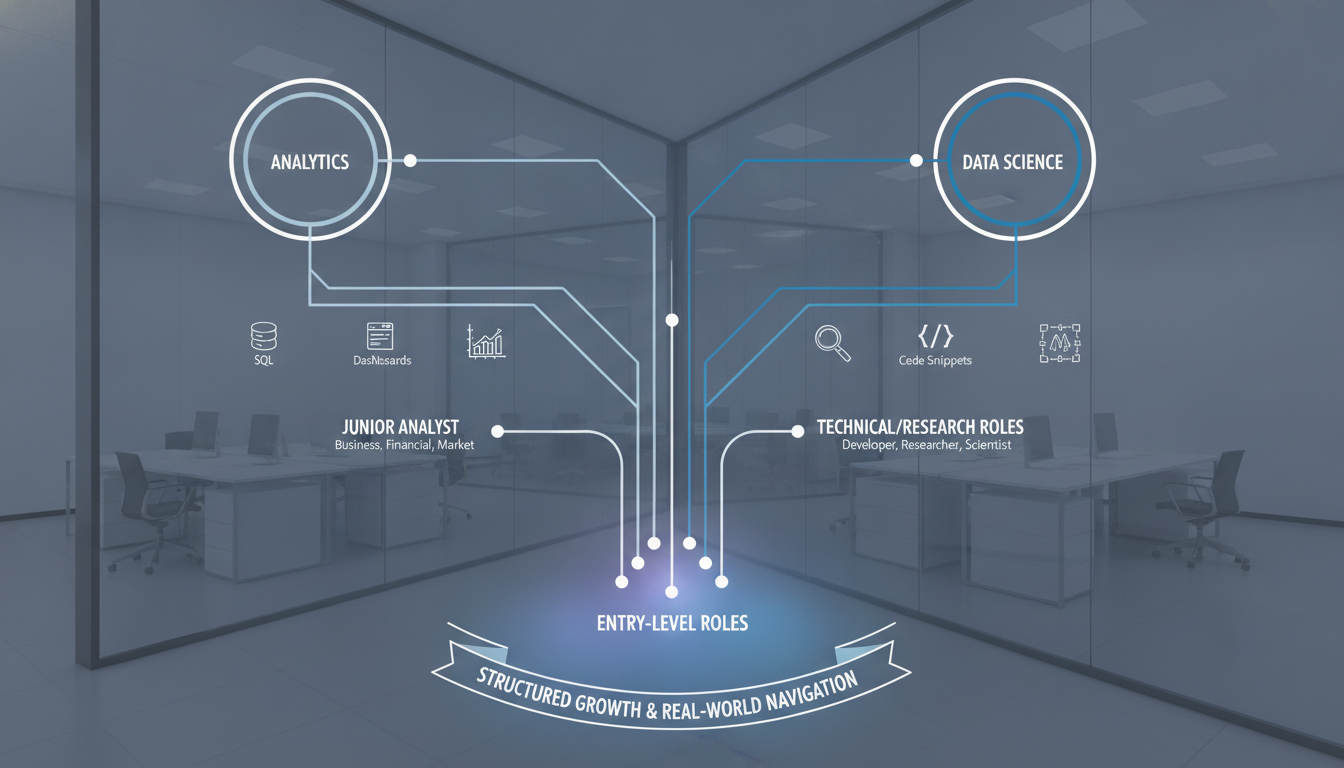
Which entry-level roles lead into each path
Job titles are messy, but career transitions tend to follow recognizable patterns. This matters because your first role does not lock your whole future, yet it does shape what skills you build under pressure.
Common entry points into data analytics
The most direct starting roles are junior data analyst, reporting analyst, business analyst, operations analyst, marketing analyst, or BI analyst. These roles usually strengthen SQL, dashboarding, KPI logic, and stakeholder communication. Someone comparing business analyst vs data scientist should notice that business analyst-adjacent work often shares more DNA with analytics than with core data science.
The usual transition is simple: you start by answering recurring business questions, then take on more complex analysis, automated reporting, experimentation support, and eventually ownership of larger datasets or domain areas. That is a classic data analytics career path.
Common entry points into data science
Direct entry into data science is possible, but less common without stronger technical preparation. People often arrive from data analyst roles, research roles, machine learning internships, software engineering, or quantitative academic work. The bridge usually happens when someone moves from describing patterns to building predictive modeling workflows.
A practical example: an analyst may begin by measuring churn, then start building churn-risk features in Python, then support an experiment, then partner on a model, and only later move into a formal data scientist title. That is how the transition often happens in real teams: not in one jump, but by taking on increasingly model-oriented work.
Which option fits your situation
You do not need more theory at this point. You need a clear recommendation based on common reader profiles. Use these as decision rules, not just descriptions.
| If this sounds like you | Choose | Why |
|---|---|---|
| I want a faster entry into a data role and prefer business-facing work | Data analytics | It usually has a lower technical barrier and rewards SQL, reporting, and communication earlier |
| I enjoy coding, statistics, and open-ended technical problems | Data science | The role is built around modeling, experimentation, and prediction |
| I am unsure and do not want to choose the wrong path yet | Start with analytics foundations | SQL, data cleaning, visualization, and statistics transfer well into both careers |
| I want to work closer to product, marketing, finance, or operations teams | Data analytics | The day-to-day work is often more embedded in business decisions |
| I want to build predictive systems and can handle heavier coding | Data science | That is the core of the role, not a side task |
The strongest decision trigger is not salary or prestige. It is whether you want your main output to be an explanation for humans or a model that predicts behavior. Both careers require data cleaning, analysis, and communication. The split happens after that common ground.
Where your answer usually lands: data science or data analytics for career goals
For most undecided beginners, the right first move is data analytics. Not because data science is better or worse, but because analytics gives you faster contact with real business problems, builds transferable skills, and lets you discover whether you actually enjoy deeper technical work before investing heavily in Python, machine learning, and advanced statistics. If you later want data science, analytics is often a legitimate bridge rather than a detour.
Choose data science now only if the evidence is already strong: you like coding enough to do it regularly, you are comfortable with probability and experimentation, and predictive modeling sounds energizing rather than intimidating. If that is you, do not dilute your path with endless dashboard work. Build the technical depth directly. If that is not you, choose analytics confidently. It is not the lesser option. It is the better fit for a different kind of high-value problem solver.