
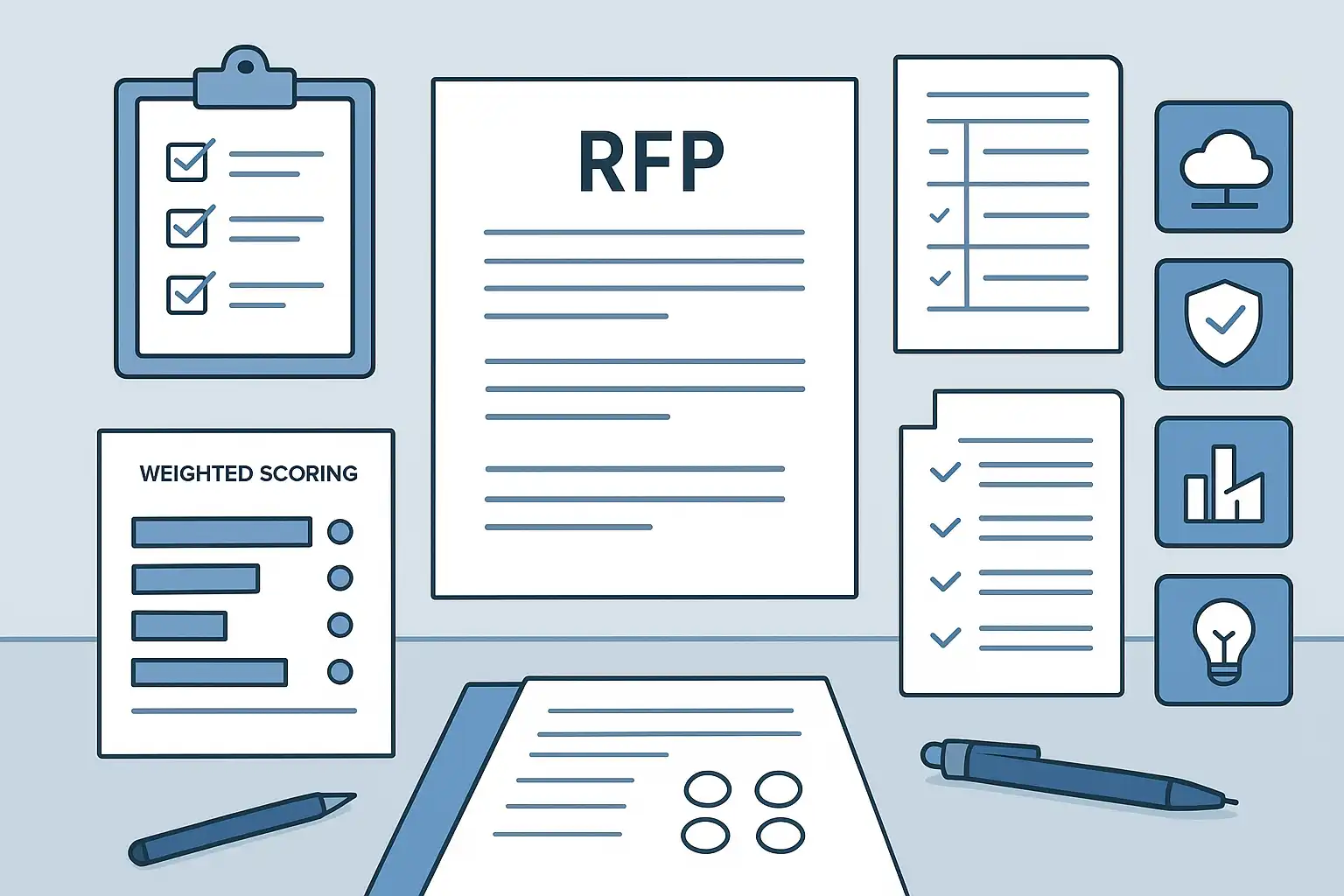
If your business needs to find a reliable data science partner, knowing what to include in your data science service provider RFP template is essential. The right criteria let you quickly shortlist vendors that meet your technology, industry, and business needs. In this guide, we’ll break down the exact RFP requirements and best practices for evaluating potential data science service providers—so you can confidently choose the best match for your project.
What are the critical RFP criteria for shortlisting data science providers?
The most effective data science service provider RFP template focuses on clear, measurable criteria across three main areas: technical skills, relevant experience, and alignment with your business goals. Right from the start, you should:
- Outline your project’s technical requirements
- Request clear examples of relevant experience from providers
- Describe your organizational objectives and expectations
- Set priorities using weighted scoring (e.g., 25% for technical expertise)
- Include security, compliance, and innovation as evaluation factors
By following this structure, your RFP helps focus your selection process and makes it easier to compare vendors on what matters most.
Technical expertise and capability
A solid RFP must evaluate a provider’s technical strength. Essential criteria include the ability to deliver on your defined technical needs, such as specific machine learning algorithms, cloud infrastructure, or analytics dashboards. Include closed, direct questions to assess:
- Core data science services (data engineering, model building, AI/ML, dashboards)
- Tools, programming languages, and platforms used—like Python, R, TensorFlow, or Azure
- Security and compliance processes, especially for regulated industries
- Ability to scale solutions and maintain them over time
Assigning a significant score (for example, 25%) to technical expertise ensures it weighs heavily in your shortlist decision. During RFP evaluation, focus on how each provider addresses your core technology challenges and safeguards your sensitive data.
Relevant experience and industry knowledge
Service providers with direct experience in your domain are far likelier to succeed. Structure your RFP to collect:
- Case studies or references from similar projects or industries
- Vendor experience in comparable project sizes and complexities
- Certifications and ongoing staff training in relevant technologies
Some companies use a two-step approach—initial screening for dealbreaker experience, then detailed evaluation for those passing the first round. This approach, combined with a weighted scoring RFP template for data science vendors, helps ensure only qualified partners move forward.
Business alignment and cultural fit
Technical skills alone aren’t enough. The best partner understands your goals, values, and pace. Use your RFP template to request:
- A project approach that meets business-defined needs
- Plans for scalability and innovation (how they can support growth or new ideas)
- Evidence of cultural fit—values, communication style, and working methods
Be transparent about your priorities, sharing the weighted scoring or what matters most to your team. This helps vendors tailor their proposals and lets you focus the evaluation on what will make the partnership successful.

How do you evaluate technical expertise in a data science RFP?
Evaluating technical expertise is about more than just checking a list of skills. Start by clearly stating your technical requirements in your data science service provider RFP template. For each vendor, score their:
- Responses to technical questions—are they specific, practical, and relevant?
- Details on the technologies and frameworks they use
- Approach to data security and compliance standards
- Team members’ expertise and certifications
Companies often score these sections heavily—as much as 25% of the total—because technical capability is the foundation for a successful project. You can use a simple scoring rubric, assigning high points for clear answers and lower scores for vague or outdated approaches.
It’s also helpful to request proof in the form of sample code, architecture diagrams, or descriptions of recent solutions. Many organizations that have used a well-designed RFP process report fewer project failures and smoother onboarding.
Which RFP criteria ensure business alignment when choosing a provider?
Shortlisting the right data science provider means choosing someone who can understand your larger strategy—not just deliver code. Prioritize these criteria:
- Business capabilities: Does the provider have a history of solving your kind of problem? Can they customize solutions to fit existing workflows or unique business needs?
- Scalability and innovation: Will their solution grow with you? Are they proactive about suggesting new data-driven approaches?
- Cultural fit and communication: Do they match your organization’s style? How transparent and responsive are they?
- ROI and value: Are they focused on delivering long-term value, not just the lowest price?
Assigning higher weights to these in your scoring template ensures vendors take business priorities seriously. Stakeholders from across your company—IT, business units, data owners—should be part of the scoring process to reflect all interests.
Real-world examples and brands to consider
Several brands successfully use RFPs to shortlist vendors, including major retailers seeking AI-powered recommendations, banks implementing fraud detection, and logistics firms optimizing their supply chains. For example, a bank may require a provider to be up-to-date with financial industry compliance, while a retailer might prioritize innovation and fast time-to-market. In each scenario, using clear RFP evaluation criteria helps ensure providers not only have the required technology but also understand business goals and risks.
When designing your own RFP, studying common industry data science service models can highlight which technical and soft skills are most critical for your field.
How can you structure the evaluation process for better shortlisting?
Structuring your RFP evaluation improves fairness and saves time. Many teams combine a pass/fail screening for basic requirements (like must-have certifications or sector experience) with a detailed, weighted scoring system for more nuanced needs.
For instance, companies seeking to enhance their data-driven strategies often incorporate data science workflow knowledge as a key selection criterion, as this signals maturity and ability to operate at scale.
| Criteria | Weight (%) |
|---|---|
| Technical Expertise | 25 |
| Relevant Experience | 20 |
| Business Alignment | 30 |
| Security & Compliance | 15 |
| Cost/ROI | 10 |
After initial scoring, it’s common to conduct interviews or request demos for top contenders. Including specific KPIs in your RFP, such as expected accuracy or timeline, also helps you assess whether a provider’s claims are realistic. Throughout, ensure all decision-makers understand the scoring approach and have a say in the final shortlist.
Common pitfalls and how to avoid them
- Being too vague in requirements—leads to irrelevant proposals
- Overemphasizing cost at the expense of quality and long-term value
- Skipping references or not checking past project outcomes
- Not considering change management and cultural fit
Learning from past Data Science Challenges will help refine your evaluation template and improve results in every new RFP.

FAQ
How does weighted scoring work in a data science RFP?
Weighted scoring lets you assign different levels of importance to categories like technical expertise, experience, business fit, or security. For example, technical criteria might be 25% of your overall score, while cost is 10%. This approach makes your evaluation transparent and prioritizes what matters most to your organization. It’s especially useful when comparing vendors who excel in different areas.
What questions should I ask about security and compliance?
Always ask about data protection measures, compliance with industry standards like GDPR or HIPAA, and how the provider manages sensitive data. You might request descriptions of recent security audits, certifications (such as ISO 27001), or examples of compliance with sector regulations. This is critical in healthcare, finance, or other regulated environments.
Should I request a proof of concept before final selection?
Yes, a proof of concept (POC) can be a valuable step. It allows you to see how the provider’s team works and whether their solution meets your actual needs. Many companies include POCs in their RFP process, especially for high-value or complex projects. The POC should have clear goals, timelines, and evaluation criteria.
What role does team augmentation play in RFP evaluations?
Team augmentation, where outside experts work alongside your employees, can be vital for project success. Some RFPs include questions on data science team augmentation capabilities, such as how providers integrate with in-house teams or transfer knowledge. This is especially important for organizations seeking to build long-term data science capacity.