
When it comes to getting real results from data science initiatives, having the right process in place makes an enormous difference. Data science project management methodologies give teams the structure and adaptability needed to move from raw data to valuable business insights — often with less risk, more transparency, and improved outcomes. In this article, we’ll answer the core question: which data science project management methodologies actually work, and how should you choose the right one for your needs?
What are the best data science project management methodologies?
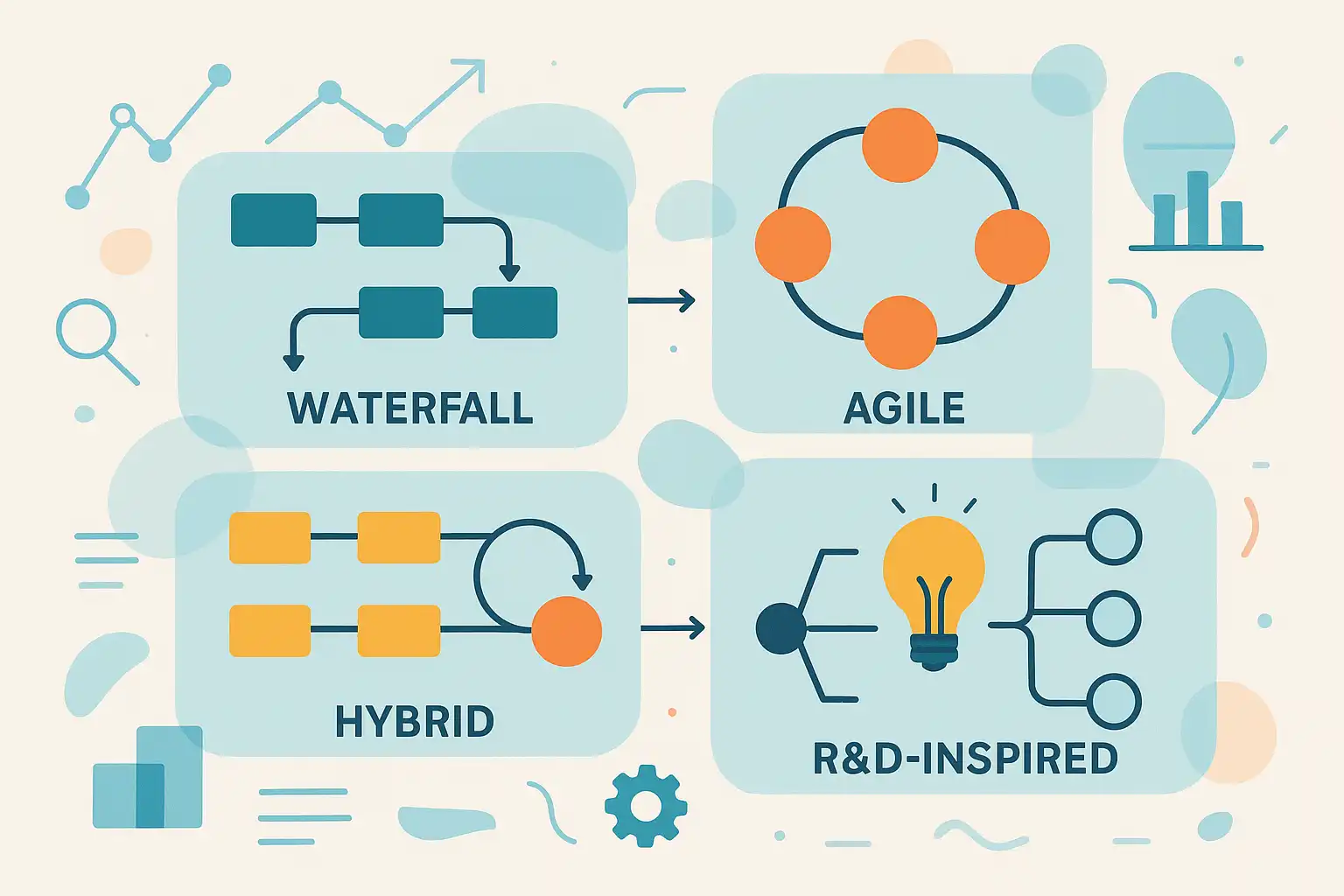
Several proven methodologies can help you manage data science projects smoothly, even when dealing with messy data, shifting goals, and evolving business needs. The most effective data science project management methodologies include:
- Waterfall: A sequential, phase-by-phase approach good for well-defined projects with clear requirements.
- Agile: A flexible, iterative model ideal for projects with evolving goals, enabling rapid feedback and adjustment.
- Hybrid: A blend of Waterfall and Agile, providing both structure and adaptability where it’s most needed.
- Research & Development (R&D)-Inspired: Focuses on exploration, iteration, and innovation, perfect for open-ended or experimental projects.
Choosing among these depends on project complexity, company preferences, and the amount of certainty or change you expect along the way. Let’s break these down to see how they work in practical settings.

How do different methodologies address common data science project challenges?
Data science projects often face unique challenges: shifting requirements, unclear goals, experimental approaches, and integration hurdles. The best data science project management methodologies are designed to help you overcome these. For example, the Waterfall method reduces ambiguity by following a strict sequence of steps. In contrast, Agile makes it easier to adapt as new information comes to light, while Hybrid approaches help balance rigorous planning with needed flexibility. The R&D-inspired model keeps teams open to creative exploration and change.
To understand how each methodology deals with challenges, consider the following table:
| Methodology | Main Strength | Common Use Case | Key Limitation |
|---|---|---|---|
| Waterfall | Clear structure, predictability | Projects with known requirements, regulated domains | Limited flexibility, not ideal for iterative work |
| Agile | Adaptable, promotes fast feedback | Projects with evolving data, changing objectives | Can feel chaotic without good communication |
| Hybrid | Mix of rigor and flexibility | Complex projects needing both planning and adjustment | Needs careful customization; can be hard to manage |
| R&D-Inspired | Supports creativity, exploration | Innovative or research-heavy projects | Less predictable timelines, flexible scope |
If your project is highly experimental, with goals likely to evolve, Agile or R&D-like approaches are a great fit. For compliance-driven efforts or projects with tight specifications, Waterfall may be the safest choice.
What does the typical data science project lifecycle look like?
No matter which methodology you choose, almost every data science project follows a set of core steps. Understanding the data science project lifecycle helps clarify where methodologies fit in:
- Problem Definition: Clearly stating the business or research problem.
- Data Collection: Gathering raw data from relevant sources.
- Data Preparation: Cleaning, transforming, and organizing data for analysis.
- Exploratory Data Analysis (EDA): Understanding the data’s features, distributions, and relationships.
- Modeling: Choosing, building, and training models appropriate for the task.
- Validation: Testing model performance and generalizability.
- Deployment: Integrating models into production systems or business workflows.
- Monitoring & Maintenance: Tracking model performance and updating as needed.
Some teams follow these steps in order (Waterfall), while others loop back as they learn (Agile, R&D-Inspired). Regardless of method, a well-defined workflow helps reduce wasted effort. If you want a deeper dive into organizing these steps, you can explore our data science workflow guide.
How does Agile improve data science project management?
Agile is popular in software development, but its principles also work well for data science. Agile encourages frequent feedback, continuous delivery, and flexibility; this makes it ideal for data science projects where requirements might change as new insights emerge.
For instance, the Scrum framework, which is widely used in Agile, divides work into “sprints” — short cycles of focused activity with clear goals. This allows data science teams to repeatedly test models, adjust direction based on what they learn, and demonstrate progress to stakeholders quickly.
Agile also empowers teams to:
- Break large tasks into smaller pieces;
- Collaborate closely with business owners;
- Quickly iterate on data cleaning, feature engineering, or modeling steps;
- Respond to feedback and update priorities on the fly.
This approach reduces surprises late in the project and ensures that the team’s work stays in sync with business needs. In organizations where new data or changing requirements are the norm, Agile often leads to better, faster results and helps teams avoid wasted effort on solutions that no longer fit the problem.

When is Waterfall a better choice for managing data science projects?
Despite its reputation for being rigid, Waterfall can be useful for certain data science projects. It works best when:
- Requirements and success criteria are clear from the start;
- Data sources and formats are stable;
- There’s little need for major changes after work begins;
- Compliance or regulatory standards require documentation and traceability.
In Waterfall, each phase (requirements, design, implementation, validation, deployment) happens in strict order. Teams only move to the next phase when the previous phase is finished. This reduces ambiguity and helps keep projects organized — but it isn’t well-suited for projects that require lots of experimentation or unexpected changes.
As an example, if a bank needs an anti-fraud model based on well-understood transaction data, and the regulatory requirements are strict, a Waterfall approach ensures every step is reviewed, documented, and auditable. However, if the project’s goals are still evolving, or you anticipate a lot of data wrangling, Waterfall might slow progress.
What is a hybrid project management approach in data science?
Many real-world teams combine elements of Agile and Waterfall to get the best of both worlds. This hybrid approach gives them the structure of Waterfall in areas where things are clearly defined (like compliance or end-user requirements), but also lets them use Agile loops for experimentation, development, and iterative improvements.
For example, a hybrid project might begin with a clear Waterfall-style requirements phase, then switch into Agile sprints for model prototyping, before returning to Waterfall for deployment and documentation. This way, teams can plan thoughtfully while still remaining flexible.
Choosing a hybrid data science project management approach makes sense for:
- Large organizations working on projects that must meet both business and technical milestones;
- Teams wanting to balance predictability with innovation;
- Projects with a mix of known and evolving requirements;
- Environments where multiple stakeholders have varying needs.
Hybrid methods are not one-size-fits-all. They require customization to match the company’s culture, tools, and goals. But with the right planning, they can offer an efficient mix of certainty and adaptability.
How do R&D-inspired methodologies foster innovation in data science?
Many breakthrough data science projects succeed because the team is allowed to explore, experiment, and learn as they go. R&D-inspired methodologies put innovation front and center. Rather than sticking to a fixed plan, teams using this approach define cycles of discovery, prototyping, and testing, allowing for frequent course corrections.
Key features of R&D-inspired approaches include:
- Open problem definitions and flexible goals;
- Cycles of idea generation, experimentation, and review;
- Acceptance of “failure” as part of the learning process;
- Regular sharing of results within and across teams.
This approach is perfect for situations where the solution is unknown at the start. For example, tackling a novel machine learning challenge or exploring new ways to use data for business benefit. While less predictable, R&D cycles help prevent teams from settling too early on suboptimal models and can drive long-term breakthroughs.
What role do tools and team structure play in successful project management?
Methodology alone doesn’t guarantee success. The tools you use and the way you build your team also have a big impact on project outcomes. For example, project management platforms like Jira, Trello, or Asana help teams track tasks and communicate. Data science platforms such as Databricks, DataRobot, or MLflow can streamline experimentation, version control, and deployment.
Equally important is making sure the right people are involved. This usually includes data scientists, business analysts, domain experts, and IT or engineering staff. Some companies go one step further with data science team augmentation, temporarily expanding capacity or bringing in expertise when the project demands it. The most effective teams meet regularly, share progress openly, and adjust roles as the project evolves.
How to choose the right data science project management methodology?
There’s no universal answer to which methodology you should use. Instead, it’s best to assess:
- The clarity of the problem and requirements;
- The stability of your data sources;
- The expected need for experimentation;
- Compliance, security, or regulatory needs;
- Your team’s size, skill set, and preferred work style.
If your project has well-understood goals, a Waterfall approach can work. For situations where learning and adapting are key, Agile or R&D methods excel. Hybrid models help when you need to meet fixed deliverables but want flexibility in development. In all cases, focus on communication, transparency, and aligned expectations.
Benefits and drawbacks of each methodology
- Waterfall: Easy to manage with defined steps, but lacks flexibility.
- Agile: Highly responsive, but requires discipline and stakeholder involvement.
- Hybrid: Customized balance, but can be complex to coordinate.
- R&D-Inspired: Most creative, but least predictable in schedule and outcome.
Real-world experience shows that the best data science project management methodologies are the ones that fit your unique context. Teams may even adapt their methodology for each phase as needs change over time.
How does project management methodology affect business alignment?
One of the main reasons data science projects fail isn’t technical, but a lack of alignment with business strategy. The best methodologies ensure regular communication between data scientists and business owners, so technical progress is always tied to organizational goals.
For instance, Agile’s regular sprints and demos make it easier to show progress and get feedback quickly, avoiding misunderstandings. Waterfall’s detailed planning ensures everyone agrees on deliverables up front. Hybrid models help balance short-term feedback with long-term planning. R&D-inspired approaches encourage blue-sky thinking but require strong check-ins to stay connected to business priorities.
Keeping strategy front and center is critical. To learn more about aligning projects to business outcomes, read our piece on data strategy alignment.
Examples: Applying methodologies to real data science problems
To see these methodologies in action, let’s look at some real-world scenarios:
- Predicting customer churn: A retail company wants to identify at-risk customers. They have clear goals but messy data. The team uses an Agile approach, iteratively refining features and models, presenting results to marketing at each sprint. Quick feedback helps them test different hypotheses and improve accuracy over time.
- Implementing a fraud detection system: A bank must follow strict regulatory rules and deliver detailed documentation. They choose Waterfall, with extensive upfront requirements gathering and step-by-step progress. Compliance teams review at every major milestone, ensuring nothing slips through the cracks.
- Developing a new product using sensor data: An engineering firm is exploring novel uses for IoT data with no set outcome in mind. Here, an R&D-inspired approach supports open-ended exploration, rapid prototyping, and frequent sharing of learnings. After promising results, they shift to a Hybrid model for productization and integration.
- Solving industry-specific analytics challenges: In sectors like healthcare or logistics, projects face domain-specific roadblocks and evolving requirements. Teams blend Hybrid and Agile practices, adjusting methodology as business context changes. For more on unique hurdles and practical solutions, our article on Data Science Challenges offers further insights.
Across all these scenarios, success hinges on picking — and adapting — the right methodology for each phase, communicating consistently, and staying open to change as new needs and data arise.
Why is overcoming challenges in data science project delivery important?
Data science projects are famous for encountering unexpected hurdles: missing data, shifting goals, or unproven algorithms. Good project management methodologies help teams anticipate risks, manage uncertainty, and keep progress visible. They also create space for experimentation, innovation, and learning from mistakes, which are all essential to uncovering valuable insights.
The common thread in all effective data science project management methodologies is their ability to provide just enough structure to keep teams focused — without stifling creativity or adaptability. That balance is what sets successful projects apart from those that stall or miss their targets.
FAQ
How do I decide if Agile or Waterfall is better for my data science project?
The right choice depends on how clearly you can define your project’s requirements at the start. Agile suits projects where requirements might change or where learning happens during the process. Waterfall fits better when everything is known from the beginning — like in regulated industries or when working with fixed data sets. Evaluate your project’s goals, data stability, and stakeholder needs before deciding.
What pitfalls can occur if I pick the wrong methodology?
If your methodology doesn’t match your project’s needs, you could face wasted effort, miscommunication, missed deadlines, or solutions that no longer address the real problem. For example, using Waterfall in a highly experimental setting might slow you down, while being too loose with Agile could lead to scope creep. It’s wise to monitor your progress regularly and adjust your approach when you spot trouble.
Is it common to change methodologies during a project?
Yes, especially in data science, it’s normal to adjust methodologies as you learn more about your data and your goals. Teams might start with an exploratory (R&D) approach, switch to Agile for prototyping, and then adopt Waterfall for deployment and compliance. Flexibility is key — just be sure to communicate changes to your team and stakeholders for continued alignment.
How can I ensure business stakeholders stay involved during a data science project?
Include them in regular reviews, demos, and planning sessions, regardless of methodology. Agile naturally supports ongoing engagement through frequent check-ins and short cycles. Even with Waterfall, it’s important to update stakeholders at key milestones and make sure their feedback drives your next steps. Keeping communication open helps ensure the final product meets real business needs.