
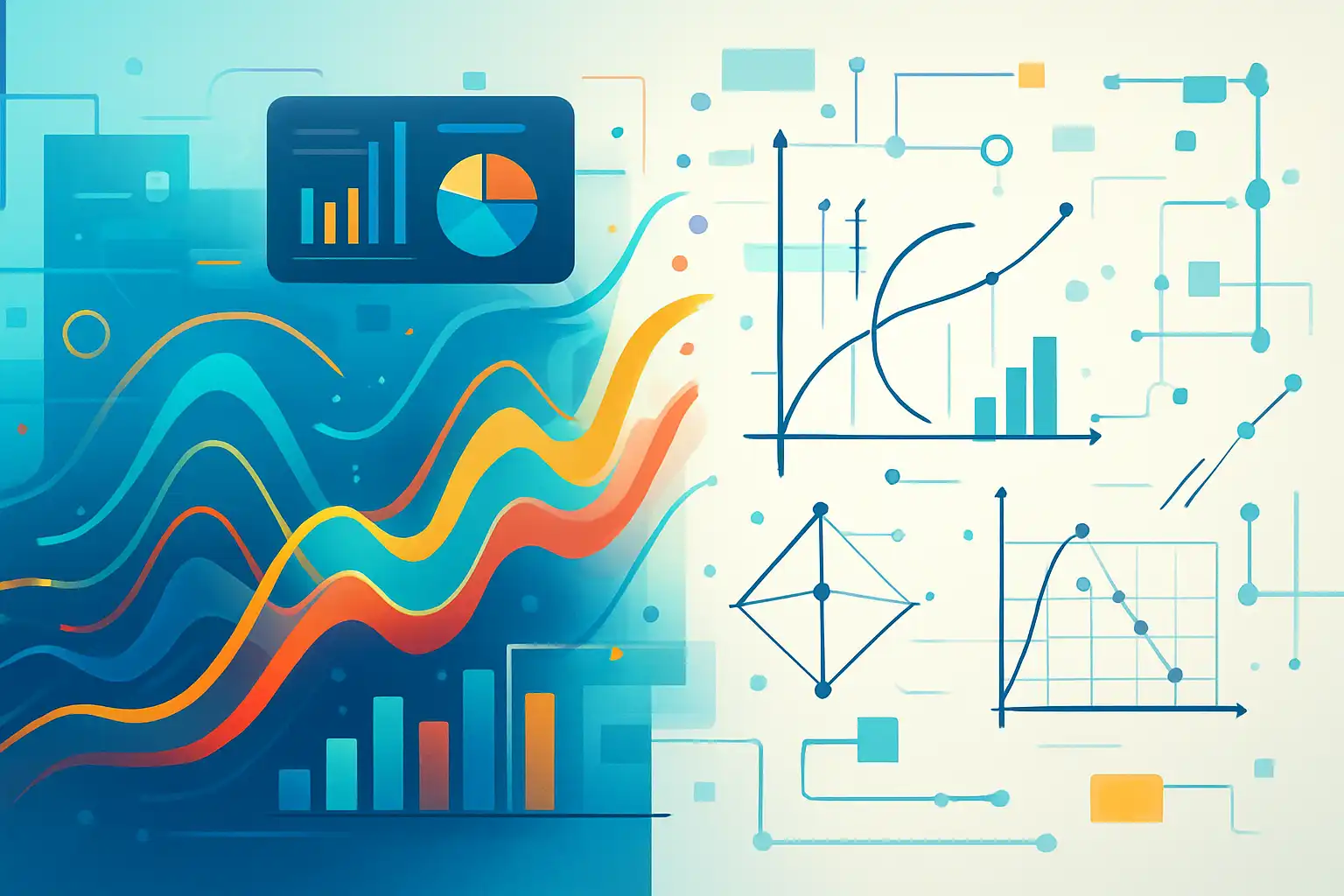
If you’ve wondered about data analytics vs statistics, you’re not alone. Both fields deal with extracting meaning from data, but their methods and end goals are quite distinct. In a nutshell, data analytics focuses on exploring and finding patterns to guide business decisions quickly, while statistics centers on confirming those findings with scientific rigor. Let’s break down these differences and see how they play out in real-world scenarios.
What are the main differences between data analytics and statistics?
Although data analytics and statistics often overlap, they approach data with unique mindsets and tools. Data analytics is about sifting through large data sets to spot trends, patterns, or anomalies. It is less about mathematical proofs and more about practical, actionable insights. The questions data analytics asks are often, “What’s happening? Why is it happening? What will happen next?”
Statistics, however, brings in scientific discipline. It validates whether the patterns seen by analysts are genuinely meaningful or could have happened by chance. Statisticians carefully design experiments or sampling methods, conduct hypothesis tests, and estimate confidence intervals to ensure findings stand up to scrutiny.
In other words, analytics is the creative explorer—curious, fast, and ready to guide action. Statistics is the careful gatekeeper—testing, validating, and safeguarding against mistakes like confusing correlation with causation.
How do the goals of data analytics differ from statistics?
Data analytics aims to help organizations respond to challenges and opportunities by digesting information rapidly. Imagine a retailer tracking sales, a hospital monitoring patient outcomes, or a city planning transport routes. Analysts want to spot changes early, understand what’s causing them, and suggest practical next steps. Their work is often broad and collaborative, involving teams across different departments.
Statistics, in contrast, has the goal of providing scientific rigor. After patterns or issues are found, statisticians step in to check if these discoveries are valid. Is an observed trend truly significant, or just random noise? Does a new product really improve customer satisfaction, or are we being misled by biased data? Statisticians rely on formal mathematical models and rules to answer such questions. Their work is sometimes independent but often happens on high-stakes or complex projects where trust in results is critical.
The two fields complement each other. Data analytics is about speed and breadth; statistics is about depth and certainty. Both are essential to making the right decisions, but they approach the problems in distinct ways.

What does a typical workflow look like in each field?
Let’s look at how a project unfolds in data analytics and statistics:
- Data Analytics: The process often starts with gathering data from multiple sources—databases, sensor feeds, even social media. Analysts clean and organize the data, prepare dashboards or charts, and look for emerging patterns. They use descriptive, diagnostic, predictive, and prescriptive analytics to guide decisions. For example, a team might notice sales falling in a region and quickly visualize the data to identify possible causes.
- Statistics: Here, the workflow is more structured. Statisticians define a hypothesis—for instance, “Did a new marketing campaign boost retention?”—and select appropriate sampling or experimental methods. They gather or curate data, deal with outliers, and carefully summarize the data (reporting the mean, median, or mode as appropriate). Next come hypothesis tests, confidence intervals, and other formal checks to validate results.
For those seeking a practical overview of each step, resources like the data science workflow can bridge the gap between instant insights and statistical discipline.
Which methods set data analytics apart from statistics?
Data analytics often leans on modern computing tools to quickly handle and visualize large data sets. Techniques include data mining, clustering, decision trees, and machine learning models. These methods allow for rapid experimentation and uncovering patterns that are not always immediately obvious.
Statistics, meanwhile, is rooted in probability theory and mathematical rigor. Core techniques include:
- Hypothesis testing
- Regression analysis
- Analysis of variance (ANOVA)
- Confidence intervals and p-values
Although data analytics may use statistical methods, its emphasis is on speed, clarity, and business application. For example, analysts might use correlation detection tools to spot relationships and immediately share results with decision-makers. Statisticians, however, will circle back to check for confounding factors or biases that might mislead conclusions.
How are data analytics and statistics used for real-world problem solving?
In business, insights gained from data analytics can swiftly highlight trends—like shifts in customer demand or areas of product improvement. A team might notice a sudden drop in website engagement and use analytics tools to visualize user paths and identify friction points. These insights help guide immediate changes in strategy or operations.
Statistics then enters the scene to ensure the changes are based on sound reasoning. For instance, before rolling out a new feature to all users, a statistician might design an A/B test. This involves dividing users into groups (one getting the new feature, one not) and using statistical tests to see if the feature has a real effect.
Organizations also rely on statisticians to assist in handling outliers—unusual data points that could distort results—and to summarize key characteristics of a data set. Their work is vital in sectors like healthcare, finance, and scientific research, where the cost of acting on incorrect conclusions can be high.
Examples in business and beyond
Consider a small retail business hoping to grow. Data analytics allows the team to monitor sales in real time, track inventory across stores, and forecast demand for different products. These rapid insights inform decisions about promotions or stock levels. In fact, adopting small‑business analytics can be the difference between thriving and merely surviving in a competitive market.
Meanwhile, statistics ensures that the team’s insights are solid before making big investments. If data shows a sharp uptick in a product’s popularity, a statistician will confirm whether the trend is significant or just a fluke. This two-pronged approach—fast analytics paired with careful validation—maximizes both speed and accuracy.
Why is statistical validation important in data analytics?
It’s easy to draw the wrong conclusions from data, especially when dealing with vast quantities and many variables. For example, a company might spot a correlation between ad spend and sales, but without statistical testing, they could mistake coincidence for causation. This can lead to wasted resources or missed opportunities.
Statistical validation acts as a quality control step. By applying techniques like hypothesis testing, statisticians can determine if findings are truly significant or could have happened by chance. This prevents costly errors and boosts stakeholder confidence in the results.
Preventing common pitfalls
Without statistical checks, teams risk misinterpreting patterns. For instance, an apparent increase in customer satisfaction after a policy change might actually be due to seasonal trends, not the policy itself. Statisticians help control for these issues, ensuring organizations make decisions based on evidence rather than assumption.
Additionally, when launching new data-driven initiatives, aligning teams around a common language and clear data goals is essential. Approaches like data strategy alignment help keep analytics efforts tied to real business objectives, maximizing value across departments.
How do roles and teams differ between data analytics and statistics?
Data analytics typically involves a broad range of roles—data engineers, business analysts, and visualization specialists—spread across departments. These roles focus on gathering, cleaning, and interpreting data for a variety of business needs. Fast communication and responsive decision-making are key, especially in dynamic industries.
Statisticians, however, are usually fewer and often centralized. Their expertise is deeper in mathematics and theory, and they are commonly pulled in for significant projects or when quality control is critical. Statisticians might spend more time designing experiments, vetting data quality, and documenting assumptions.
In many organizations, the interplay between analytics and statistics creates a powerful combination: analytics generates ideas and opportunities; statistics tests and refines them. For particularly tough challenges, teams may seek out Expert Data Analytics Solutions to blend these strengths and solve complex problems.

Data analytics vs statistics: What should you choose for your organization?
Choosing between data analytics vs statistics depends on your needs. If you want to explore new markets, understand customer behavior, or quickly react to changes, analytics gives you speed and flexibility. If your goal is to make high-stakes decisions—like investing in new products, evaluating treatment effects in healthcare, or testing scientific theories—statistics is essential for reliable, validated results.
Most organizations benefit from using both in tandem. Analytics lets you see the big picture and move fast; statistics gives confidence that your next step is the right one. Building teams with skills from both domains strengthens your ability to adapt, grow, and stay ahead of the competition.
Your questions on data analytics vs statistics answered
- Can you apply data analytics without statistics?
Yes, but it carries risks. Analytics alone can provide useful insights quickly, but without statistical validation, there’s a higher chance of acting on misleading patterns. For best results, combine both approaches—explore with analytics, then confirm findings with statistics. - Is statistics always more accurate than analytics?
Not necessarily. Statistics brings scientific rigor, but it relies on solid data and proper methods. If the data is biased, incomplete, or not well-understood, even statistical approaches can reach faulty conclusions. Collaboration between analysts and statisticians helps ensure both accuracy and relevance. - How do teams typically work together?
Analysts usually identify problems or opportunities through data exploration. Statisticians join in to test these findings, especially when big investments or public decisions are at stake. Strong teamwork and clear communication are essential for success. - What tools do each use?
Data analytics often relies on platforms like Tableau, Power BI, Python, or R for visualization and analysis. Statistics may use similar tools but focuses more on packages for hypothesis testing and modeling, such as SPSS, Stata, or specialized functions in R and Python.
In summary, data analytics vs statistics isn’t about picking winners—it’s about combining the practical, speedy insights from analytics with the trustworthy, tested conclusions from statistics. Together, these fields empower organizations to make smart decisions, adapt quickly, and innovate with confidence.