
LLM Inference at Scale: GPU Capacity, Latency and Model Serving Decisions
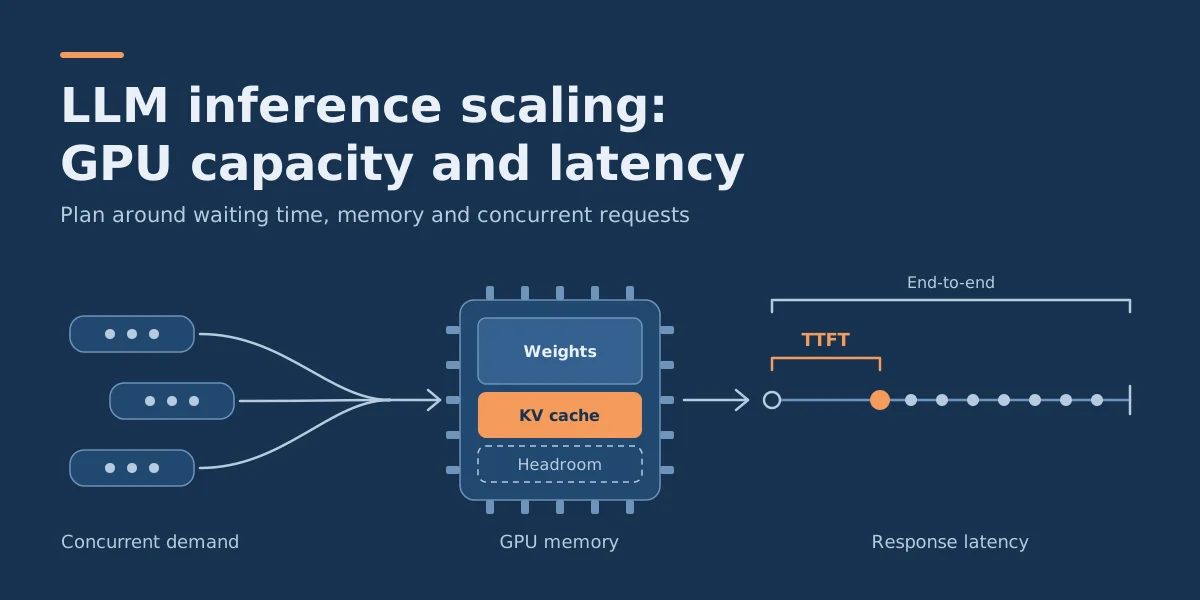
Running a language model on a GPU proves that inference is possible. It does not tell a product team how many users the system can support, how long they will wait for a response or how much the workload will cost when traffic changes. Those questions depend on the length of each request, the amount of generated text, concurrent demand and the way the serving system schedules work.
This is why LLM inference scaling should begin with a workload and a service-level target, not with a GPU shopping list. A model that feels fast during individual testing may respond differently when long conversations, image requests and concurrent sessions compete for resources. Optimising only for maximum tokens per second can also make the experience worse if users wait too long for the first word.
This article explains how to assess model-serving capacity, the memory and latency trade-offs behind it, and when self-managed inference is worth the operational responsibility. It draws on published inference research and the transferable lessons of an anonymised conversational AI engineering project, without presenting private deployment details or unpublished performance results.
The capacity question starts with the user’s waiting time
“How many requests can one GPU handle?” is an incomplete specification. A short classification response and a long conversational answer do not use the same amount of compute. A prompt containing a lengthy conversation history also behaves differently from a short standalone question. Even the same model can produce different latency and throughput under different concurrency levels.
For an interactive product, distinguish these measurements:
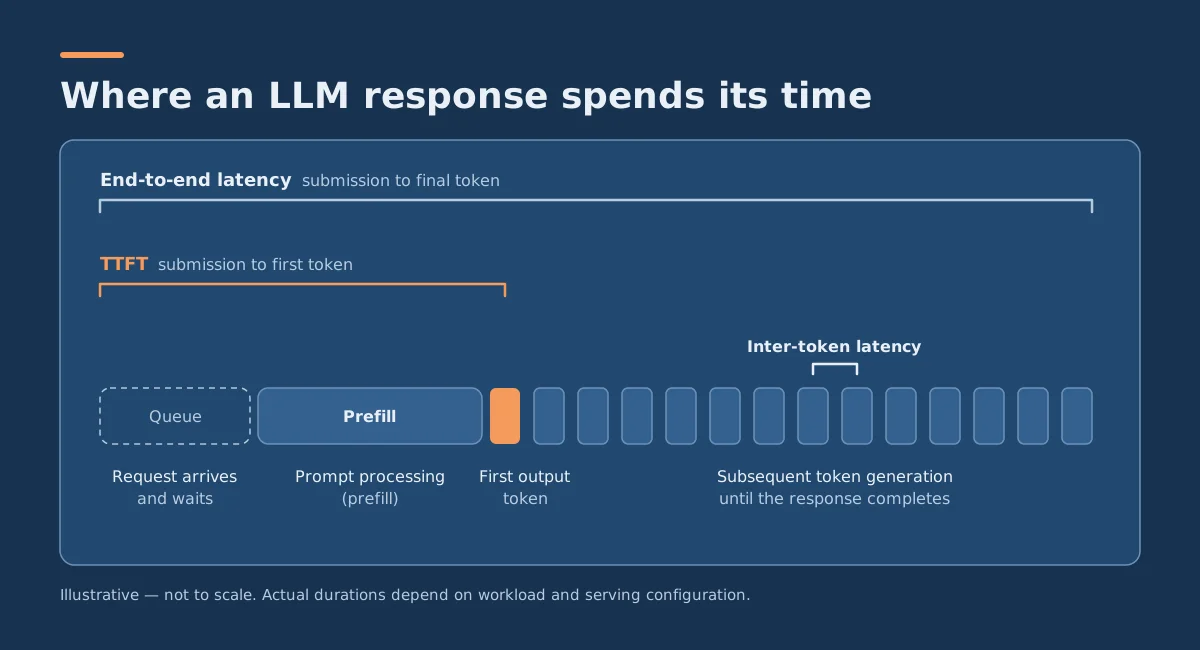
- Time to first token (TTFT): the time from submitting a request until the first non-empty generated token arrives. This affects whether a streaming response feels responsive.
- Inter-token latency (ITL): the time between output tokens after generation has begun. It influences how quickly the response continues to appear.
- End-to-end latency: the time between submitting the request and receiving the complete response.
- Request and token throughput: completed requests or processed tokens per unit of time. These describe capacity, not necessarily the experience of any individual user.
For consistent definitions, NVIDIA’s inference benchmarking documentation defines TTFT, inter-token latency and end-to-end latency, and explains that queueing, prefill and network time affect the first-token delay. It also cautions that measurements must be compared using aligned definitions.
A product team should choose objectives for at least the slow end of the distribution—such as a suitable percentile of TTFT and completed-response latency—rather than reporting only the mean. The exact target is a product decision: the tolerance of a voice interaction may differ from that of an asynchronous research task.
Describe the workload before selecting hardware
The first useful input to capacity planning is a small profile of real or representative requests. For each important user journey, record the distribution of input-token length, expected output length, arrival rate, concurrent sessions, and whether the user needs streaming. Include bursts rather than assuming every request arrives at a uniform rate.
| Workload characteristic | Why it changes the serving plan | What to measure |
|---|---|---|
| Input length | Longer prompts increase prefill work and consume attention-cache memory. | Median and high-percentile input tokens by workflow |
| Output length | Long generations keep requests active and use decode capacity. | Generated tokens and completed-response latency |
| Concurrent demand | Requests compete for scheduler capacity and memory. | Active requests, waiting requests and burst patterns |
| Interaction mode | Streaming chat, background analysis, image understanding and speech have different latency expectations. | Per-feature latency targets and workload mix |
| Failure tolerance | Some requests can wait or retry; others need an immediate fallback. | Timeout rate, abandonment and acceptable degradation |
For a new application without production traffic, build an explicitly labelled synthetic test set from expected user journeys and replace assumptions as observations arrive. Do not infer peak capacity by multiplying single-request speed by a guessed number of users. Benchmark at increasing arrival rates until the service no longer meets the agreed latency and error targets.
GPU memory: model weights are only the first line item
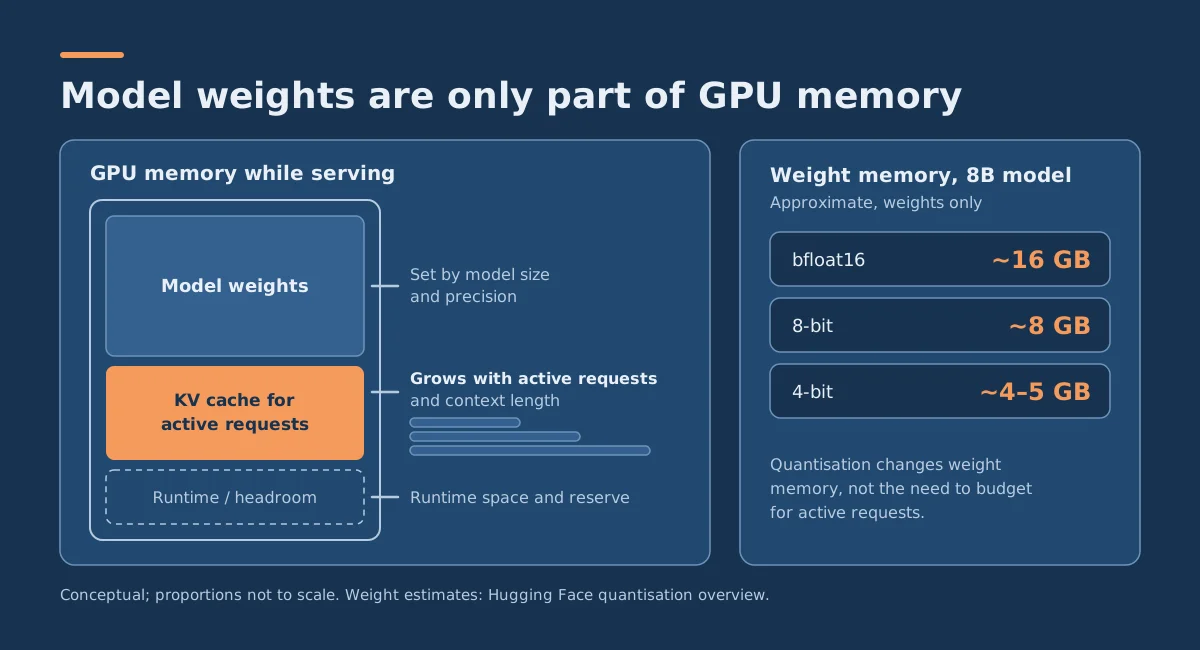
Model size is an important constraint, but the weight file alone does not determine required accelerator memory. Serving also needs space for runtime operations and the key-value (KV) cache that stores attention state as sequences are processed. The memory used by active requests therefore changes with context length and concurrency.
For a concrete public reference, Hugging Face’s quantisation overview estimates that an 8-billion-parameter model requires about 16 GB for weights in bfloat16, about 8 GB at 8-bit precision and roughly 4–5 GB at 4-bit precision. These figures describe approximate weight memory, not the GPU memory needed to serve that model under load.
Quantisation can make a model fit on hardware that could not accommodate the original weights. But it is not a free capacity upgrade. The same Hugging Face reference explains that lower-precision methods trade memory against speed and accuracy. The production choice should be checked against representative prompts, particularly edge cases where a small change in output quality matters.
KV-cache management is another major factor. In the peer-reviewed 2023 PagedAttention paper, the researchers reported 2–4 times higher serving throughput for their vLLM system than the comparison systems in the workloads they evaluated, at a similar latency level. The result supports the importance of efficient cache management; it is not a promise that adopting a particular serving engine will deliver the same gain for another model, machine or traffic pattern.
The practical test is to measure memory headroom and the number of simultaneously active requests at realistic context lengths. A model that fits into accelerator memory while idle may still run out of serving headroom under longer or more concurrent conversations.
Batching raises throughput, but can change responsiveness
Model servers can combine work from multiple requests to improve accelerator utilisation. In systems supporting continuous batching, requests can enter and leave active processing as generation progresses instead of waiting for a fixed batch to finish. That makes scheduling and memory use central parts of inference performance.
The vLLM project documentation describes continuous batching, PagedAttention and other serving techniques. The benefits still depend on the model, hardware, configuration and actual workload.
Higher concurrency may produce more aggregate tokens per second while individual users experience greater delay. A meaningful benchmark therefore plots throughput against latency at several load levels, using the same model, prompt-length distribution and output-length distribution for each candidate. NVIDIA’s published methodology for measuring generative-model performance discusses the trade-off between throughput and inter-token latency when serving requests concurrently.
There is no universal “best batch size” or safe requests-per-second number. The useful operating point is the highest workload the system can sustain while meeting the product’s latency, quality and failure requirements with enough reserve for bursts or routine maintenance.
Do not let every feature compete for the same capacity budget
As AI products expand beyond text generation, the demand on shared inference resources becomes less predictable. An image-understanding request may be more expensive than a short text response. Speech input and speech output may have their own models, dependency requirements and user-facing latency targets.
This does not mean every feature needs a separate GPU. It means the application should recognise separate workload classes and decide which ones can share capacity safely. Possible choices include separate request queues, workload-specific concurrency limits, different model endpoints or independent pools where measured contention warrants them.
For conversational products that combine modalities, DataColab’s article on private multimodal assistants covers ingestion, RAG and supporting capabilities. The present article addresses a different question: how to keep those capabilities within a predictable serving budget once real users begin making concurrent requests.
A simple experiment exposes contention: measure the text-only baseline, then repeat the test while injecting a realistic volume of media requests. If text TTFT or failure rates deteriorate, the team has evidence for a scheduling or resource-isolation decision. Without that experiment, adding hardware may conceal an avoidable coordination problem.
What an anonymised conversational AI project illustrated
In one conversational AI engineering engagement, a team moved beyond a single conversation loop to support additional model-backed capabilities. The documented work included self-managed language-model inference on rented accelerator resources, iterative model-serving changes, separate media and voice capabilities, and operational controls to respond to finite inference capacity.
Those elements were built as part of a wider application, with capacity and reliability addressed iteratively rather than as a one-time setup. The central lesson was that the model-serving choice could not be isolated from product design. Different capabilities placed different demands on shared resources, and operational recovery mattered alongside model quality.
That is a useful pattern for technical buyers evaluating a similar product. Ask not only whether a team can deploy a model, but whether it can explain the workload it expects, show how it measures contention and define what happens when a dependency slows down.
Should you self-manage inference or use a hosted API?
The two approaches solve different operational problems. A hosted model API moves much of accelerator provisioning and model serving to the provider. Self-managed inference can give a team more direct control over models and deployment, but the team then owns capacity planning, serving reliability, software maintenance and more of the security and operational work.
| Decision factor | Hosted model API | Self-managed inference |
|---|---|---|
| Time to initial experiment | Often faster when the model and terms meet the requirements | Requires serving setup, hardware access and monitoring |
| Traffic variability | Provider absorbs much of the infrastructure variation, subject to limits and terms | The team needs headroom, queueing, capacity changes or an agreed degraded mode |
| Model and runtime control | Restricted to supported models, features and provider controls | More freedom to choose models and serving software, with added maintenance |
| Cost structure | Often usage-based, with input/output usage and contract terms to assess | Compute reservation and utilisation, plus engineering and operations |
| Data handling | Depends on provider terms, region, retention and configuration | Depends on the team’s own hosting, access, security and retention practices |
| Failure responsibility | Provider incidents still require application-side handling | Infrastructure incidents and serving failures become part of the team’s remit |
Self-hosting does not automatically make an application private, compliant or cheaper. Likewise, a hosted API is not automatically unsuitable for sensitive workloads. Examine the specific provider agreement, data flow, infrastructure controls and application design before making those claims.
For a broader financial comparison of purchased and custom AI solutions, see DataColab’s build-or-buy ROI worksheet. An inference decision requires a narrower calculation based on model usage and service-level performance.
Calculate effective cost at an acceptable service level
Cost per token is meaningful only when the output quality and user experience are acceptable. A low apparent GPU-hour price can be misleading if the model rarely receives traffic or requires expensive operational support. A low API token price can be misleading if prompts are long, usage grows rapidly or the product makes frequent retries.
Use the same representative workload to estimate each option:
- Measure monthly input and output tokens by feature, including the long-context and peak-demand cases.
- For an API, apply the current supplier’s relevant pricing and contract terms to that usage. Include retries and any separate charges.
- For self-managed serving, estimate allocated accelerator hours, other hosting charges, deployment and monitoring costs, and the team’s maintenance work.
- Benchmark the self-managed option at the required concurrency. Do not treat theoretical maximum throughput as sustainably billable capacity.
- Divide each option’s total expected cost by the successfully completed requests meeting your quality and latency criteria. Compare like with like.
As a supplementary metric, effective cost per million generated tokens can be calculated as (total serving cost / generated tokens) × 1,000,000. State whether the numerator includes only compute or all operations. The metric does not replace cost per successfully served user interaction, especially when candidate models produce different output lengths or quality.
This makes the comparison useful for a purchasing decision: instead of asking which GPU or model is cheapest in isolation, ask which implementation meets the required experience at the lowest credible total cost, with a manageable operational burden.
A reproducible inference capacity test for technical buyers
Before approving a scaling plan, ask the engineering team or vendor to run a bounded test with documented inputs. The following evaluation template is intentionally not tied to a particular serving engine or GPU.
| Test | Evidence to request | Decision it informs |
|---|---|---|
| Single-user baseline | TTFT, inter-token latency and completed-response latency for representative requests | Whether the chosen model meets the basic interaction target |
| Load ramp | Latency percentiles, throughput and failures as concurrent load rises | Usable capacity rather than theoretical maximum speed |
| Long-context stress | Memory use, queue time and failures for high-percentile input lengths | Whether context growth changes the hardware or memory plan |
| Mixed-feature workload | Text latency while other supported capabilities run | Whether scheduling or resource isolation is necessary |
| Dependency degradation | User-visible behaviour when a model worker is slow or unavailable | Whether the application fails in a controlled way |
| Change regression | Same workload run before and after model, precision or serving-engine changes | Whether an optimisation helps without unacceptable quality loss |
Serving frameworks can expose relevant telemetry. For example, vLLM’s metrics reference documents measurements such as running and waiting requests, KV-cache usage, prompt and generation tokens, and time to first token. Exact metric availability varies by software version and configuration. Collect client-side measurements too: the user’s end-to-end experience can include network and application delays that a serving engine cannot see.
The final deliverable should be a short decision record: workload assumptions, test environment, results, accepted trade-offs, known uncertainties and the trigger for revisiting capacity. If traffic or model requirements change, rerun the same tests rather than relying indefinitely on a benchmark from launch day.
Choose a serving strategy you can test and operate
For a product team, the best inference architecture is not necessarily the one with the most sophisticated engine or the largest accelerator. It is the one that can serve the actual workload at acceptable quality, latency, reliability and cost—and that the team can maintain after launch.
Start by measuring the workload, compare hosted and self-managed options using the same criteria, and document the operating point where user experience begins to deteriorate. If you need help evaluating the engineering scope of a model-backed product, contact DataColab.