
Healthcare Data Solutions: Workflows, Governance and Outcomes Worth Measuring
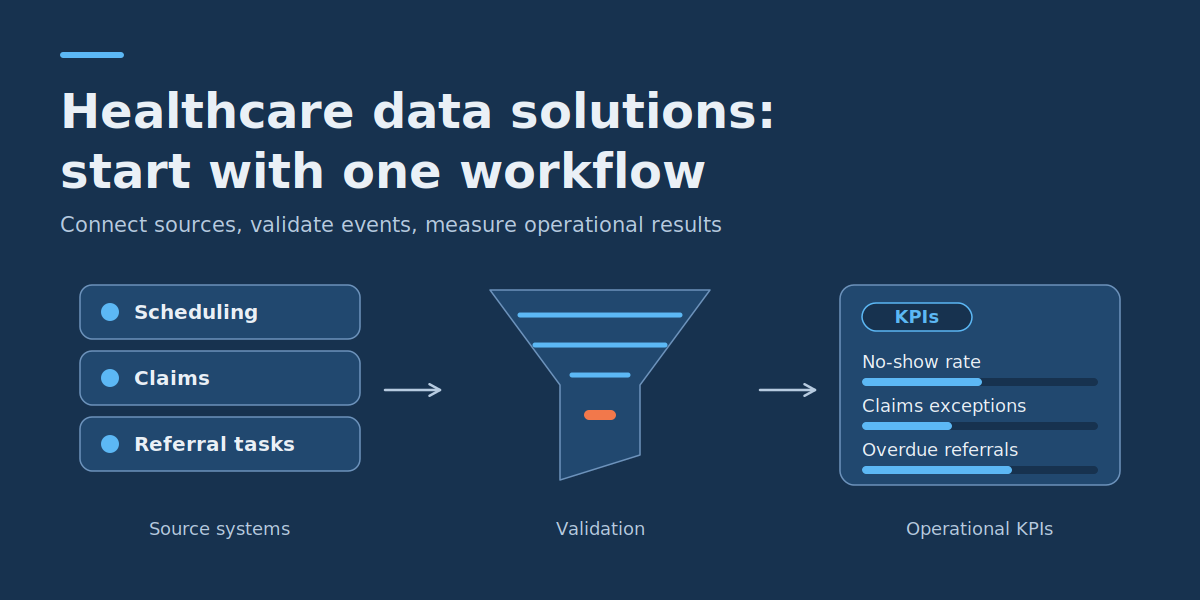
Healthcare data solutions help organizations connect information, monitor operational processes and make the right data available to authorized staff. They can support appointment scheduling, claims administration, care coordination and reporting. But successful implementation takes more than collecting records in a dashboard or adding automation.
Product and operations teams need to understand how information moves between systems, who may access it, which errors need human review and which operational results can be measured reliably. The most practical approach is to pick one workflow, define its inputs and controls, establish baseline performance and test whether the proposed solution improves the process without creating unacceptable privacy, security or operational risk.
What matters most when implementing healthcare data solutions?
- Start with a defined operational workflow. Scheduling delays, claims exceptions and care coordination tasks are concrete problems to investigate before investing in a broad analytics platform.
- Interoperability requires more than connecting APIs. Systems must exchange information with compatible meanings, identifiers, timestamps and authorization rules.
- Put data quality and access controls before automation. Incorrect record matching, incomplete events and excessive permissions can undermine the reliability and safety of a new workflow.
- Measure operational outcomes with clear denominators. No-show rates, claims exception rates and overdue referral tasks need consistent definitions and credible baselines.
- Separate operational improvements from clinical claims. Faster processing or fewer manual steps does not automatically demonstrate better patient health outcomes.
What are healthcare data solutions?
Healthcare data solutions are software systems, integrations and analytical capabilities used to collect, exchange, organize, validate and process information for healthcare-related activities.
They may support clinical information management, but not every healthcare data application is a clinical decision-support system. Many valuable projects focus on administrative and operational problems that do not require software to diagnose conditions or recommend treatment.
| Solution type | Primary function | Example application |
|---|---|---|
| Healthcare data integration | Exchange information between authorized systems. | Connect scheduling records to operational reporting. |
| Healthcare analytics | Calculate measures and investigate patterns. | Track appointment utilization and claims processing delays. |
| Workflow automation | Route tasks, update statuses and manage defined process steps. | Assign incomplete administrative submissions to a review queue. |
| Data governance | Control quality, ownership, permissions and permitted uses. | Restrict reporting access according to organizational roles. |
| Operational reporting | Provide consistent visibility into services and resources. | Show outstanding referral tasks or delayed billing submissions. |
| Applied AI and machine learning | Support narrowly defined prediction or classification tasks where justified. | Prioritize administrative exceptions for human review, subject to validation and oversight. |
These categories often overlap. A scheduling analytics project, for example, may need integration, data validation, access control and a reporting interface. Needing several capabilities does not mean the organization has to replace its entire technology environment.
Which healthcare data systems need to work together?
Healthcare organizations usually keep information across multiple applications with different purposes, data structures and owners. Before planning a new solution, identify which source system is authoritative for each required field.
Electronic health records and clinical systems
Electronic health record (EHR) or electronic patient record (EPR) platforms may hold encounters, observations, clinical documentation, orders and other information used in healthcare delivery.
Access often requires organizational agreements, vendor-supported interfaces and specific permissions. A technical integration should not collect more sensitive information than the intended workflow requires.
Scheduling and resource-management systems
Scheduling platforms may contain appointment dates, statuses, service locations, staff availability and resource allocations.
For an operational report on unused appointment slots, the team might need only appointment status, scheduled time and an organizational location identifier. Clinical notes and patient demographics may be unnecessary.
Claims and revenue-cycle systems
Claims platforms manage administrative and financial information about services, submissions, responses, exceptions and payments.
Different systems may represent submitted, rejected, denied, adjusted and paid claims differently. Preserve those distinctions in reporting rather than merging every unsuccessful claim event into one category.
Referral and care-coordination applications
Care operations may depend on referral systems, task queues, document exchanges and communication platforms.
Knowing whether a referral was received, assigned, acknowledged or completed supports workflow monitoring. But a referral marked complete in software does not prove that a patient received appropriate care or had a better health outcome.
Healthcare interoperability: why connecting systems is not enough
Interoperability means systems can exchange information and make it usable for the intended purpose. Establishing a connection is only one part of the problem. A successful integration must also address identifiers, data meaning, workflow states, version compatibility, security and error handling.
Where HL7 FHIR fits
HL7 FHIR (Fast Healthcare Interoperability Resources) is a standard for healthcare data exchange published by HL7. The specification organizes its content into modules, including exchange mechanisms such as a REST API with search, documents, messaging and subscriptions, plus separate modules for security and privacy, terminology and conformance.
FHIR also defines resources that map to the workflows in this article. Appointment, Schedule, Task and ServiceRequest (used for referrals) sit in the workflow module, Claim sits in the financial module, and AuditEvent sits in the security and privacy module. Patient, Location and Organization appear in the administration module, and Observation appears in diagnostics.
The current published release is R5, with earlier releases such as R4 and R4B still available, so the version a partner system supports matters. HL7 also points implementers to implementation guides, which are specifications built on top of FHIR. That is why FHIR does not automatically solve every interoperability problem: systems may use different versions, profiles, code systems or local guides, and an endpoint may restrict which resources, searches and operations a connected application can use.
Before choosing an integration architecture, ask:
- Which exact FHIR version and implementation guide does each system support?
- Which resources, fields and operations are available through its actual interface?
- Which terminology systems and local codes must be mapped?
- How are identifiers matched across sources?
- Which authentication, authorization and contractual requirements apply?
- How are changed, cancelled, duplicated or delayed events represented?
FHIR suits some exchanges, while other systems use different interface formats. Follow the interfaces your sources and destinations actually support rather than forcing every feed into an unnecessary conversion.
Patient matching and record identity
Record matching matters most when linking information across healthcare systems. Two records for the same person may carry different local identifiers, and similar demographic details do not prove two records belong to the same individual.
Integrations should not silently merge ambiguous patient records because names or dates look similar. Define matching requirements with the relevant healthcare organization and add controlled review procedures for uncertain matches.
When reporting does not need person-level information, avoid introducing patient identity matching at all. Aggregate operational measures can often be calculated from appointment, claim or task events alone.
A worked healthcare data flow using entirely synthetic, non-patient information
Consider an illustrative outpatient organization that wants to understand appointment usage, administrative claim exceptions and overdue referral tasks across its service locations.
It begins with an operational reporting solution. It does not try to automate clinical decisions or combine detailed medical histories. The example uses invented workflow-event identifiers and contains no patient names, dates of birth, addresses, clinical records or other real patient information.
Example data flow diagram
SCHEDULING SYSTEM       CLAIMS SYSTEM       REFERRAL TASK SYSTEM
        |                     |                      |
        +---------------------+----------------------+
                              |
                              v
                  AUTHORIZED DATA CONNECTORS
                  - Approved fields only
                  - Source-specific permissions
                  - Recorded extraction status
                              |
                              v
                    VALIDATION AND MAPPING
                  - Required-field checks
                  - Identifier consistency
                  - Status-code mappings
                  - Duplicate and late events
                              |
                   +----------+----------+
                   |                     |
                   v                     v
             ACCEPTED EVENTS      EXCEPTION QUEUE
                   |               - Missing fields
                   |               - Unknown codes
                   |               - Conflicts
                   |                     |
                   |                HUMAN REVIEW
                   v
              REPORTING DATA STORE
              - Controlled retention
              - Data freshness metadata
              - Authorized data access
                   |
                   v
              METRIC DEFINITIONS
              - Appointment no-show rate
              - Claims exception rate
              - Overdue referral tasks
                   |
                   v
              OPERATIONS DASHBOARD
              - Approved aggregated views
              - Role-based permissions
              - Drill-down only if authorized

Cross-cutting controls:
Access authorization | Audit logging | Monitoring | Incident response
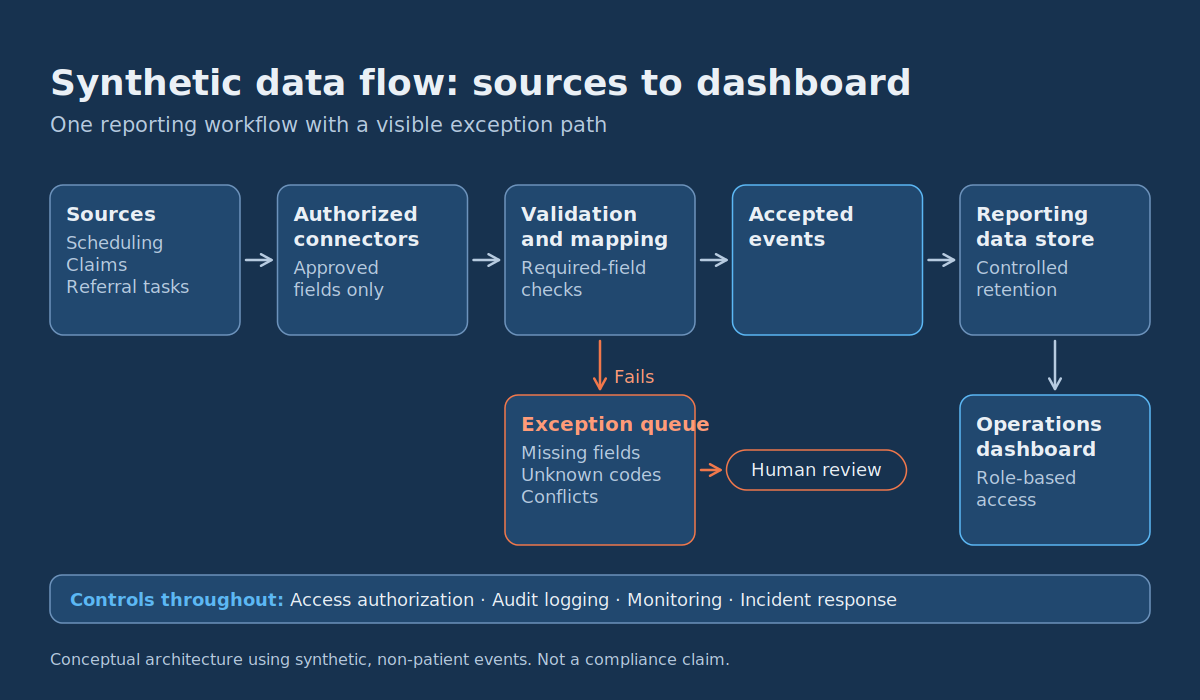
This is a conceptual architecture, not a claim that any particular vendor implementation is compliant or production-ready. Connectors, storage choices and controls must be validated for the actual environment.
Example synthetic event records
| Event ID | Source | Location | Event status | Reporting treatment |
|---|---|---|---|---|
| APT-001 | Scheduling | Site-A | Attended | Completed scheduled appointment. |
| APT-002 | Scheduling | Site-A | No-show | Missed eligible appointment. |
| APT-003 | Scheduling | Site-A | Cancelled in advance | Excluded from the example no-show denominator. |
| CLM-001 | Claims | Site-B | Validation passed | Eligible for submission under the defined checks. |
| CLM-002 | Claims | Site-B | Missing required code | Route to administrative exception review. |
| REF-001 | Referral tasks | Site-C | Overdue acknowledgment | Flag for authorized operational follow-up. |
All six records are fictional and exist only to demonstrate the design. Real implementations may need additional event identifiers, source timestamps, version tracking and approved linkage mechanisms, depending on the workflow.
How to validate the data flow
Test more than whether records appear in a dashboard.
- Validate source-to-target mapping. Confirm that each incoming status corresponds to the intended reporting category.
- Test duplicates. Reprocess an event and check that the same appointment or claim is not counted twice.
- Test event corrections. Change a test appointment from booked to cancelled and verify that the downstream metric updates according to its rules.
- Test delayed ingestion. Confirm that users can identify a stale report and that late-arriving events are handled consistently.
- Test access boundaries. Ensure users cannot query another organization’s or department’s restricted records just by changing an API parameter.
- Test the exception path. An invalid code should produce a reviewable error, not silently become a valid status.
Completion criterion: The reporting workflow processes known test events correctly, identifies invalid information and limits access according to the approved policy.
Three healthcare data workflows worth evaluating first
Choose the use case based on an identifiable operational problem. Claims administration, appointment scheduling and care operations are useful starting points because they involve observable process states and measurable administrative outcomes.
1. Appointment scheduling and capacity reporting
Scheduling data can help operations staff spot unused capacity, cancelled appointments, no-shows and differences in scheduling patterns across service locations. A focused first release might show scheduled appointments, completed appointments, no-shows and relevant cancellation categories for a defined reporting period.
Before building the report, agree how rescheduled appointments, late cancellations, duplicate bookings and unfinalized statuses affect each measure.
Operational decision: Which scheduling processes or service locations warrant further investigation?
Important limitation: A drop in recorded no-shows does not by itself establish better access to care or improved clinical outcomes. Changes in appointment availability, cancellation policies and patient populations can all affect the figures.
2. Claims validation and administrative exception management
Claims workflows can involve required-field checks, coding validation, submission statuses, insurer responses, corrections and resubmissions. A data solution might identify submissions with missing mandatory fields, route them to an authorized staff queue and track how long each exception takes to resolve.
The system must distinguish pre-submission validation failures, payer rejections, denials and other adjudication outcomes. They occur at different stages and mean different things.
Where FHIR-based exchange is supported, the Claim resource in the financial module is the relevant starting point. The actual integration must also account for the administrative standards and trading-partner requirements used by the participating organizations.
Operational decision: Which categories of administrative error are delaying the claims workflow?
Important limitation: Passing pre-submission validation does not guarantee a claim will be accepted, adjudicated favorably or paid.
3. Referral and care operations task visibility
Care operations involve tasks that move between teams, systems and organizations. An application can help authorized staff see which tasks have been received, assigned, acknowledged, completed or left outstanding. For example, a referral coordination team may want a list of referral tasks awaiting acknowledgment beyond an approved operational threshold.
Such a solution needs clearly defined task states, assigned ownership and escalation procedures. Missing information or ambiguous status updates should trigger review, not an unsupported assumption that the task is complete.
Operational decision: Which outstanding coordination tasks need an authorized staff member’s attention?
Important limitation: Task acknowledgment or administrative closure is a process measure. It does not demonstrate clinical appropriateness, completion of treatment or improved health outcomes.
Healthcare operational outcomes: what should you measure?
A useful healthcare analytics solution starts with a measurement contract: a defined question, numerator, denominator or calculation, reporting period, data source and accountable owner. A dashboard on its own is not evidence that the workflow has improved.
Reusable measurement framework
| Workflow | Operational KPI | Definition | Data quality requirement | Interpretation limit |
|---|---|---|---|---|
| Scheduling | Appointment no-show rate | No-show appointments divided by eligible appointments due in the reporting period, multiplied by 100. | Consistent final statuses, appointment identifiers and cancellation rules. | Does not measure clinical effectiveness or overall access to care. |
| Claims | Pre-submission exception rate | Unique eligible claim records failing defined validation checks divided by all eligible records checked, multiplied by 100. | Complete validation results and reliable deduplication. | Does not measure payer denial rates or payment success. |
| Claims | Exception resolution time | Elapsed time from exception creation to verified administrative resolution. | Reliable timestamps, status histories and reopening rules. | Shorter duration does not prove the correction was appropriate. |
| Care operations | Overdue referral task rate | Open eligible tasks beyond an approved acknowledgment threshold divided by eligible open tasks, multiplied by 100. | Defined task owner, creation time, acknowledgment events and exclusions. | Does not prove whether a referred patient received care. |
| Integration | Data validation failure rate | Distinct incoming events rejected by required validation rules divided by all distinct events processed. | Defined event identities, validation rules and processing records. | A lower failure rate does not prove complete source data. |
| Integration | Reporting freshness | Elapsed time between the latest included source event or approved source watermark and the reporting update, using a defined method. | Reliable source timestamps, clock handling and ingestion metadata. | Fresh data can still be incomplete or incorrect. |
These are candidate operational measures, not universally mandated healthcare KPIs. Each organization must confirm which definitions apply to its workflow and whether the required data can be obtained appropriately.
Worked calculation: appointment no-show rate
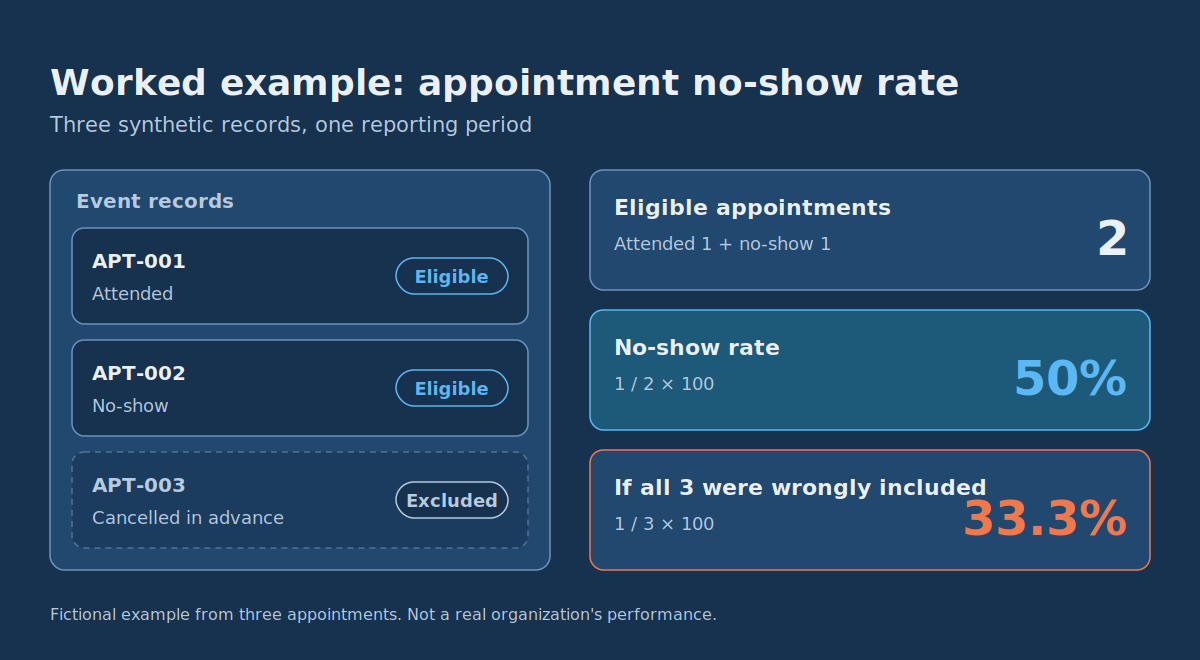
Using the synthetic data flow above, assume APT-001, APT-002 and APT-003 all relate to appointments scheduled in the same reporting period. The organization defines eligible appointments as those that reached an attended or no-show final status. Appointments cancelled in advance are excluded.
- Attended appointments: 1.
- No-show appointments: 1.
- Appointments cancelled in advance: 1, excluded.
- Eligible appointment count: 2.
No-show rate = 1 / 2 × 100 = 50%.
This figure comes only from the fictional three-appointment example. It is not an estimate of any real organization’s performance, and the sample is too small to support an operational conclusion.
The calculation shows why denominator rules matter. If all three records were wrongly included, the reported rate would be 33.3%, even though the agreed metric excludes advance cancellations.
To use the calculation in a real organization:
- Approve the definitions of attended, no-show, cancelled and rescheduled.
- Select the reporting period and time-zone convention.
- Deduplicate appointments and resolve conflicting statuses.
- Validate the calculation against a representative, authorized source-system sample.
- Record a baseline before introducing workflow changes.
- Compare later periods while checking for changes in scheduling policies, service mix and data completeness.
How to distinguish improvement from coincidence
Suppose a scheduling team introduces automated administrative reminders and later sees a lower no-show rate. The change is worth investigating, but a before-and-after comparison alone cannot show that reminders caused it. Other explanations include changes in appointment types, seasonal demand, cancellation policies, data recording or the population served.
For operational evaluation, define the intervention, baseline, observation period and relevant comparison groups before interpreting results. If the organization needs to establish causal effects or patient-level outcomes, involve qualified evaluation and clinical experts and use a suitable study design.
Measure what the solution actually changes. Processing time, completeness and administrative workload may be measurable long before any credible claim about clinical outcomes is possible.
Healthcare data governance: quality, privacy and access controls
Healthcare data governance sets who owns information, which uses are permitted, how quality is evaluated and how access is managed across a system’s lifecycle. A solid data governance strategy for compliance and trust is what keeps a healthcare integration reliable after launch. An integration is not safe merely because it uses a recognized exchange standard, encryption or a cloud provider.
Define permitted information before building the pipeline
Start by listing the fields each workflow genuinely needs. Aggregate scheduling reporting, for example, may need only site identifiers, event IDs, dates and appointment statuses. Diagnostic details, free-text clinical notes and patient identifiers may add nothing to that task.
Limiting collection to what the approved purpose requires reduces unnecessary exposure. Requirements for lawful processing, disclosure, retention and secondary use must be assessed under the applicable jurisdiction and organizational policies.
Check data completeness and consistency
At minimum, assess:
- Completeness: Are required records and fields present?
- Validity: Do codes, identifiers, timestamps and field values follow expected rules?
- Uniqueness: Are repeated events correctly distinguished from duplicate records?
- Consistency: Do shared fields and workflow states mean the same thing across systems?
- Timeliness: Is the information current enough for its intended decision?
- Traceability: Can authorized personnel identify the source and processing history of disputed information?
Do not automatically delete unusual records because they do not fit expected patterns. In healthcare, unusual information may need investigation and correction by authorized personnel.
Enforce access controls at the data and application boundaries
Authentication establishes identity, while authorization determines what an identified person may do. Controls may need to restrict information by organization, location, role, purpose and other approved criteria. Dashboard filters are not a substitute for enforcing permissions in the services and databases that supply the data.
Test direct requests, exports and administrative interfaces as well as the normal user interface.
Regulations differ by jurisdiction. In the US, for example, the HIPAA Security Rule applies to covered entities and business associates and addresses administrative, physical and technical safeguards. It is not the universal legal standard for every healthcare organization worldwide, and other regions require their own legal and regulatory assessment.
How should healthcare data access be audited?
Audit records should help authorized security and privacy personnel investigate relevant system activity. Depending on system requirements, useful audit information may include:
- The authenticated actor or service identity.
- The action attempted or performed.
- The event timestamp and originating system.
- The resource or resource category involved, recorded appropriately.
- The authorization decision and outcome.
- Administrative changes to permissions or important configurations.
FHIR includes an AuditEvent resource in its security and privacy module, alongside resources for consent and provenance, which gives teams a standard way to represent security-relevant events where FHIR is in use.
Good audit design also covers log integrity, access restrictions, retention rules, monitoring and incident escalation. Logs can themselves contain sensitive information and must be protected accordingly, so avoid recording clinical payloads or unnecessary personal details in ordinary application logs.
Audit logging is not the same as compliance certification. The organization must decide which activities have to be recorded, reviewed and retained under its actual obligations.
Where does AI fit into healthcare data solutions?
Artificial intelligence can support selected data-processing tasks, but it should not be the default starting point for every healthcare workflow. If a requirement can be met with reliable integration, defined business rules and a conventional dashboard, adding a machine learning model creates extra validation and maintenance work.
Potential administrative use cases include categorizing document-processing exceptions, helping staff search approved internal material and prioritizing a queue of records that need review. Where a task genuinely warrants it, custom AI and ML software services can build models around a clearly defined, validated use case.
For each proposed AI feature, define what the system may do, what information it may process, how its outputs are checked and when a human must step in.
The NIST AI Risk Management Framework is a voluntary framework, released on January 26, 2023, that helps organizations build trustworthiness considerations into the design, development, use and evaluation of AI products, services and systems. NIST also published a Generative AI Profile in July 2024 and states that AI RMF 1.0 is currently being revised as part of the White House AI Action Plan, so check the NIST page for the current version before citing it in governance documents.
The framework is not a substitute for medical device regulation, clinical validation, healthcare-specific risk management or applicable legal requirements.
A lower-risk administrative AI example
Consider a system that reviews claim submission errors and suggests a category for staff investigation. A controlled pilot might:
- Use appropriately authorized and minimized information.
- Predict only an administrative error category.
- Display supporting evidence available to the authorized reviewer.
- Let staff reject or correct the classification.
- Route uncertain results to manual review.
- Record errors and assess performance on representative data before production use.
The system should not independently alter clinical records, determine medical eligibility or make treatment decisions just because it can classify administrative information. Even an administrative application needs a clear assessment of the consequences of incorrect outputs and of whether additional healthcare-specific review is necessary.
Healthcare data solutions procurement checklist
When evaluating an external provider or considering an internal build, prioritize suitability for the defined workflow over the length of a vendor’s feature list. You can copy the checklist below into an evaluation document and apply it consistently to every candidate.
Questions to ask every prospective supplier
| Evaluation area | Buyer question | Evidence to request |
|---|---|---|
| Workflow fit | Can the solution support the specific operational problem and exception paths? | A demonstration using agreed synthetic workflow scenarios. |
| Interoperability | Which systems, standards, versions and interfaces are actually supported? | Integration specifications, supported operations and a realistic connectivity assessment. |
| Data quality | How are missing fields, duplicate events, conflicting codes and delayed updates handled? | Validation rules, error examples and evidence from representative tests. |
| Identity and access | How are users authenticated and authorized for each required operation? | Access-control architecture and appropriate positive and negative test results. |
| Privacy and legal requirements | What information is processed, for what purpose, by which parties and in which locations? | Data-flow inventory, contractual terms and relevant legal/privacy review. |
| Auditability | Can authorized reviewers investigate access decisions and important system actions? | Audit-event examples, retention policies and incident procedures. |
| Operational reliability | What happens when a source system fails or sends incorrect information? | Failure-handling demonstrations, recovery procedures and service responsibilities. |
| Measurement | Can the solution calculate and explain the agreed operational KPIs? | Metric definitions, sample calculations and source reconciliation tests. |
| Commercial ownership | What will the organization own and maintain after implementation? | Cost breakdown, support terms, documentation and exit or migration arrangements. |
A simple evaluation scoring method
For the nine areas above, use these illustrative scoring rules:
- 0 — Not demonstrated: The requirement is unsupported or described only through an unverified claim.
- 1 — Partially demonstrated: Documentation or a limited demonstration exists, but material questions remain.
- 2 — Demonstrated: The candidate provides evidence that meets the organization’s predefined acceptance criteria.
With nine criteria, the maximum unweighted score is 18. However, a high total should never excuse a critical security, privacy, interoperability or safety failure. These should be mandatory acceptance gates when the requirement is material to the deployment.
For example, a candidate may offer excellent reporting and attractive commercial terms but fail to enforce the necessary data-access restrictions. That candidate should not be approved for a sensitive-data workflow until the issue is resolved.
To adapt the checklist, identify which requirements are mandatory, which can come later and which matter mainly for cost or convenience. Record the evidence behind each score and involve the right technical, security and domain owners in the decision.
How to implement a healthcare data solution in controlled phases
A phased implementation lets an organization validate the design before widening scope or introducing sensitive production information.
Phase 1: Define the workflow and responsibilities
Owners: Operations sponsor, workflow owner, technical lead and appropriate healthcare/privacy stakeholders.
Identify the operational decision, current process, source systems, authorized users and known failure modes. Specify one initial KPI and define what evidence would show the workflow is operating correctly.
Acceptance criterion: The use case, data requirements, business definitions and responsibilities are documented and approved.
Phase 2: Validate interfaces and governance requirements
Owners: Integration engineering, source-system owners and information security/privacy representatives.
Confirm interface availability, supported standards, permissions, mapping rules, data protection requirements and ownership of integration credentials. Run a representative technical proof of concept with synthetic data wherever possible.
Acceptance criterion: Required information can be exchanged through approved interfaces, with documented access rules and known integration limitations.
Phase 3: Build a minimal reporting workflow
Owners: Engineering, analytics and operations.
Implement the approved data flow, validation logic, exception process and a focused reporting view. Build just enough to answer the selected operational question rather than a broad analytics platform.
Acceptance criterion: Synthetic test cases produce the expected results, invalid information is handled visibly and unauthorized access attempts fail under the defined tests.
Phase 4: Conduct authorized pilot evaluation
Owners: Operations sponsor, relevant healthcare domain reviewers, technical team and security/privacy representatives.
Move to authorized real-world evaluation only after the relevant risk, legal, security and governance reviews are complete. Establish baseline measurements, monitor data quality and document how exceptions are handled. If the system could affect clinical or patient safety decisions, apply additional domain-specific evaluation and oversight before operational use.
Acceptance criterion: The pilot meets predefined operational and safety requirements, and findings rest on validated measurements rather than assumptions.
Phase 5: Operate, measure and improve
Owners: Service owner, engineering operations, reporting owner and designated security/privacy contacts.
Monitor integration failures, data freshness, reporting accuracy, operational exceptions and access-related events. Review user feedback and observed process outcomes. Expand the solution only when new requirements justify additional data collection, automation or infrastructure.
Acceptance criterion: The organization has a documented operating process, accountable owners and evidence that the solution performs its intended workflow reliably.
Frequently asked questions about healthcare data solutions
What is the difference between healthcare data integration and healthcare analytics?
Healthcare data integration connects information from different systems and makes it available in an agreed structure or interface. Healthcare analytics uses that information to calculate measures, explore patterns and support decisions.
A reporting solution may need integration first, but successful integration does not guarantee accurate analytics. Metric definitions, data quality and authorized use still need validation.
Do all healthcare integrations need to use FHIR?
No. FHIR is an important healthcare data exchange standard, but systems vary in the interfaces and standards they support. Some workflows rely on other established formats or proprietary interfaces.
Use FHIR where it is supported and appropriate, and confirm the required versions, profiles, terminology and security arrangements before implementation.
How can an organization audit access to healthcare data?
Establish an audit policy defining which activities must be recorded, who can review them and how records are protected and retained.
Typical audit-relevant events include authentication attempts, authorization decisions, sensitive data access and important administrative changes. Audit records should support investigation without copying protected information into logs unnecessarily. Specific obligations depend on the organization’s legal and regulatory requirements.
Which healthcare operational KPIs should be implemented first?
Choose measures directly connected to the selected workflow, such as appointment no-show rate, claims exception rate, exception resolution time or overdue referral task rate.
Prefer a small set of accurately defined and validated measures over a dashboard full of poorly understood indicators. Establish the baseline and make sure users know what each measure can and cannot demonstrate.
Can healthcare data solutions improve patient outcomes?
Healthcare data systems can support processes associated with care delivery, but better administrative performance does not automatically establish better clinical outcomes.
Claims of clinical benefit need appropriate evidence, outcome definitions, evaluation methods and qualified review. A scheduling or reporting project should claim only the operational effects it actually measured.
Should healthcare organizations use AI for every data workflow?
No. Many integration, reporting and administrative validation problems can be solved with conventional software and deterministic rules.
Consider AI when a clearly defined task warrants it and the organization can evaluate accuracy, failures, privacy, oversight and the consequences of incorrect outputs. Healthcare-specific clinical or regulatory risks need specialist review.
Choose the healthcare workflow before choosing the technology
The most useful healthcare data solutions begin with a precise operational problem and a clear understanding of the systems, information and responsibilities involved.
A scheduling dashboard, claims exception workflow or referral task report can make a suitable first project if its data is available through approved interfaces, its measures can be validated and its users have legitimate access. Add more sophisticated platforms or AI capabilities only when they solve a demonstrated problem that a simpler implementation cannot.
Start by mapping the workflow, identifying the minimum required information, approving the relevant access controls and setting measurable acceptance criteria. Use synthetic test events to validate the data flow before any authorized production pilot, and keep observed operational changes separate from unproven clinical benefits.
For healthcare organizations and product teams evaluating integration or reporting work, DataColab can help scope the technical feasibility of data pipelines, workflow software and analytics around a defined use case through its custom software development for business workflows. Such projects should involve the organization’s domain, security, privacy and regulatory specialists in reviewing the applicable requirements.