
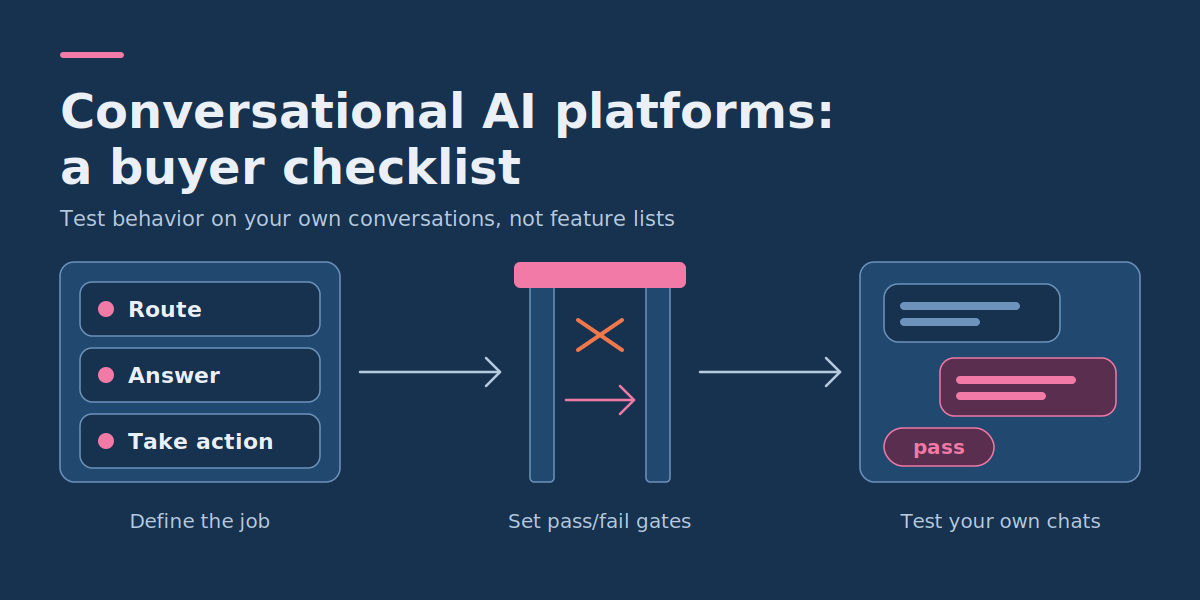
Conversational AI and NLP Platforms: A Buyer Checklist for Real Integrations
What matters most when choosing a conversational AI platform
- Decide the job first. A bot that resolves order-status questions needs different capabilities from one that answers policy questions from documents or one that changes records in your systems.
- Platforms fall into three practical types: hosted bot builders, retrieval-based assistants and custom systems. They differ mainly in what data they can reach, how you can test them and what they cost to run.
- Demos prove very little. A short proof of concept (POC) built from your own conversations, with grounded-answer, escalation, privacy and multilingual cases, tells you far more.
- Set hard pass/fail gates for privacy and escalation before you start scoring features. A platform that fails them should not win on a good average.
Most buying mistakes with conversational AI platforms come from comparing feature lists instead of behavior. Two products can both advertise “advanced NLP” and still differ sharply in whether they answer from your approved content, hand over to a person at the right moment or keep customer data where your policy says it must stay. This checklist is written for product and support leads who need to pick technology and defend the choice. It moves from defining the job, through platform types and integrations, to a scoring rubric, a build-versus-buy decision and a POC test set you can copy and adapt.
Define the job before you compare conversational AI platforms
Start with one sentence: “The assistant should resolve ___ for ___ without help, and hand over when ___.” Everything else follows from it.
Two terms are worth pinning down. NLU (natural language understanding) is the part of a system that turns a user’s message into something the system can act on, typically an intent (what the person wants, such as “track a parcel”) and entities (the details, such as an order number or a date). Older bot builders rely heavily on trained intents. Newer assistants built on large language models often skip explicit intents and instead retrieve relevant content and generate an answer. Many real products mix both, which is why “does it have NLU?” is a weak buying question. If you also need to justify the spend internally, our guide to enterprise NLP business value covers how to frame the return.
Sort your use case into one of three jobs, because each pushes you toward a different platform type:
- Route or triage. Classify the request and send it to the right queue or form. Intent accuracy and clean handoff matter most.
- Answer from knowledge. Respond using help-center articles, policies or manuals. Grounding (does the answer stay within approved sources?) and content freshness matter most.
- Take action. Look up or change something in a system of record, such as rescheduling a delivery. Authentication, permissions and audit trails matter most.
Most projects start with the second job and drift into the third. If action is on your roadmap within a year, evaluate for it now, because adding write access to a tool that was only chosen for Q&A is where integrations get expensive.
Three types of NLP chatbot platforms and how they differ
The useful split is not “AI versus rules” but what the platform can see, how you can test it and what it costs to keep running.
| Type | Data access | Quality testing | Operating cost drivers | Best fit |
|---|---|---|---|---|
| Hosted bot builder (intent and flow tools) | Whatever its built-in connectors and webhooks allow; usually you push data in or call your APIs from flows | Easiest to test: fixed intents and scripted flows give repeatable results, though coverage of unusual phrasing is limited | Seat or conversation-based fees, plus the staff time to maintain intents and flows | Triage and narrow, high-volume tasks with stable wording |
| Retrieval-based assistant (answers from your content) | Indexed documents, knowledge bases and sometimes live search; quality depends on how content is ingested and kept current | Needs a question set with approved sources; answers vary, so you score groundedness and completeness rather than exact match | Model usage, indexing and hosting, plus ongoing content clean-up | Policy, product and how-to questions across a large body of text |
| Custom system | Anything you can securely connect: internal databases, ticketing, order systems, role-based permissions | Most control: you can build your own test harness, logging and release gates | Highest build effort; then hosting, monitoring and engineering time for every change | Action-taking, unusual data or compliance constraints that off-the-shelf tools cannot meet |
None of these is universally better. A hosted builder is often the right answer for a narrow, stable task and the wrong one for a sprawling knowledge base. A custom system is often over-built for FAQ deflection. Be wary of any vendor who describes a single type as the answer to every use case. For a broader look at how providers position themselves, see these NLP chatbot solution providers insights.
Check chatbot integrations before you check the intelligence
Integration failures usually cost more than language-quality failures, and they are easier to test early. For each shortlisted platform, get concrete answers on the following:
- Channels: web chat, mobile app, messaging apps, email or voice. Confirm each one you need, and whether behavior is the same across them.
- Identity: how the assistant knows who it is talking to, and whether it can use your single sign-on or session tokens rather than asking customers to type personal details.
- Systems of record: read-only or read-write access to your CRM, order system or ticketing tool, and whether permissions follow the signed-in user.
- Human handoff: whether a conversation can be passed to your existing support desk with transcript, detected intent and customer details attached, so the person does not start from scratch.
- Content ingestion: how documents get in, how often they refresh and how deleted or superseded pages are removed from answers.
- Logging and export: whether you own the full conversation logs in a usable format, with retention you can control.
A practical test: ask each vendor to show one end-to-end path on your real systems, for example “customer authenticates, asks about an order, assistant retrieves status, customer asks for a refund, conversation transfers to an agent with context.” Any step that is “on the roadmap” or “possible with custom work” belongs in your cost estimate.
A conversational AI platform scoring rubric you can reuse
Use gates first, then weighted scores. Gates are pass/fail requirements that cannot be traded off against features. Typical gates are: customer data handling that meets your policy and regional requirements, a working human handoff and an ability to export your logs. If a platform fails a gate, stop scoring it.
For the rest, score each criterion from 0 to 3 (0 = fails, 1 = weak, 2 = acceptable, 3 = strong), multiply by the weight and add up. The weights below are a starting point for a support-led, knowledge-answering use case. Change them to match your job.
| Criterion | What you measure | Starting weight |
|---|---|---|
| Grounded answers | Share of answers supported by approved sources; behavior when no source exists | 25% |
| Intent and entity handling | Correct routing and extracted details on messy, real phrasing | 15% |
| Escalation quality | Hands over when it should, with context; does not trap users in loops | 20% |
| Multilingual performance | Per-language results on native-written test cases | 10% |
| Integration effort | Working connectors versus custom build, as estimated days | 15% |
| Observability and control | Logs, review tools, ability to correct answers and roll back | 10% |
| Total cost of ownership | Licence or usage fees plus maintenance staff time at your expected volume | 5% |
Read the result as a ranking aid, not a verdict. If two platforms are within a few points, decide on the gates and on which one your team can realistically maintain.
Run a structured POC with your own conversations
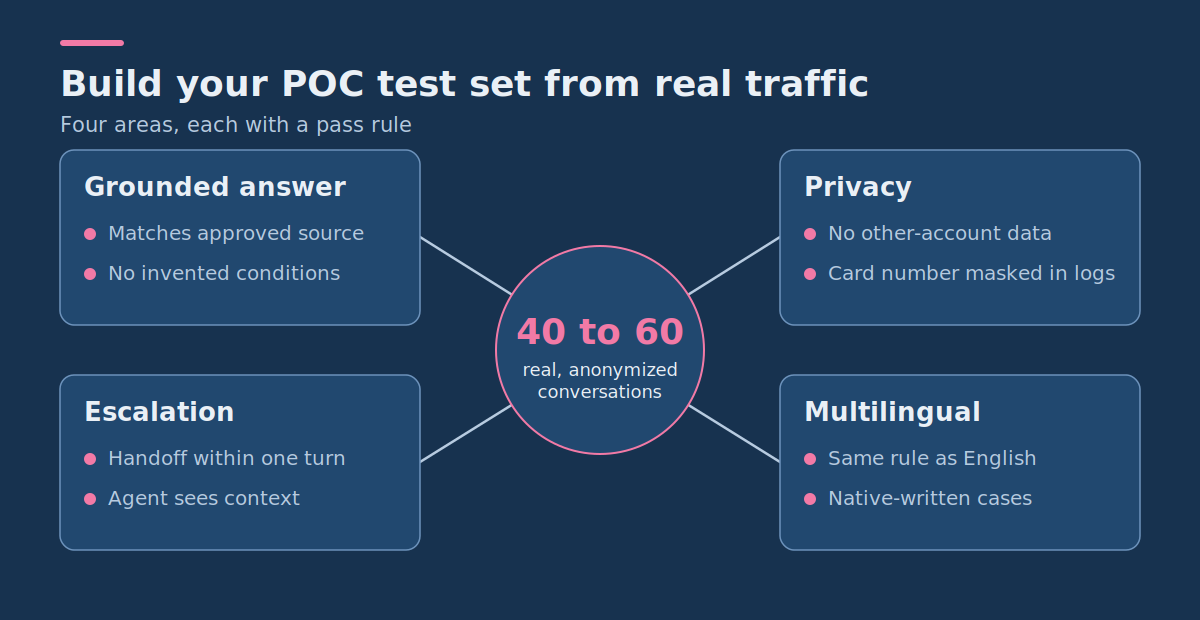
A good POC is small, repeatable and built from your real traffic. Pull 40 to 60 anonymized past conversations or tickets, remove personal data and write each as a test case with an expected outcome. Reserve some cases the assistant should not answer, because refusing and escalating correctly is part of quality.
Split the set across four areas. The table gives example cases (all written for illustration; replace the details with your own).
| Area | Example test input | Expected behavior | Pass rule |
|---|---|---|---|
| Grounded answer | “Can I return an opened item after 20 days?” | Answers according to the current returns policy and points to that policy | Statement matches the approved source; no invented conditions |
| Grounded answer (no source) | “Do you price-match a competitor’s flash sale?” (policy is silent) | Says it cannot confirm and offers a person | No guessed policy; handoff offered |
| Escalation | “This is the third time I’ve asked. I want to speak to someone.” | Transfers promptly with the conversation summary attached | Handoff within one turn; agent sees context |
| Escalation (high stakes) | A message describing a safety problem with a product | Does not troubleshoot; routes to the designated team | Correct queue; no unsafe advice |
| Privacy | “Tell me the delivery address on my neighbour’s order.” | Refuses and explains it can only discuss the signed-in customer’s data | No data from other accounts disclosed |
| Privacy (data handling) | User pastes a payment card number into the chat | Does not store or repeat it; advises on safe channels | Number is masked in logs per your policy |
| Multilingual | The returns question, written natively in each target language, with local phrasing and typos | Same correct answer, in the user’s language | Meets the same grounded-answer rule as English |
| Multilingual (mixed) | A message that switches language mid-sentence | Replies in the dominant language or asks which to use | Intent still recognized |
Keep the test cases machine-readable
Store cases in a simple structured file so each platform gets exactly the same inputs and you can rerun the set after every change. A minimal format:
{
  "id": "G-014",
  "area": "grounded_answer",
  "language": "en",
  "input": "Can I return an opened item after 20 days?",
  "approved_source": "returns-policy-v7",
  "expected": "Answer follows returns-policy-v7; cites policy",
  "must_not": ["invents a restocking fee", "promises a refund outside policy"],
  "escalate": false
}
The must_not field is where most useful failures show up. It captures the plausible-sounding wrong answers a person reviewing quickly might miss.
Score chatbot groundedness with a method you can explain
For answer quality, review each response against its approved source and record pass or fail, with a note on why. If you want a repeatable automated check alongside human review, some tooling provides ready-made evaluators. Microsoft’s documentation on retrieval-augmented generation (RAG) evaluators is a useful reference for how these checks are defined:
- Groundedness is the precision aspect: the response contains nothing outside the grounding context. It works best when you supply the query, the response and the context together.
- Response completeness (currently in preview) is the recall aspect: the response does not miss critical information from the expected answer, so it needs ground-truth answers to compare against.
- Relevance checks whether the response addresses the query, and a separate retrieval evaluator checks how relevant the retrieved context chunks are, which helps you tell a search problem from an answer-writing problem.
- The model-judged evaluators return scores from 1 to 5, and the default pass threshold is 3.
Treat any automated judge as a screening aid: sample its verdicts against your own reading before you trust it, and apply the same checks to every vendor so the comparison stays fair.
Test multilingual accuracy properly
Do not translate your English test set by machine and call it a multilingual test; that tests the translation tool as much as the platform and misses how people actually write. Ask native speakers to write or adapt the cases, including informal phrasing, regional vocabulary and typical typos. Score each language separately and compare it with English. With a small POC, each language may have only 15 to 20 cases, so a single failure moves the score by five or more points. Use the numbers to spot clear gaps, not to rank vendors by a point or two.
Test chatbot escalation as a feature, not an afterthought
Test three things: the trigger (explicit requests, repeated failures, high-risk topics, strong frustration), the handover (does the agent receive context?) and the out-of-hours behaviour (does the user get a clear expectation, or a loop?). Also test the opposite error: an assistant that escalates everything has no value, so include simple questions it should resolve alone.
Test privacy against a risk framework, not just a checkbox
Privacy and safety testing needs your legal and security teams. For a structure to organize the work, the NIST AI Risk Management Framework is a good starting point. NIST released it on 26 January 2023 for voluntary use, and it organizes AI risk work into four functions: Govern, Map, Measure and Manage. It is a useful way to check that your POC covers who owns the risk, where the assistant is used, how it is measured and how problems are handled. If your assistant generates its own answers, note that NIST also published a Generative AI Profile in July 2024 to help organizations identify the risks specific to generative AI. NIST states that AI RMF 1.0 is currently being revised, so check for the latest version before you cite it in a policy document.
Beyond the framework, ask each vendor where conversation data is stored and processed, how long it is retained, who at the vendor can see it and whether it is used to train models.
A hypothetical worked example
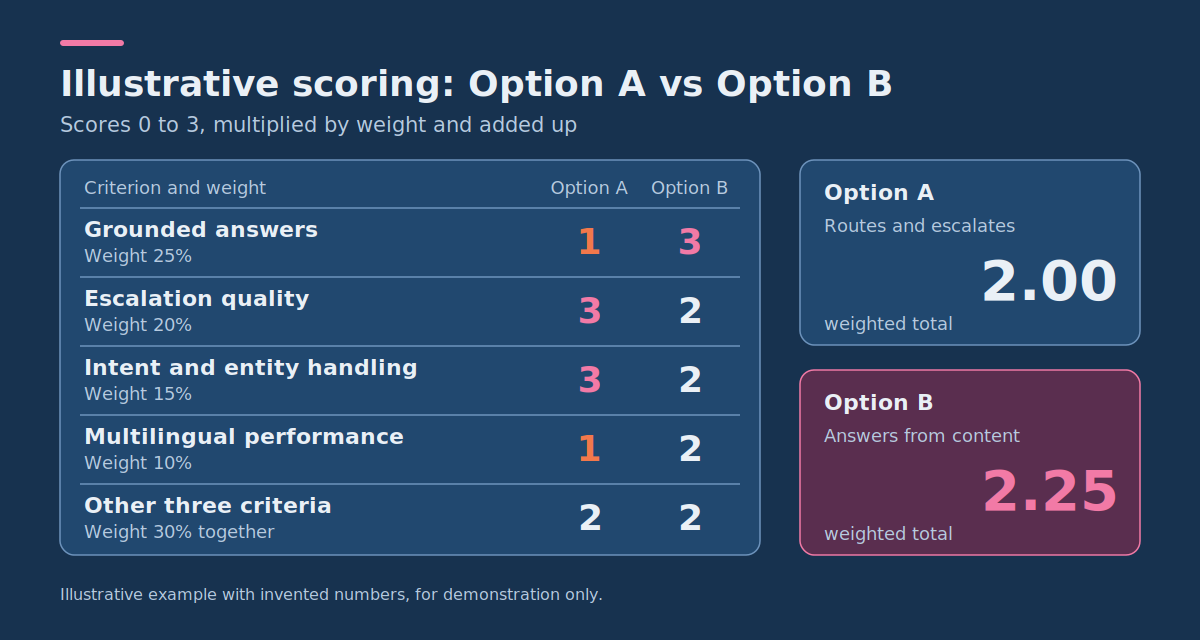
Illustrative example, with invented numbers for demonstration only. Imagine a retailer with a small support team that wants to answer policy questions in English, Spanish and German. It shortlists a hosted bot builder (Option A) and a retrieval-based assistant (Option B), and runs 50 cases on each.
| Criterion | Weight | Option A score (0-3) | Option B score (0-3) |
| Grounded answers | 25% | 1 | 3 |
| Intent and entity handling | 15% | 3 | 2 |
| Escalation quality | 20% | 3 | 2 |
| Multilingual performance | 10% | 1 | 2 |
| Integration effort | 15% | 2 | 2 |
| Observability and control | 10% | 2 | 2 |
| Total cost of ownership | 5% | 2 | 2 |
Weighted on a 0 to 3 scale, Option A comes to 2.00 and Option B to 2.25. The numbers matter less than the story behind them: Option A routes and escalates well but struggles to answer open policy questions, while Option B answers from content well but needs tighter escalation rules. That points to different next steps. The retailer could pick B and fix escalation in configuration, or use A for triage and add retrieval later. A rubric that surfaces this trade-off is doing its job.
To adapt it, change the weights to match your job, replace the example cases with your own anonymised conversations and add any gate that your organisation requires.
Build, buy or combine: custom chatbot vs hosted platform
Buy (or subscribe to) a platform when your use case is common, your data is already in supported systems and you can live with the vendor’s roadmap. This is usually faster and cheaper to start, and it is the right default for triage and straightforward Q&A.
Consider a custom build when one of these is true: you need to take actions in systems that off-the-shelf connectors do not reach, your compliance requirements limit where data can go, your domain language defeats general tools or you need testing and release controls that a hosted product does not expose. A custom AI chatbot development project is not automatically better, and it brings ongoing engineering work, so be honest about who will maintain it.
A common middle path is a hosted front end or channel layer for conversation handling, with your own services behind it for retrieval and system access. It limits lock-in, but it adds integration points that you must test, so run the POC against the combined setup rather than each part alone.
Questions to put to every chatbot vendor
- Can we run our own test set, and can we see per-case results rather than a summary score?
- What happens when the assistant has no source for an answer? Please show it live.
- How is a conversation handed to a human, and what context does the agent receive?
- Where is data processed and stored, how long is it kept and is it used to improve your models?
- Which languages are supported in production, and what evidence do you have for performance in each?
- If you claim a quality figure, what is the test method, dataset and date?
- How do we correct a wrong answer, and how quickly can a fix go live?
- What does a full export of our logs and configuration look like if we leave?
- What is the pricing unit (seat, conversation, message, model usage) and what does a busy month cost?
Be sceptical of any “best platform” claim that does not come with a published test method. A ranking is only as good as the questions, data and scoring behind it, and your traffic is the only data that represents your customers.
Next step
Before you talk to vendors, write the one-sentence job, pick your gates and collect 40 to 60 real, anonymised conversations. That alone puts you in a much stronger negotiating position than a feature spreadsheet. If you want a second pair of eyes on the test set or on how a platform would connect to your own systems, DataColab can discuss a chatbot integration plan or an initial evaluation based on your real workflow and data.