
Data Support Engineer Roles and Responsibilities: A Practical Team Guide
Data support engineer roles and responsibilities come down to one question: who responds when business-critical data stops working as expected? A pipeline can complete successfully while producing incomplete records. A database can remain available while a dashboard shows yesterday’s figures. Someone must recognize the impact, investigate and coordinate recovery before people make decisions with unreliable information.
This guide explains how to define that responsibility in a real team. It includes a sample job description, a RACI ownership matrix, an example runbook, a worked incident escalation flow and a KPI scorecard that engineering managers can adapt.
Data support engineer responsibilities at a glance
- A data support engineer keeps production data services usable by monitoring failures, investigating incidents, performing approved recovery steps and coordinating fixes.
- The role normally owns the operational response, not every underlying system or permanent code change.
- Runbooks, escalation rules, service objectives and clear ownership boundaries determine what an engineer can resolve independently.
- Data engineers typically own changes to pipeline logic, while database or platform specialists own infrastructure within their remit. A support engineer brings the right people together when incidents cross those boundaries.
- A useful job description defines decision authority, on-call expectations, handoffs and measurable outcomes rather than listing tools alone.
What is a data support engineer?
A data support engineer is responsible for the day-to-day operational support of data platforms and the services built on them. Depending on the organization, those services may include extract, transform and load (ETL) pipelines, data warehouses, database integrations, scheduled reports, data quality checks and analytics systems.
The central purpose is an accountable operational response between production data systems, the engineers who build them and the people who depend on their outputs.
What does a data support engineer actually own?
The important distinction is between owning the response to a problem and owning the underlying system’s design. A support engineer may investigate a failing transformation, identify the faulty component and execute an approved retry. The data engineering team may still be responsible for modifying that transformation to prevent the failure from recurring.
Six core data support engineer responsibilities
- Monitoring and alert triage: Review pipeline execution status, freshness indicators, quality checks and service alerts. Determine whether an alert represents actual or impending user impact rather than treating every warning as an emergency.
- Incident investigation: Gather logs, job identifiers, timestamps, error messages, affected datasets and recent change history to establish what failed and how widely the problem has spread.
- Approved recovery: Perform documented, authorized actions such as restarting a failed job, retrying an idempotent task or initiating an approved backfill. Check the result rather than assuming a successful execution means the data is correct.
- Ticket and request handling: Manage operational issues involving missing records, delayed reporting, access failures, unexpected query behavior and other supported services. Route requests requiring privileged access or engineering changes to the appropriate owner.
- Escalation and communication: Notify the appropriate technical owner when an incident exceeds the engineer’s permissions, recovery procedure or investigation time limit. Keep stakeholders informed of impact, progress and outstanding uncertainty.
- Operational improvement: Update runbooks, identify repetitive incidents, recommend better alerts and contribute evidence to root-cause reviews.
What monitoring principles should guide data support?
Google’s guidance on monitoring distributed systems was written for web-scale services, but several of its points transfer directly to data operations:
- Separate the symptom from the cause. The chapter says a monitoring system should answer two questions: what is broken, and why. For data teams, “the finance dataset missed its 08:00 deadline” is the symptom. “An upstream extraction task failed” is the cause.
- Page only for actionable problems. The chapter states that every page should be actionable and should require human judgment. If the response is purely robotic, the page should not exist.
- Beware alert fatigue. It warns that when pages are too frequent, people begin to skim or ignore alerts, sometimes missing a real one hidden in the noise.
- Count wrong content as a failure. It describes errors that are implicit, such as a successful response that carries the wrong content, and notes that only end-to-end checks catch them. This is the same reason a “green” pipeline run does not prove the data is correct.
- Use black-box checks for paging and white-box signals for diagnosis. Externally visible symptoms justify waking someone up; logs and internal metrics help explain why.
- Remove recurring toil. The chapter recommends finding and eliminating root causes of frequent alerts or, where that is not possible, fully automating the response.
The chapter’s “four golden signals” are latency, traffic, errors and saturation. It does not define data-specific equivalents, so mapping them to freshness, volume, validation failures and resource limits is our adaptation, not Google’s recommendation.
Data support responsibilities should therefore be tied to the data services people actually use, not merely to the number of jobs running in an orchestration tool.
A day in the life of a data support engineer
Actual schedules depend on whether the organization processes data in batches, streams events continuously or supports services across multiple time zones. The following is an illustrative working day for an engineer supporting a batch-based analytics platform.
| Time | Activity | Expected outcome |
|---|---|---|
| 09:00 | Review overnight alerts, unresolved incidents and shift handover notes. | Known service problems have an owner and an appropriate priority. |
| 09:30 | Check scheduled pipeline completion, data freshness and quality results. | Critical datasets are confirmed ready, or exceptions are logged. |
| 10:30 | Investigate missing records reported by a finance analyst. | The affected dataset, likely failure point and business impact are established. |
| 11:30 | Run an approved recovery procedure and validate the output. | Data is verified or the issue is escalated with supporting evidence. |
| 14:00 | Review open tickets with data engineering and platform owners. | Longer-term repairs have named owners and next actions. |
| 16:00 | Improve documentation and prepare the next shift handover. | Outstanding risks, incident history and ownership are recorded. |
These are example activities and times, not an industry-standard timetable. A team handling continuous ingestion may organize its day around real-time alerts and on-call coverage rather than morning batch checks.
The engineer’s workload also changes with the maturity of the platform. Repeated manual restarts might dominate an immature operation. As the system improves, support should spend more time identifying recurring problems and helping engineering teams remove their causes.
How should on-call responsibilities and support tickets work?
Not every data support problem deserves an immediate interruption. A useful operating model separates incidents that require urgent human intervention from issues that can be handled through a normal ticket queue.
Define incident priority according to business impact
The following priority model is illustrative. Actual severity classifications, response commitments and escalation rules must be approved by the organization.
| Priority | Example | Response approach |
|---|---|---|
| P1 — Critical | A company-wide reporting service is unavailable during a critical reporting deadline. | Page the responsible on-call team, start incident coordination and notify affected stakeholders immediately. |
| P2 — High | A critical dataset is stale and blocking an important scheduled business process. | Begin prompt investigation, establish the recovery deadline and escalate if timely restoration is at risk. |
| P3 — Normal | A noncritical report is delayed without an immediate business deadline. | Record a ticket, assign an owner and resolve within the agreed service window. |
| P4 — Low | A documentation correction or minor nonurgent operational request. | Prioritize through the standard work queue. |
Priority must be based on impact and urgency, not simply on which component generated the alert. Primary and secondary on-call rotations, and different ways of sharing ticket work, are common arrangements. Each data team should choose a coverage model appropriate to its service obligations and staffing.
When on-call coverage is required, define the primary responder, backup responder, escalation destination, shift boundaries and handover procedure. Do not assume that a daytime support position automatically includes 24-hour availability.
What should a data support runbook contain?
A runbook is an operational procedure that helps an authorized responder investigate and handle a known class of problem consistently. It should clearly separate safe actions from those requiring additional approval.
Example runbook: Daily finance dataset is late
Illustrative assumptions: A daily pipeline produces a finance dataset expected by 08:00. The support team can inspect execution logs and retry approved jobs, but cannot modify production transformation code or publish unvalidated financial figures.
| Runbook field | Example instruction |
|---|---|
| Trigger | The finance dataset has not passed its freshness and validation checks by 08:00. |
| Initial checks | Confirm the last successful update, current job status, execution identifier, upstream dependency status and relevant error logs. |
| Impact assessment | Identify which reports consume the dataset and whether finance users are approaching a decision or reporting deadline. |
| Approved recovery | Retry only the documented, idempotent task after confirming the underlying condition has been resolved. |
| Validation | Check freshness, record counts, uniqueness constraints and agreed business reconciliation controls. |
| Escalation condition | Escalate to data engineering if recovery requires a code change, unsafe replay, manual data modification or exceeds the team’s agreed investigation window. |
| Communication | Tell affected users which dataset is delayed, what is known, who owns the response and when the next update is expected. |
| Closure | Record the resolution, validation evidence, recovery time and any follow-up engineering work. |
The runbook should also identify where the relevant dashboards, logs, escalation contacts and recovery procedures are maintained. Those destinations must exist and be accessible to the actual responders.
Never treat a retry as automatically harmless. Replaying a data job may duplicate records, overwrite valid outputs or trigger downstream processes again. Where replay safety is unknown, the data engineer who owns the pipeline should evaluate the operation first.
Example incident escalation flow: a failed data pipeline
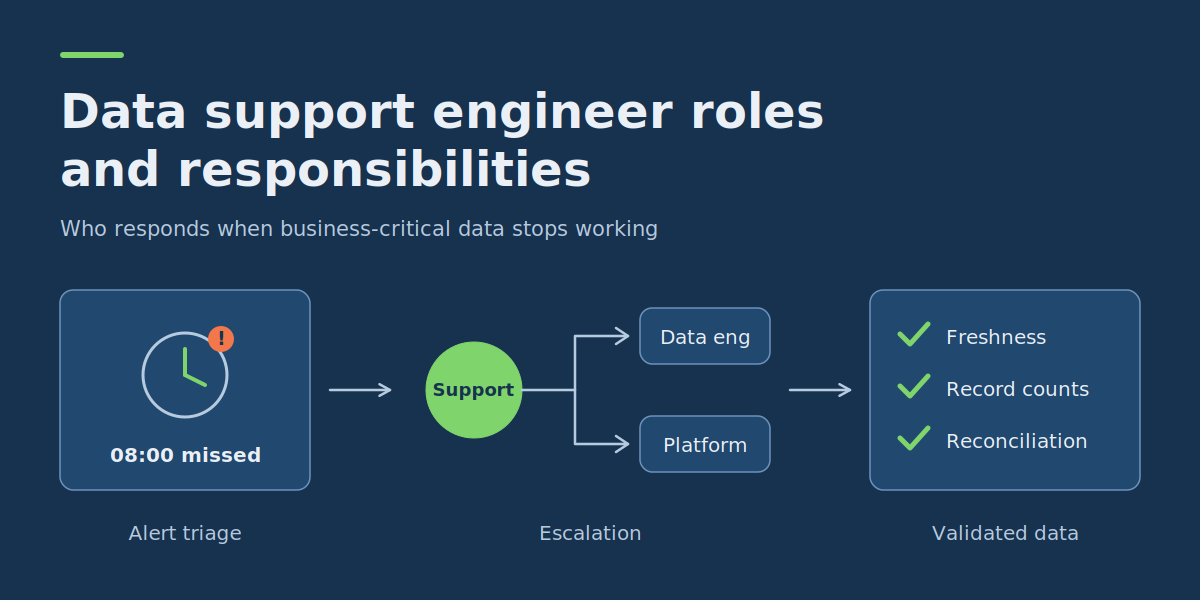
Consider a hypothetical retail business whose sales reporting dataset must be ready by 08:00. At 08:20, a freshness check reports that the dataset still contains only yesterday’s information. Finance needs today’s figures for a scheduled reporting activity.
The team has agreed that the first technical escalation occurs after 15 minutes of unsuccessful investigation or immediately when the required recovery step falls outside support’s authority. These are example operating rules, not universal service-level requirements.
- Detect and acknowledge: The monitoring system reports a freshness failure. The data support engineer acknowledges the alert, opens an incident record and confirms the dataset is genuinely stale.
- Assess business impact: The engineer identifies the affected dashboards, reporting deadline and available last-known-good data. The incident receives a priority according to the team’s approved policy.
- Investigate: The engineer reviews the orchestration history and discovers that an upstream extraction task failed following an authentication error.
- Check recovery authority: The documented procedure permits investigation and retry after credentials are restored by an authorized owner. The support engineer must not independently rotate production secrets or bypass access controls.
- Escalate: The platform or identity owner is engaged for the credential problem. The data engineer is contacted if the pipeline needs a configuration or code change. For a major incident, an assigned incident commander coordinates the overall response.
- Recover and validate: Once the underlying issue is resolved, an authorized responder reruns the appropriate job. Support verifies both successful execution and the agreed data-quality checks.
- Communicate and close: Finance receives confirmation that the affected dataset is ready, with any remaining limitations disclosed. The incident ticket records the timeline, resolution and follow-up owner.
The essential handoff is more specific than saying “escalated to data engineering.” A useful escalation includes the incident identifier, affected service, business impact, first failure time, job or query identifiers, observed errors, checks performed, actions already taken and the decision now required.
For major incidents, separating technical recovery from coordination and stakeholder communication can prevent important work from being missed. Smaller teams may combine incident command, operations and communications, but the responsibilities still need to be explicit.
Data support engineer vs data engineer: where are the boundaries?
A data engineer and a data support engineer may use the same logs, SQL queries and orchestration tools. Their primary accountabilities are nevertheless different.
A data engineer commonly develops and maintains data pipelines, transformations and architectural components. A data support engineer is concerned with whether those systems are working correctly in production, how incidents are handled and when a problem needs a specialist.
| Area | Data support engineer | Data engineer |
|---|---|---|
| Pipeline failure | Triage, collect evidence, follow approved recovery procedures and confirm restoration. | Investigate and correct faulty pipeline code or design. |
| Data quality | Detect violations, identify affected outputs and coordinate validation. | Develop or modify transformation logic and automated quality controls. |
| Monitoring | Review operational alerts, assess usefulness and improve response procedures. | Provide instrumentation and pipeline-specific signals needed for diagnosis. |
| Deployment | Perform defined operational checks and report production regressions. | Build, review and deploy changes under the team’s release process. |
| Documentation | Maintain incident instructions, escalation details and recovery evidence. | Document system behavior, dependencies and technical change procedures. |
| Long-term improvement | Identify recurring operational issues and support automation opportunities. | Implement durable fixes and changes to the data platform. |
These are recommended boundaries rather than universal job-title definitions. A smaller company may combine both functions into one position. A larger enterprise may split support further into database support, data platform operations, data reliability engineering and specialized big data support.
For example, a database support engineer may have delegated authority for certain database maintenance operations, while a data support engineer working with analytics pipelines may have no such access. Similarly, supporting a distributed data processing platform can require specialist knowledge without automatically making its support engineer responsible for infrastructure architecture.
For a separate discussion of technical capabilities, see the data support engineer skills guide. The key question for team design is not simply whether someone knows SQL or Python, but what production decisions that person is authorized and expected to make.
Sample RACI matrix for data support ownership
A RACI matrix identifies who is Responsible for performing work, Accountable for its outcome, Consulted before or during execution and Informed about progress or results.
The following completed example assumes a team with separate support, engineering, platform, business ownership and incident-command functions. Each activity has one accountable role. An organization may combine roles, but should preserve a clear accountable decision-maker for each activity.
| Activity | Data support | Data engineering | Platform / DBA | Business data owner | Incident commander |
|---|---|---|---|---|---|
| Initial alert triage | R/A | C | C | I | I |
| Execute an approved routine pipeline retry | R/A | C | I | I | I |
| Correct faulty transformation code | C | R/A | C | I | I |
| Restore failed database infrastructure | C | C | R/A | I | I |
| Validate business correctness after recovery | R | C | I | A | I |
| Coordinate a declared major incident | R | C | C | I | A |
| Approve business data delivery objectives | C | C | C | R/A | I |
How to adapt this matrix: Replace the example role labels with your team’s actual positions. Review each activity with the people performing it, and check that every activity has exactly one accountable role. Then confirm that responsibility matches production permissions and available coverage.
For instance, if the support engineer cannot safely retry production pipelines, retry accountability should move to an authorized engineering or operations owner. RACI assignments cannot grant technical permissions or replace change-approval policies.
For broader organizational design beyond production support, see the guide to business intelligence team roles, which covers how analytics and engineering responsibilities fit together.
Sample data support engineer job description
This example can be adapted for a hiring brief or an internal role charter. It assumes a team operating production data pipelines, databases and analytics services with defined engineering escalation routes.
Job title: Data Support Engineer
Role purpose: Maintain the operational reliability of production data services through monitoring, incident response, approved recovery procedures, request handling and coordination with technical and business stakeholders.
Reporting line: Data Platform Engineering Manager or designated Data Operations Lead.
Key responsibilities
- Monitor production data pipelines, data freshness, scheduled deliveries, data quality indicators and supported platform services.
- Investigate incidents using logs, job execution histories, SQL queries and established diagnostic procedures.
- Record and prioritize incidents according to their impact on business processes and agreed service objectives.
- Execute documented recovery procedures within assigned permissions and confirm that recovered data meets validation requirements.
- Escalate failures requiring application code changes, database administration, infrastructure changes or decisions outside delegated authority.
- Communicate the impact and status of incidents to relevant technical teams and business stakeholders.
- Maintain operational runbooks, incident records, shift handovers and troubleshooting documentation.
- Identify repeated incidents, inefficient manual procedures and opportunities for monitoring or operational automation improvements.
Required capabilities
- Ability to investigate database and data pipeline problems using SQL and execution logs.
- Working understanding of data ingestion, transformation, scheduling and downstream dependencies.
- Familiarity with monitoring, alerting, ticketing and incident escalation practices.
- Ability to distinguish recoverable operational failures from defects requiring specialist engineering work.
- Clear written communication, careful documentation and sound judgment when working with production data.
Authority and role boundaries
The engineer may perform approved diagnostic and recovery tasks, create incident records, initiate agreed escalations and recommend monitoring or runbook improvements. Changes to production transformation code, sensitive credentials, database security, destructive data operations and infrastructure configuration require the appropriate ownership and authorization.
Working arrangements
On-call or out-of-hours duties apply only where explicitly defined in the employment arrangement and team coverage policy. Those expectations should specify the support window, response requirements, backup coverage, escalation route and applicable compensation or time-off arrangements.
How performance will be evaluated
Performance should reflect dependable incident handling, recovery validation, clear handoffs, documentation quality and reductions in avoidable operational work. Ticket closure volume alone is not an adequate indicator of service reliability.
Which KPIs should a data support engineer track?
A practical scorecard should distinguish the engineer’s operational performance from the reliability of the entire data platform. Support can influence system reliability, but it may not control the code, infrastructure or upstream services responsible for every incident.
| KPI | How to measure it | What it helps reveal |
|---|---|---|
| Time to acknowledge | Elapsed time from a page or assigned incident notification to responder acknowledgement. | Whether routing and coverage arrangements work. |
| Time to restore | Elapsed time from incident start to validated service restoration, using a consistent incident start definition. | How quickly affected services recover. |
| Data delivery timeliness | Percentage of expected dataset deliveries that pass agreed completion and validation checks by their deadline. | Whether users receive usable data when needed. |
| Runbook recovery success | Share of eligible documented recovery attempts that restore service and pass validation. | Whether routine recovery procedures are effective. |
| Repeat incident rate | Number or proportion of incidents linked to previously identified failure modes. | Whether recurring problems are being addressed. |
| Escalation completeness | Percentage of sampled escalations containing required impact, diagnostic and handoff information. | Whether specialist teams receive enough evidence to act. |
| Actionable alert rate | Percentage of human-directed alerts that require a meaningful investigation or response. | Whether monitoring creates useful work or unnecessary interruptions. |
Use a small set of measures relevant to the service, and review incident records to understand what the numbers mean. For example, a low average restoration time may conceal a small number of severe incidents. A high ticket closure count may simply mean that the system generates too many repetitive problems.
Targets should be agreed after examining the service’s criticality, baseline performance and staffing. Publishing arbitrary industry-wide response-time targets can create unrealistic expectations.
Who owns SLAs and service objectives?
A service level agreement (SLA) is a formal commitment between a service provider and a customer or stakeholder. A service level objective (SLO) is a measurable reliability target used to manage a service. An organization may operate with internal objectives even when no formal SLA exists.
For a data delivery service, an illustrative SLO might be: “At least 99% of scheduled daily finance dataset deliveries pass required validation by 08:00 during the measurement month.” That is a proposed measurement example, not an observed benchmark or recommended universal target.
The accountable service or business owner should approve the objective and its business trade-offs, with technical input from engineering and operations. Data support engineers help monitor performance, respond to breaches and report recurring issues. They should not independently promise contractual service levels they lack the authority or resources to deliver.
Common mistakes when defining data support responsibilities
Making support responsible for everything that breaks
If a support engineer is considered the owner of every problem involving data, escalation becomes ambiguous and permanent fixes are delayed. Every production service needs a technical owner alongside a defined operational response process.
Treating successful job execution as successful data delivery
A pipeline can finish without an error while producing incomplete, duplicated or stale results. Incident closure should use the validation criteria appropriate to the dataset, which may include freshness, schema checks, reconciliation or business-owner confirmation.
Writing runbooks without clear permission boundaries
A list of commands is not enough. The procedure must explain when an action is safe, when approval is needed and when to stop and escalate. This is particularly important for destructive updates, large backfills and production credential changes.
Measuring support only through ticket numbers
Counting tickets encourages rapid closure, not necessarily durable recovery. A stronger measure combines response quality, restoration evidence, repeated failure patterns and the reduction of avoidable manual intervention.
Frequently asked questions
What are the main data support engineer roles and responsibilities?
They include monitoring and alert triage, incident investigation, approved recovery, ticket handling, escalation and communication, and operational improvement. The role owns the operational response, while data engineers and platform specialists own design and infrastructure changes.
Who handles a failed data pipeline?
The assigned data support or on-call engineer often performs initial triage and approved recovery steps. The pipeline’s data engineering owner handles defects in its code or design, while platform specialists handle relevant infrastructure failures. The precise allocation should be documented before an incident occurs.
Is a data support engineer the same as a database support engineer?
Not necessarily. Data support may span pipelines, warehouse outputs, integrations and analytics deliveries. Database support usually concentrates more directly on database availability, configuration, access, performance and associated operational tasks. Responsibilities overlap, especially in smaller teams.
Does a data support engineer need to be on call?
Only when the supported services require out-of-hours response and the organization has assigned that coverage to the role. On-call obligations, backup arrangements and escalation expectations should be explicit rather than inferred from the job title.
Who is responsible for writing and maintaining runbooks?
Data support engineers can own the operational documentation process, but technical owners should review procedures that affect their systems. Runbooks should be updated after relevant incidents, changes to recovery methods or changes in system ownership.
How to put this role definition into practice
Start with one production data service that regularly generates incidents or support requests. Identify its users, delivery expectations, technical owner and current escalation path. Then adapt the RACI matrix to the actual team, document one high-frequency incident runbook and test the handoff using a realistic failure scenario.
A useful first exercise is to ask the support engineer and the data engineer separately what should happen when the service delivers late or incorrect data. If their answers differ, resolve the ownership boundary before relying on the process in production.
The objective is not to create more organizational paperwork. It is to ensure that when data fails, someone can detect the impact, act within their authority, bring in the correct specialists and demonstrate that the data is safe to use again.
Pingback:Data Support Engineer Skills: SQL & Incident Response Checklist