
Data Support Engineer Skills: Troubleshooting, SQL And Incident Response Checklist
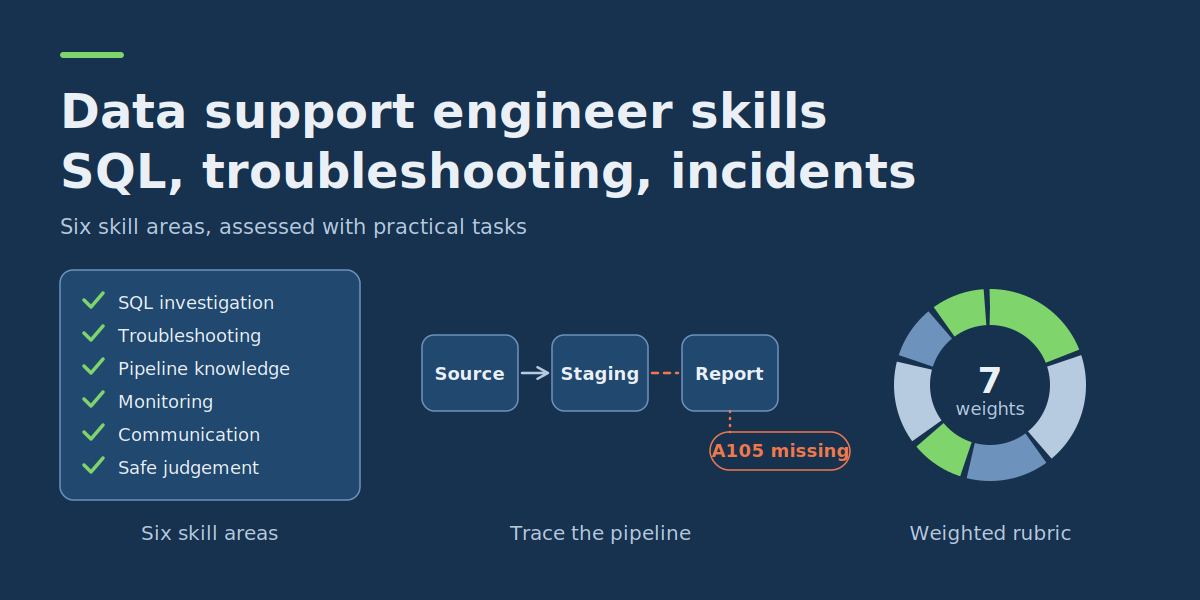
Data support engineer skills fall into six areas: SQL investigation, structured troubleshooting, data pipeline knowledge, monitoring and incident response, clear communication and safe operational judgement. This guide shows how to assess each one with practical tasks rather than a list of tools on a CV.
What Skills Does A Data Support Engineer Need?
- SQL and database investigation: Query production data safely, compare datasets, identify missing or duplicate records and investigate performance problems.
- Structured troubleshooting: Reproduce a reported issue, measure its scope, form testable hypotheses and separate symptoms from confirmed causes.
- Data pipeline knowledge: Understand ingestion, transformation, scheduling, dependencies, retries and data quality checks.
- Monitoring and incident response: Detect data freshness and correctness problems, assess business impact, escalate appropriately and verify recovery.
- Clear communication: Explain technical findings to business users without speculation, document decisions and provide useful status updates.
- Safe operational judgement: Know when to investigate independently, when to request approval and when a proposed fix could make the problem worse.
A capable data support engineer does more than answer database questions or restart failed jobs. They can investigate why a report contains incorrect information, determine where a data workflow failed, communicate the impact and help restore reliable service without introducing additional problems.
For hiring managers, these skills are best evaluated through practical tasks. For candidates, the same tasks provide a roadmap for what to practise. This guide includes a beginner-to-advanced skills matrix, a reproducible SQL troubleshooting exercise, an incident-response checklist and a weighted assessment rubric that can be adapted for interviews or self-evaluation.
What Is A Data Support Engineer Responsible For?
A data support engineer helps maintain the availability, reliability and usability of data systems that employees and applications depend on. The work often involves database queries, pipeline troubleshooting, incident tickets, data quality investigations and collaboration with engineering or business teams.
For example, a finance analyst may report that yesterday’s sales dashboard shows fewer orders than the transactional system. The data support engineer needs to establish whether the difference is expected, identify which data is affected, inspect the relevant processing steps and coordinate a safe resolution.
The precise responsibilities vary by organisation. Some positions emphasise SQL and database support, while others focus on cloud data platforms, business intelligence or production data pipelines.
This article concentrates on demonstrated technical and operational capabilities. For a broader explanation of daily duties, team boundaries and career progression, see our guide to data support engineer roles and responsibilities.
1. SQL Skills For Data Support Engineers: Investigating Data, Not Just Retrieving It
SQL is one of the most useful technical skills for data support engineers because many operational incidents require verifying what a database actually contains.
Knowing how to write a SELECT statement is a starting point. Stronger candidates can use SQL to isolate discrepancies, compare records across processing stages and avoid common mistakes that produce misleading results.
Beginner SQL Capabilities
A beginner should be able to:
- Use SELECT, WHERE, ORDER BY and LIMIT to inspect records.
- Filter by identifiers, dates and status values.
- Apply COUNT, SUM and GROUP BY for basic reconciliation.
- Understand primary keys, foreign keys and missing values.
- Use simple JOIN operations to combine related datasets.
- Recognise that a NULL value is not equivalent to zero or an empty string.
For example, when investigating a missing order, the engineer should be able to find that order in the source table and determine whether it exists in the reporting table.
Intermediate SQL Capabilities
An intermediate engineer should be able to:
- Use common table expressions (CTEs) to organise investigations.
- Compare source and destination records with joins.
- Identify duplicate identifiers and unexpected one-to-many relationships.
- Investigate unexpected row-count or aggregate differences.
- Apply window functions where they clarify ordering or deduplication.
- Explain how filters, joins and NULL handling affect query results.
- Inspect execution plans when queries become unexpectedly slow.
In PostgreSQL, EXPLAIN shows the planner’s chosen query plan, while EXPLAIN ANALYZE actually executes the statement. Production performance investigations therefore require appropriate permissions and care, particularly for expensive or modifying statements.
Advanced SQL Capabilities
An advanced data support engineer can diagnose problems involving large datasets, competing workloads, transactions, indexes and query execution behaviour.
They should understand how to investigate lock contention, query plan changes, inefficient joins and resource constraints without immediately making disruptive production changes.
Advanced skill does not mean memorising every database-specific command. It means knowing how to gather evidence, interpret it correctly and work within the organisation’s operational controls.
2. Troubleshooting Skills: Find The Point Where Data Diverges
Effective troubleshooting starts with verifying the reported symptom. The engineer should avoid assuming that an incorrect dashboard means a database or pipeline has failed.
Consider the statement: “Yesterday’s revenue is lower than expected.” Several explanations are possible:
- The reporting dataset is incomplete.
- The dashboard uses a different timezone or date filter.
- Some orders were excluded by a business rule.
- The source contains cancelled or refunded transactions not included in reporting.
- A pipeline completed but produced incomplete output.
- The dashboard is showing a stale cached result.
A good engineer tests these possibilities instead of immediately choosing one.
A Repeatable Data Troubleshooting Sequence
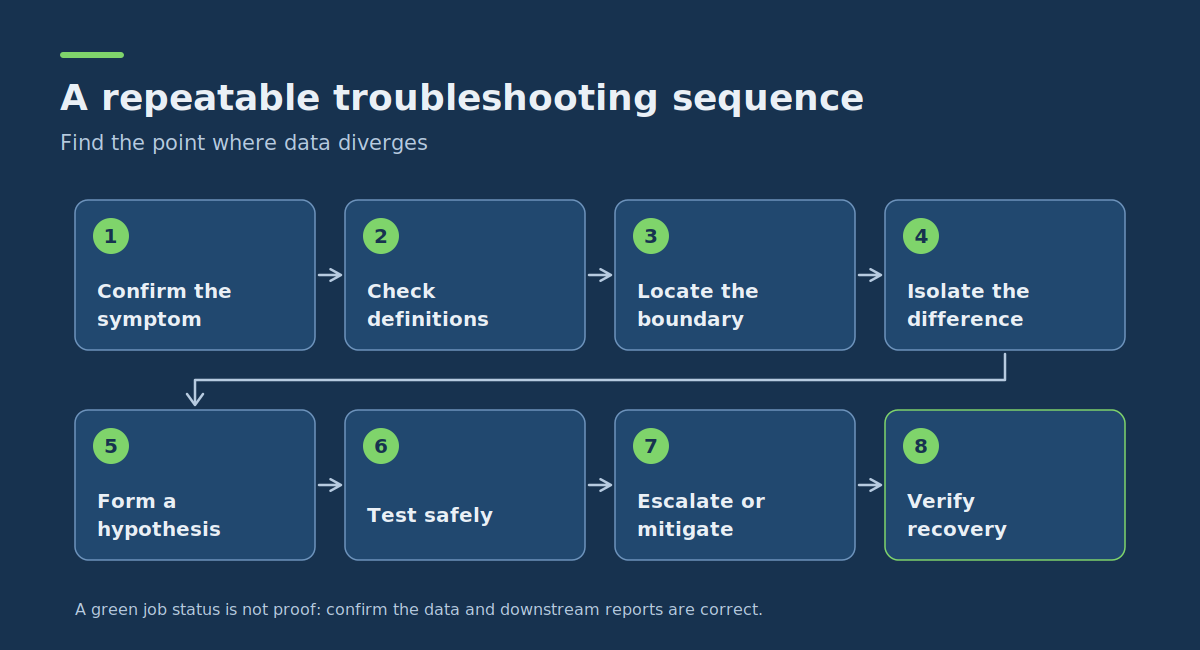
- Confirm the symptom. Identify the report, affected date range, expected value, observed value and evidence supplied by the user.
- Check definitions. Confirm that source and reporting systems use the same filters, timezone, metric definition and data cutoff.
- Locate the boundary. Compare the source, staging, transformed and reporting datasets where applicable.
- Isolate the difference. Identify missing records, duplicated identifiers, unexpected values or delayed updates.
- Form a hypothesis. Propose a specific explanation supported by the observations.
- Test safely. Use read-only investigation or an approved test environment before changing production data.
- Escalate or mitigate. Coordinate a recovery action that matches the incident’s impact and operating procedures.
- Verify recovery. Confirm that affected data and downstream reports are correct, not merely that a job reports success.
The distinction between a symptom and its cause is central to Google’s SRE book chapter on monitoring distributed systems. It describes good monitoring as answering two separate questions: what is broken (the symptom) and why (the cause). The chapter also points out that in a layered system, one person’s symptom is another person’s cause. Slow database reads are a symptom for the database team but a cause for the team watching a slow website. Data work follows the same pattern: a missing row on a dashboard is the analyst’s symptom and a clue for the pipeline owner.
The same chapter notes that a single incident can have several root causes, each of which should be repaired. That is a useful reminder not to stop investigating after finding the first plausible explanation.
3. Data Pipeline Skills: Follow Information From Source To Report
A data support engineer should understand how information moves through the systems they support, even when a separate data engineering team owns pipeline development.
A typical analytics workflow might look like this:
Source application → Ingestion → Staging → Transformation → Data warehouse → Reporting dataset → Dashboard
Each stage introduces possible operational failures. Records may arrive late, transformations may exclude unexpected values, scheduled jobs may run out of order or a downstream report may display an outdated dataset.
What To Investigate In A Data Pipeline Incident
| Pipeline stage | Possible symptom | Useful investigation |
|---|---|---|
| Ingestion | Recent source records are absent from staging. | Check ingestion timestamps, source watermarks, connector status and relevant errors. |
| Transformation | Input records exist but expected output records are missing. | Inspect filtering rules, joins, validation results and rejected rows. |
| Scheduling | A dataset is older than expected. | Review scheduled runs, task states, dependencies and completion times. |
| Loading | Target records are incomplete or duplicated. | Compare keys and row counts; inspect retry and loading behaviour. |
| Reporting | A dashboard disagrees with validated warehouse data. | Review semantic definitions, refresh schedules, filters and cached data. |
An engineer should be able to tell the difference between a failed job, a delayed job and a job that succeeded technically but produced incorrect data.
Orchestration tools such as Apache Airflow expose task states and upstream and downstream dependencies, which help operators understand what ran and in what order. However, a successful task state alone does not prove that its output satisfies business requirements. Data correctness requires independent checks.
4. Monitoring Skills: Detect Failures That Job Status Misses
Monitoring data systems requires more than checking whether the database server is online. A service may be technically available while providing stale or incorrect information. For example, a data warehouse can respond to queries normally even though its latest business records have not arrived.
Google’s SRE book recommends the four golden signals of monitoring: latency, traffic, errors and saturation. Its advice is to focus on these four if you can only measure four metrics of a user-facing system. The chapter is written for services rather than data pipelines, so data teams should adapt it by adding explicit freshness, completeness and correctness checks.
One idea transfers directly. The chapter defines errors broadly: a request can fail explicitly, or implicitly, such as a success response that carries the wrong content. It notes that only end-to-end checks can catch that second kind. A pipeline that finishes green but loads incomplete data is the data equivalent, which is why output validation matters more than job status.
The chapter also separates white-box monitoring, which inspects a system’s internals such as logs and metrics, from black-box monitoring, which tests externally visible behaviour as a user would see it. In data support, job logs and task metrics are white-box signals. A reconciliation check on the finished report is closer to black-box testing, because it asks whether the business-facing output is right.
Practical Monitoring Signals For Data Support
| Signal | What to measure | Example investigation trigger |
|---|---|---|
| Freshness | Time since the latest successfully available data | A reporting table has not received the expected daily partition. |
| Completeness | Expected records versus received or processed records | A completed reporting window has fewer records than the validated source. |
| Correctness | Required invariants, field validity and reconciliation results | Order totals differ between two systems that should agree. |
| Job reliability | Failures, retries, duration and dependency status | A scheduled load repeatedly fails or exceeds its expected completion window. |
| Query performance | Latency, error rates and resource pressure | A critical report becomes unusually slow or times out. |
The appropriate threshold depends on the pipeline’s actual schedule and service expectations. A daily financial report and a near-real-time customer dashboard should not automatically use the same freshness alert.
What Makes A Data Alert Useful?
A useful alert identifies an actionable problem with a meaningful impact or credible risk. It should give the responder enough context to decide what to examine next.
For example, an alert saying “data issue detected” gives little direction. An alert identifying a missing daily reporting partition, the expected completion time and the affected dataset is far more actionable.
The SRE book is direct about the cost of noisy alerting. When alerts fire too often, people begin to skim or ignore them, and a real problem can be masked by the noise. It suggests asking whether a rule detects an urgent, actionable condition that is otherwise undetected, and whether anyone could ever safely ignore the alert. It also advises against alerting simply because something looks slightly unusual, and keeping the rules that page humans simple enough to represent a clear failure.
For data support, the objective is to detect conditions that matter to downstream users, not to generate the largest possible number of metrics.
5. Incident Response Checklist For Data Support Engineers
An incident occurs when a data service fails or becomes sufficiently unreliable to affect its intended users or operations. The first responsibility is to establish impact and coordinate a safe response. Finding the complete root cause may take longer than restoring service.
Data Incident Response Checklist
- Record the incident. Capture the reported symptom, detection time, affected system and current status.
- Assess impact. Determine which users, reports or downstream applications are affected and whether decisions depend on the incorrect data.
- Assign ownership. Identify the incident lead and the engineering or business stakeholders required for resolution.
- Preserve evidence. Retain relevant logs, job identifiers, timestamps and diagnostic results in accordance with security policies.
- Investigate the failure. Compare processing stages and test plausible explanations.
- Choose a safe mitigation. Consider an approved retry, targeted backfill, reporting restriction or other controlled recovery action.
- Communicate status. Explain what is known, what remains uncertain and when the next update will be issued.
- Validate recovery. Confirm that affected records, aggregates and downstream outputs have been corrected.
- Close and learn. Document the verified cause when known, the recovery action and any necessary prevention work.
Why Immediately Rerunning A Job Can Be Dangerous
A retry may be safe when a pipeline is designed to be idempotent: repeated processing of the same input has no unintended additional effect.
Without that guarantee, retrying a failed job could produce duplicate rows, repeated external actions or conflicting updates.
Before rerunning or backfilling production data, a support engineer should understand the affected range, target write behaviour, duplicate-prevention mechanism and approval requirements.
A strong candidate recognises when the safest immediate action is to investigate and escalate rather than modify production data.
6. Stakeholder Communication: Translate Technical Findings Into Useful Updates
Incident communication is a practical engineering skill. Business users need to understand whether they can trust the information they are seeing and what action they should take.
An effective status update usually answers five questions:
- What is affected?
- What impact has been confirmed?
- What is currently known?
- What is being done?
- When will another update be provided?
Example Incident Update
The following is an illustrative message for a reporting-data discrepancy:
We are investigating incomplete order data in the sales dashboard for 16 October. An initial comparison shows that some records available in the source system are missing from the reporting dataset. The cause is not yet confirmed. Please avoid using the affected daily total for financial decisions until validation is complete. We are checking the processing steps and will provide another update at 10:30 UTC.
The message identifies the business impact without claiming a root cause that has not been established. Compare that with “The ETL is broken, but we are fixing it.” The second statement provides no confirmed scope, evidence or useful next action.
Data Support Engineer Skills Matrix: Beginner, Intermediate And Advanced
The following matrix is a practical assessment tool for hiring managers, technical interviewers and candidates.
The levels describe demonstrated performance on relevant tasks, not years of experience or formal job titles. An engineer can be advanced in SQL while remaining intermediate in incident coordination.
| Skill area | Beginner: guided work | Intermediate: independent investigation | Advanced: complex ownership |
|---|---|---|---|
| SQL and databases | Write queries with filters, aggregates and simple joins; locate a known record. | Reconcile datasets, find missing or duplicate records and explain query behaviour. | Investigate complex performance or concurrency problems and recommend safe improvements. |
| Data troubleshooting | Reproduce a reported discrepancy and collect relevant evidence. | Locate the stage where data diverges and test competing hypotheses. | Lead investigations involving multiple systems and ambiguous failure conditions. |
| Pipeline operations | Identify failed jobs and understand basic task dependencies. | Trace records through ingestion, transformation and reporting; assess safe retry options. | Diagnose complex recovery scenarios and design or improve operational safeguards. |
| Monitoring | Interpret existing alerts and check job status. | Investigate freshness, completeness and data quality signals; propose actionable thresholds. | Improve monitoring coverage while balancing detection quality, cost and alert noise. |
| Incident response | Follow a runbook, record impact and escalate appropriately. | Coordinate routine incidents, evaluate mitigations and verify data recovery. | Lead significant incidents, manage risk and drive systemic prevention. |
| Communication | Write clear tickets and factual investigation notes. | Explain impact, uncertainty and next steps to technical and non-technical stakeholders. | Coordinate complex communications and help stakeholders make decisions under uncertainty. |
| Operational safety | Use authorised access and avoid unapproved data modifications. | Evaluate permissions, rollback options, idempotency and sensitive-data handling. | Improve access, recovery and change-control practices across supported systems. |
How to use the matrix: Choose the level required for the actual job, then ask candidates to demonstrate the corresponding actions. Avoid assuming that knowledge of a particular commercial tool proves the underlying skill.
For example, a candidate who has never used your orchestration platform may still be capable of independently investigating task dependencies and incomplete output. Assess that reasoning separately from familiarity with the interface.
Practical SQL Troubleshooting Exercise: Investigate Missing Sales Records
This exercise is designed for an intermediate data support engineer interview. It can also be used for self-assessment.
Suggested duration: 45–60 minutes.
Required tools: A SQL editor supporting PostgreSQL and a text editor for the incident summary. No production system or cloud account is required.
Scenario: At 09:00 UTC on 17 October 2026, a sales analyst reports that the dashboard total for 16 October is lower than the source system’s total. The daily pipeline is marked successful.
Assume that both datasets represent the same finalised reporting window, amounts are in US dollars, order identifiers are unique and neither refunds nor cancellations need separate treatment for this exercise.
Exercise Inputs
The source system contains these six orders:
| Order ID | Order date | Amount ($) |
|---|---|---|
| A101 | 2026-10-15 | 100 |
| A102 | 2026-10-15 | 70 |
| A103 | 2026-10-15 | 30 |
| A104 | 2026-10-16 | 200 |
| A105 | 2026-10-16 | 120 |
| A106 | 2026-10-16 | 40 |
The reporting dataset contains five orders:
| Order ID | Order date | Amount ($) |
|---|---|---|
| A101 | 2026-10-15 | 100 |
| A102 | 2026-10-15 | 70 |
| A103 | 2026-10-15 | 30 |
| A104 | 2026-10-16 | 200 |
| A106 | 2026-10-16 | 40 |
Candidate Tasks
- Write SQL to compare record counts and total amounts by date between the two datasets.
- Identify which order is missing from reporting.
- Explain what has been established and what remains unknown about the cause.
- Describe the next three investigation steps.
- Write a business-facing incident update of no more than 100 words.
- Propose one monitoring rule that could detect this type of problem.
- Explain what must be checked before attempting a retry or backfill.
The exercise assesses more than SQL syntax. Candidates should demonstrate the ability to connect a numerical discrepancy to a safe investigation and communication process.
Worked Solution: SQL Reconciliation Query And Expected Output
The following PostgreSQL query creates the illustrative datasets in memory using VALUES, calculates totals independently and identifies missing source orders. It does not create tables or modify stored data.
WITH source_orders (order_id, order_date, amount) AS (
    VALUES
        ('A101', DATE '2026-10-15', 100),
        ('A102', DATE '2026-10-15', 70),
        ('A103', DATE '2026-10-15', 30),
        ('A104', DATE '2026-10-16', 200),
        ('A105', DATE '2026-10-16', 120),
        ('A106', DATE '2026-10-16', 40)
),
reporting_orders (order_id, order_date, amount) AS (
    VALUES
        ('A101', DATE '2026-10-15', 100),
        ('A102', DATE '2026-10-15', 70),
        ('A103', DATE '2026-10-15', 30),
        ('A104', DATE '2026-10-16', 200),
        ('A106', DATE '2026-10-16', 40)
),
source_totals AS (
    SELECT
        order_date,
        COUNT(*)    AS source_count,
        SUM(amount) AS source_amount
    FROM source_orders
    GROUP BY order_date
),
reporting_totals AS (
    SELECT
        order_date,
        COUNT(*)    AS reporting_count,
        SUM(amount) AS reporting_amount
    FROM reporting_orders
    GROUP BY order_date
),
missing_orders AS (
    SELECT
        s.order_date,
        STRING_AGG(s.order_id, ', ' ORDER BY s.order_id) AS missing_ids
    FROM source_orders s
    LEFT JOIN reporting_orders r
        ON s.order_id = r.order_id
    WHERE r.order_id IS NULL
    GROUP BY s.order_date
)
SELECT
    s.order_date,
    s.source_count,
    COALESCE(r.reporting_count, 0)  AS reporting_count,
    s.source_amount,
    COALESCE(r.reporting_amount, 0) AS reporting_amount,
    s.source_amount - COALESCE(r.reporting_amount, 0) AS amount_gap,
    COALESCE(m.missing_ids, 'None') AS missing_ids
FROM source_totals s
LEFT JOIN reporting_totals r
    ON s.order_date = r.order_date
LEFT JOIN missing_orders m
    ON s.order_date = m.order_date
ORDER BY s.order_date;
Expected output:
| Date | Source rows | Report rows | Source total ($) | Report total ($) | Gap ($) | Missing ID |
|---|---|---|---|---|---|---|
| 2026-10-15 | 3 | 3 | 200 | 200 | 0 | None |
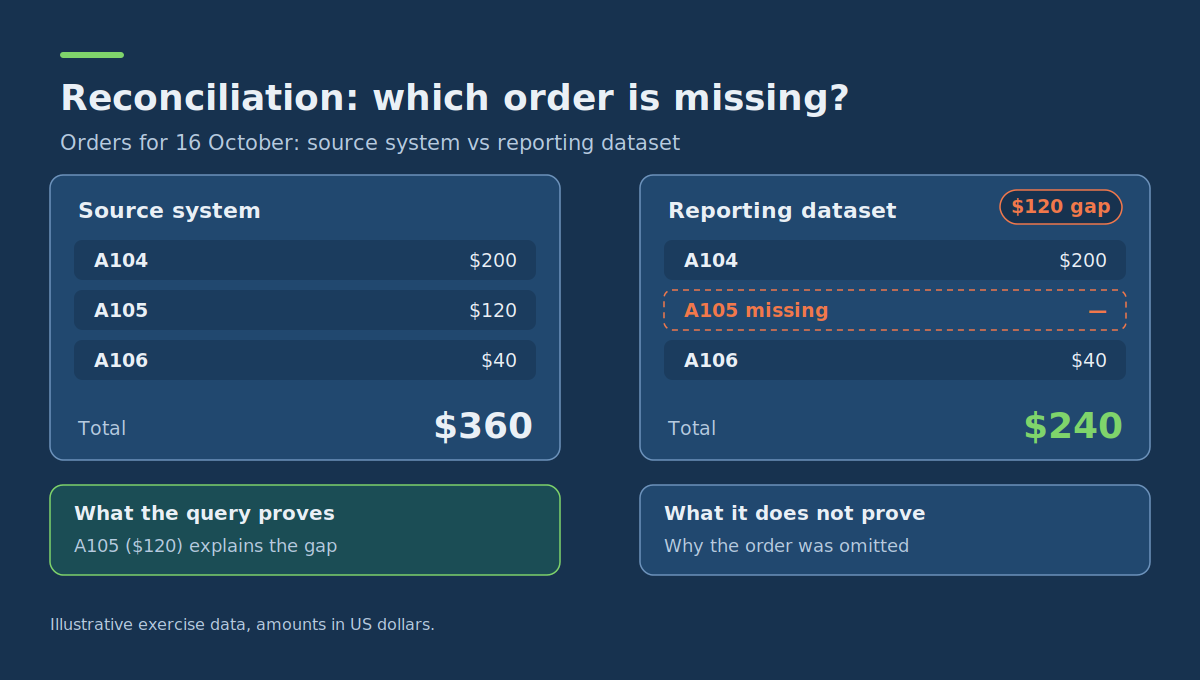
| 2026-10-16 | 3 | 2 | 360 | 240 | 120 | A105 |
The missing record is A105, with an amount of $120. This accounts for the observed difference between the source and reporting totals on 16 October.
The query deliberately computes totals separately before joining their daily summaries. This avoids accidentally multiplying aggregate amounts when individual tables contain repeated keys.
In a real investigation, the engineer would additionally check for duplicate identifiers, unexpected destination-only records, changed amounts and mismatched date assignments. The illustrative query starts from source dates, so it would not reveal a reporting-only date with no corresponding source date.
What Does The SQL Result Prove?
The result proves that the supplied reporting dataset is missing a specific source order and that the missing amount explains the total discrepancy under the exercise assumptions.
It does not prove why the order was omitted. The engineer still needs to investigate potential causes, such as an ingestion problem, transformation filter, load failure or incorrectly applied business rule.
Three Appropriate Next Investigation Steps
- Check staging and ingestion. Determine whether order A105 reached the expected intermediate dataset and whether the relevant ingestion window completed.
- Inspect transformation and load evidence. Review job logs, filtering conditions, rejected-record outputs and processing identifiers associated with the affected run.
- Check downstream state and safe recovery options. Verify whether the order exists in the warehouse but is excluded from reporting, then determine whether a targeted correction or authorised rerun is appropriate.
These steps narrow the cause without assuming it in advance.
Illustrative Incident Update
We have confirmed a $120 discrepancy in the sales reporting dataset for 16 October. Order A105 exists in the source data but is absent from reporting. The daily pipeline shows a successful run, so the cause of the missing record remains under investigation. The affected daily total should not be used for final reporting until the data is reconciled. We are tracing the order through the processing stages and will provide another update at 10:30 UTC.
This response demonstrates both technical precision and appropriate uncertainty.
A Suitable Data Monitoring Rule
For this scenario, an effective initial control would compare source and reporting totals after the relevant daily window has been finalised.
Illustrative alert rule: If the validated source and reporting datasets for a completed daily partition have unequal order counts or monetary totals, create an actionable data-quality alert identifying the date, affected dataset and measured difference.
In production, the rule needs an agreed cutoff for late-arriving records and clearly defined handling for refunds, adjustments and other legitimate differences. Without those conditions, a simple count comparison may generate false alerts.
How To Grade The Take-Home Exercise
A weighted assessment rubric gives interviewers a consistent way to examine evidence and helps prevent familiarity with particular tools from dominating the decision.
The following framework is an illustrative hiring tool, not an externally validated industry standard. Teams should adapt it to their job requirements and confirm that scoring is applied consistently.
Assessment Weights
| Competency | Weight | Evidence to evaluate |
|---|---|---|
| SQL investigation | 20% | Correct reconciliation query, sensible joins, accurate aggregation and identification of A105. |
| Troubleshooting | 20% | Clear distinction between observed discrepancy and unverified root cause. |
| Pipeline understanding | 15% | Logical investigation across ingestion, transformation, loading and reporting. |
| Monitoring | 10% | Actionable detection rule with awareness of data cutoffs and false alarms. |
| Incident response | 15% | Appropriate impact assessment, escalation, mitigation and recovery validation. |
| Communication | 10% | Clear stakeholder update with facts, uncertainty and a useful next step. |
| Operational safety | 10% | Respect for read-only investigation, approval requirements and safe retry behaviour. |
Scoring Scale
| Score | Interpretation | Observed performance |
|---|---|---|
| 0 | Not demonstrated | No usable answer or evidence of the competency. |
| 1 | Beginner | Completes simple parts but requires significant guidance or misses important considerations. |
| 2 | Intermediate | Completes the expected task independently, with correct reasoning and appropriate safeguards. |
| 3 | Advanced | Completes the task and identifies broader failure cases, trade-offs or systemic improvements. |
Calculate the overall score as follows, using percentage weights that total 100:
Weighted assessment score = SUM( Competency weight × Candidate score / 3 )Worked Candidate Scoring Example
Suppose a hypothetical candidate receives these scores:
| Competency | Weight | Candidate score | Weighted contribution |
|---|---|---|---|
| SQL | 20% | 3 | 20.0 |
| Troubleshooting | 20% | 3 | 20.0 |
| Pipelines | 15% | 2 | 10.0 |
| Monitoring | 10% | 2 | 6.7 |
| Incident response | 15% | 2 | 10.0 |
| Communication | 10% | 2 | 6.7 |
| Operational safety | 10% | 3 | 10.0 |
| Total | 100% | — | 83.3% |
The candidate demonstrates strong SQL investigation and troubleshooting, with competent pipeline knowledge and incident handling.
However, the overall score should not be treated as an automatic hiring decision. A candidate who proposes an unsafe production action may require further evaluation even if their combined technical score is high. For a role involving direct production access, an employer may reasonably require demonstrated minimum competence in operational safety and incident handling, independent of the weighted total.
How Should Hiring Managers Adapt The Assessment?
Different data support positions require different levels of specialisation. A junior analyst-support role should not necessarily be assessed against the same requirements as a senior engineer responsible for production recovery.
Junior Data Support Roles
Prioritise accurate SQL fundamentals, evidence collection, documentation and responsible escalation. Good junior candidates should know when they lack sufficient information and avoid risky assumptions. They do not need to lead a complex incident independently.
Intermediate Data Support Roles
Expect independent investigation of routine pipeline and data-quality issues, correct use of diagnostic SQL, meaningful incident updates and safe recovery recommendations. The take-home exercise in this article is primarily designed for this level.
Senior Data Support Roles
Add deeper scenarios involving competing failure hypotheses, ambiguous data freshness, operational trade-offs, incident leadership and improvement of recurring failure patterns.
Ask candidates how they would reduce repeated incidents, distinguish urgent problems from low-priority anomalies and improve the team’s ability to investigate future issues. Senior assessment should examine judgement and system-level thinking, not simply demand more complex SQL syntax.
How Can Candidates Improve Their Data Support Engineer Skills?
A focused learning plan is more useful than attempting to learn every database, warehouse and orchestration platform simultaneously. Start with the abilities needed for a common support investigation.
- Practise SQL reconciliation. Work with small datasets containing missing rows, duplicates, unexpected NULLs and mismatched totals.
- Learn one database well. Understand its query tools, permissions, indexing concepts and basic performance diagnostics.
- Trace a simple pipeline. Build or inspect a source-to-report workflow and deliberately investigate an incomplete output.
- Study monitoring fundamentals. Define freshness and completeness checks and decide when an alert should require action.
- Practise incident communication. Write short status updates that distinguish confirmed findings from hypotheses.
- Document a recovery procedure. Explain prerequisites, approvals, validation steps and rollback considerations for a controlled correction.
Use the exercise above as a starting point. After solving it, create variations: duplicate order IDs, late-arriving data, differing timezones or an incorrectly joined reporting table. For each variation, explain how your diagnostic approach changes and what evidence would be required before proposing a fix.
Common Mistakes In Data Support Interviews And Production Troubleshooting
Assuming A Successful Job Means Correct Data
A job’s successful execution state does not guarantee that expected business records were processed. Validate the output against clearly defined expectations.
Changing Production Data Before Identifying The Problem
Unapproved manual corrections can conceal the original issue or create additional inconsistencies. First establish the affected scope and the safest recovery path.
Ignoring Timezone And Reporting-Window Differences
Two valid queries can return different totals when they use different time boundaries or definitions. Confirm these assumptions before treating a difference as a defect.
Using Complex SQL Without Validating The Result
A technically sophisticated query can still be incorrect. Check joins, row counts and aggregates, particularly when one-to-many relationships may multiply records.
Reporting A Hypothesis As A Confirmed Root Cause
A missing record does not automatically prove that ingestion failed. Good engineers describe the evidence, state what remains unknown and test explanations systematically.
Closing The Incident When The Pipeline Turns Green
Recovery requires confirming that the business-facing data is correct and available. A green task status without output validation is insufficient.
Frequently Asked Questions About Data Support Engineer Skills
Is SQL Enough To Become A Data Support Engineer?
SQL is an important foundation, but the role generally requires broader troubleshooting, data pipeline understanding, communication and operational judgement. SQL helps identify discrepancies; production support also requires explaining their causes, assessing impact and coordinating safe resolution.
What SQL Troubleshooting Tasks Should A Candidate Be Able To Perform?
At an intermediate level, a candidate should be able to compare source and reporting records, identify missing or duplicated identifiers, investigate unexpected aggregates, inspect relevant filters and explain how joins affect results. The candidate should also know when database performance diagnostics or specialist assistance are needed.
What Is The Difference Between A Data Support Engineer And A Database Support Engineer?
The responsibilities can overlap. A database support engineer may focus more closely on database availability, queries, permissions, performance and recovery. A data support engineer may additionally investigate transformations, ingestion jobs, reporting datasets and data quality across multiple systems. Actual job descriptions are more informative than the title alone.
How Should Data Support Skills Be Graded?
Use practical evidence against defined levels of responsibility. Assess whether a candidate can complete straightforward tasks with guidance, investigate routine incidents independently or manage complex technical and operational problems. A weighted rubric can support consistency, but critical safety requirements should be assessed separately.
Does A Data Support Engineer Need Python?
Python is useful for automation, log analysis, API checks and validating datasets, but its importance depends on the organisation’s systems. Some roles rely heavily on SQL and platform-specific administration tools. Strong diagnostic reasoning matters more than familiarity with a particular scripting language.
How Can Someone Without Production Experience Demonstrate Incident-Response Skills?
Use controlled simulations and document the investigation process. A candidate can reproduce a data discrepancy, write diagnostic SQL, identify uncertainty, propose safe next steps and produce an incident update without accessing production systems. Such exercises demonstrate reasoning, although they cannot fully replace experience handling real incidents.
Use Demonstrated Capability As The Standard
A strong data support engineer can move from a vague business complaint to a verified technical finding, an appropriate response and evidence that the affected information is trustworthy again.
For hiring managers, the most useful next step is to adapt the skills matrix and take-home exercise to your actual data environment. For candidates, it is to practise the same investigation until you can explain both the SQL result and the operational decisions that follow from it.
To see how these support responsibilities connect to broader project activities, read our guide to the data science workflow steps. It adds context on data preparation, validation, deployment and monitoring across the lifecycle of a data project.
Pingback:Data Support Engineer Roles and Responsibilities: Practical Guide