
Deep Learning Project Ideas: 12 Practical Builds with Datasets, Baselines and Real-World Uses
The best deep learning project ideas are not the ones with the fanciest architectures. A strong project has a clear problem, an accessible dataset, a simple baseline, measurable evaluation and an honest account of where the system could be useful.
This guide covers 12 practical deep learning projects across computer vision, natural language processing, audio, time series, recommendation systems and graph learning. Each one lists a public dataset, a baseline, a suggested neural approach, an evaluation method and a limitation worth investigating. It suits students choosing a final-year project, developers building a portfolio and R&D leads checking technical feasibility.
Quick picks
- Beginners: image classification, text classification or demand forecasting.
- Intermediate: speech recognition, image segmentation, sensor-based activity recognition or recommendation systems.
- Advanced: anomaly detection, environmental audio classification, graph neural networks or question answering with abstention.
Two rules apply to every project. First, establish a baseline: compare your neural network with a simpler model or decision rule before claiming deep learning adds value. Second, make evaluation part of the project by documenting dataset limitations, failure cases, deployment requirements and reproducibility.
Deep learning project ideas compared
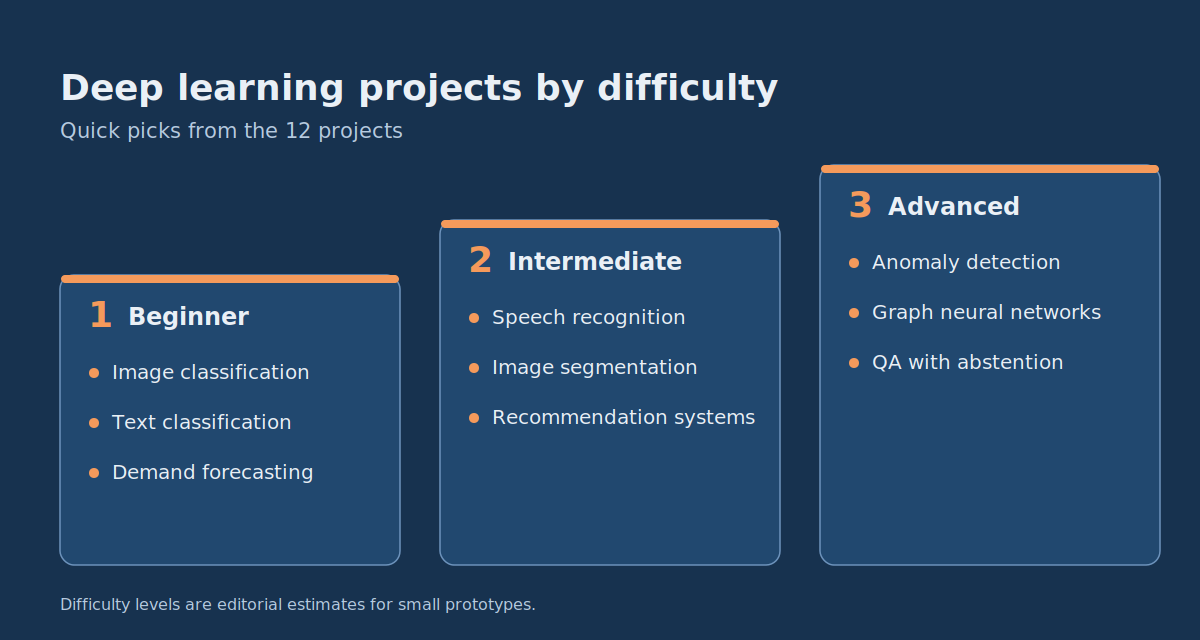
Use this table to choose a project before committing to a framework. Difficulty levels are editorial estimates for a small educational prototype using existing libraries or pretrained models. They are not measured development times or hardware benchmarks.
| Project | Difficulty | Public dataset | Primary metric | Important failure mode |
|---|---|---|---|---|
| 1. Clothing image classification | Beginner | Fashion-MNIST | Test accuracy, per-class recall | Poor transfer from small grayscale images to real product photos |
| 2. SMS spam detection | Beginner | UCI SMS Spam Collection | Spam precision and recall | Legitimate messages blocked |
| 3. Bike rental demand forecasting | Beginner–Intermediate | UCI Bike Sharing | Mean absolute error | Future information leaks into inputs |
| 4. Movie review sentiment analysis | Beginner–Intermediate | IMDb Large Movie Review Dataset | Accuracy, macro F1 | Weak on sarcasm and other writing domains |
| 5. Spoken keyword recognition | Intermediate | Speech Commands | Keyword recall, false activations | Noise and unfamiliar speakers cause mistakes |
| 6. Pet image segmentation | Intermediate | Oxford-IIIT Pet | Intersection over Union | Boundaries fail under unusual lighting and poses |
| 7. Smartphone activity recognition | Intermediate | UCI Human Activity Recognition | Macro F1 across activities | Evaluation benefits from familiar participants |
| 8. Movie recommendation engine | Intermediate | MovieLens 100K | Rating MAE or Recall@K | Fails for new users and unseen items |
| 9. Industrial visual anomaly detection | Advanced | MVTec AD | AUROC, defect localization | Lighting differences mistaken for defects |
| 10. Environmental sound classification | Intermediate–Advanced | ESC-50 | Fold-averaged macro F1 | Recording artifacts leak class information |
| 11. Citation graph classification | Advanced | Cora via PyTorch Geometric | Node classification accuracy | Transductive results mistaken for unseen-graph generalization |
| 12. Question answering with abstention | Advanced | SQuAD 2.0 | Exact Match, token F1 | Answers questions the passage doesn’t support |
Check dataset licenses first. Public availability is not permission for commercial reuse. MVTec AD and ESC-50 carry non-commercial conditions, and Movie Lens 100K requires permission for commercial or revenue-bearing use. Review each dataset’s terms, attribution rules and redistribution limits before downloading, sharing or deploying.
Where to find more datasets. If none of the 12 fits your interest, Kaggle’s dataset library describes hundreds of thousands of open datasets for AI research and model training. Apply the same checks to anything you find there: labels, documentation and license.
How to choose a deep learning project you can finish
A good project is hard enough to teach you something and narrow enough to evaluate properly. Ask five questions before you commit.
1. Can you describe the input and output? For image classification, the input is a clothing image and the output is one of ten garment categories. For forecasting, the input is historical counts plus calendar data, and the output is expected demand. If you can’t state this, the project isn’t defined yet.
2. Are labels or evaluation targets available? Raw images or documents without annotations may require substantial labeling work. Check dataset structure, missing values and licensing before choosing an architecture.
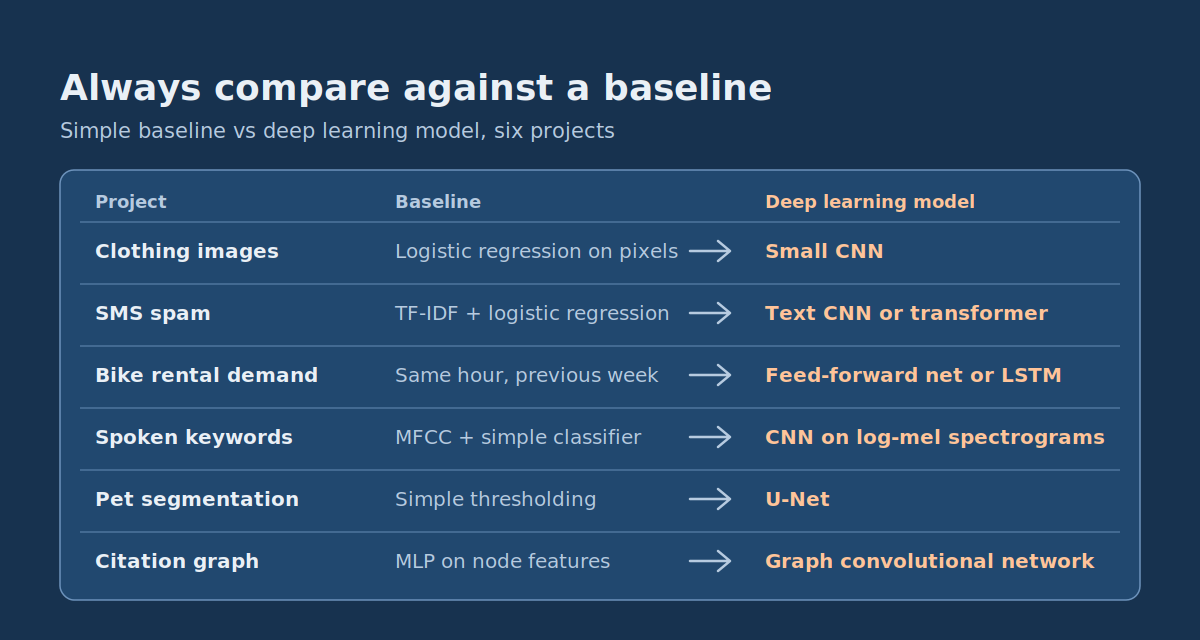
3. Can you build a simpler baseline? For text, try TF-IDF with logistic regression. For forecasting, try the same hour from the previous week. For segmentation, try simple thresholding. A neural network needs a meaningful comparison.
4. Can you evaluate without data leakage? Leakage happens when a model uses information that wouldn’t exist at prediction time. The scikit-learn guide to common pitfalls states the core rules:
- Split your data into train and test sets first, before any preprocessing.
- Never call
fiton the test data. - Use a pipeline to keep preprocessing inside the training data.
Some projects need extra safeguards: split audio by speaker, activity data by participant, and forecasting data chronologically.
5. What can you show beyond a score? Useful extras include a small demo, visual error analysis, a resource-usage measurement or a reproducible baseline comparison. Make clear which situations remain outside the model’s tested scope.
1. Clothing image classifier with Fashion-MNIST
Difficulty: Beginner · Area: Computer vision
Clothing classification is a practical first step into convolutional neural networks (CNNs). Fashion-MNIST, released by Zalando Research, has 60,000 training and 10,000 test images. Each is a 28-by-28 grayscale image labeled with one of ten clothing categories.
What to build
- Input: a 28-by-28 grayscale image.
- Baseline: logistic regression on flattened pixel values.
- Deep learning model: a small CNN with convolutional layers and a classification head.
- Evaluation: accuracy, per-class recall and a confusion matrix on the test set.
- Deliverable: an upload demo that shows predicted labels and flags confusing categories.
What you’ll learn: image preprocessing, convolutional feature extraction, training curves and class-level error analysis. Higher average accuracy doesn’t mean every category is recognized equally well. Compare visually similar classes such as shirts and T-shirts, and show examples where the CNN disagrees with the baseline.
Limitation to investigate: Fashion-MNIST is a controlled educational dataset. Strong results don’t show the model can classify catalog photos with complex backgrounds, varied viewpoints and different lighting.
2. SMS spam detection model
Difficulty: Beginner · Area: Natural language processing
Spam detection is a binary text-classification problem in which different mistakes have different costs. The UCI SMS Spam Collection contains 5,574 labeled messages gathered for spam research.
What to build
- Input: short message text.
- Baseline: TF-IDF with logistic regression or Naive Bayes.
- Deep learning model: a compact text CNN, or a pretrained transformer fine-tuned for classification.
- Evaluation: spam precision, spam recall, a confusion matrix and results at a chosen decision threshold.
- Deliverable: a text-entry demo with a predicted class and a short note on the evaluation trade-off.
What you’ll learn: a false positive blocks a legitimate message, and a false negative lets spam through. Investigate how the threshold changes both outcomes, and check for duplicate or near-identical messages across your training and test data.
Limitation to investigate: spam campaigns change over time. A model trained on a historical collection may fail on current messages, new languages or new attack patterns. Add human review or recovery before automated filtering touches important communications.
3. Bike rental demand forecasting with a neural network
Difficulty: Beginner–Intermediate · Area: Time-series forecasting
Forecasting asks you to predict future demand using only information available at forecast time. The UCI Bike Sharing dataset has daily and hourly rental counts from 2011 and 2012, plus seasonal and weather variables, under CC BY 4.0.
What to build
- Input: prior rental counts, hour, day of week, calendar variables and weather available at forecast time.
- Baseline: the previous comparable hour, or the same hour from the previous week.
- Deep learning model: a feed-forward network with lagged features, or a small LSTM.
- Evaluation: mean absolute error (MAE) on a later chronological period, plus error by hour and day type.
- Deliverable: a forecast chart comparing predictions, actual counts and the baseline.
What you’ll learn: why random splits often fail for forecasting. A random split can put future observations in training while testing on earlier periods. Reserve later dates for evaluation and build lagged features that would have been known when the forecast was made. If you use weather, separate observed weather from forecast weather. Using actual future weather makes the evaluation unrealistically easy.
Limitation to investigate: good average error can hide poor performance during holidays, unusual events or sudden operational changes. Judge the model against the cost of under- and overestimating demand.
4. Movie review sentiment analyzer
Difficulty: Beginner–Intermediate · Area: Natural language processing
Sentiment analysis shows how neural networks represent meaning beyond word counts. The IMDb Large Movie Review Dataset has 25,000 labeled training reviews and 25,000 labeled test reviews, plus additional unlabeled reviews.
What to build
- Input: review text.
- Baseline: TF-IDF with logistic regression.
- Deep learning model: a lightweight text CNN, or a pretrained language encoder fine-tuned for classification.
- Evaluation: test accuracy, macro F1 and error analysis on hard examples.
- Deliverable: a classification interface and an explanation of typical mistakes.
What you’ll learn: compare how word-based features and contextual representations handle negation, mixed sentiment and long passages. “The opening was excellent, but the ending ruined the film” shows why a few positive words aren’t enough. Hold out a validation subset from the training data, and don’t repeatedly tune on the published test set.
Limitation to investigate: a model trained on strongly positive and negative movie reviews may struggle with short customer comments, neutral feedback, sarcasm and industry jargon. A sentiment score is not a full explanation of customer intent.
5. Spoken keyword recognition system
Difficulty: Intermediate · Area: Audio deep learning
Keyword spotting means recognizing short commands while rejecting other speech and noise. Google’s Speech Commands dataset was built for evaluating small speech recognition systems. The TensorFlow Datasets version provides target words plus unknown-word and silence classes.
What to build
- Input: short audio clips as waveforms or spectrograms.
- Baseline: MFCC features with a simple classifier.
- Deep learning model: a compact CNN on log-mel spectrograms.
- Evaluation: per-class recall, false activation rate and latency under a defined test workload.
- Deliverable: a microphone or upload demo that detects supported commands such as “yes”, “no”, “stop” and “go”.
What you’ll learn: sample rate, clip length, background noise and volume all change model behavior. Evaluate the silence and unknown-word cases, not just the command classes. Use the dataset’s intended split so recordings from the same speaker don’t inflate results.
Limitation to investigate: a model that does well on recorded clips can trigger constantly when listening continuously in a noisy room. Measure real triggering behavior and inference latency before calling it suitable for a voice interface.
6. Pet image segmentation system
Difficulty: Intermediate · Area: Computer vision
Classification labels a whole image, while segmentation predicts which pixels belong to an object. The Oxford-IIIT Pet dataset has cat and dog images with breed labels and pixel-level trimaps. Its official documentation covers the annotations and licensing.
What to build
- Input: pet images and their segmentation masks.
- Baseline: simple color or foreground thresholding.
- Deep learning model: U-Net or a compact encoder-decoder network.
- Evaluation: Intersection over Union (IoU), Dice score and visual inspection of boundaries.
- Deliverable: an interface showing the original image, predicted mask and overlay.
What you’ll learn: dense prediction, where the output is spatial rather than one label per image. If you convert trimaps to binary masks, document how ambiguous boundary pixels are handled in training and evaluation. Compare results on complex backgrounds, dark fur, similar foreground and background colors, and partly hidden animals.
Limitation to investigate: pixel accuracy on pet photos doesn’t prove reliability on unrelated objects or professional background removal. The dataset may not cover the lighting, resolution and composition of your target use.
7. Human activity recognition from smartphone sensors
Difficulty: Intermediate · Area: Sensor-based sequence classification
Accelerometer and gyroscope signals can reveal movement patterns. The UCI Human Activity Recognition dataset has recordings from 30 participants performing six activities while carrying a smartphone, with a participant-based train/test split.
What to build
- Input: time windows of accelerometer and gyroscope signals.
- Baseline: logistic regression or a random forest on the supplied engineered features.
- Deep learning model: a 1D CNN on the underlying sensor windows.
- Evaluation: macro F1 and a per-activity confusion matrix on the subject-independent test partition.
- Deliverable: a visualization of sensor signals next to predicted activities (walking, upstairs, downstairs, sitting, standing, lying down).
What you’ll learn: generalization across people. If windows from one participant appear in both training and test sets, the model can exploit that person’s movement style, so use subject-based evaluation. Also keep the engineered feature vectors separate from the raw signal files, because a true 1D CNN needs temporal inputs rather than a vector of summary statistics.
Limitation to investigate: performance shifts with device position, sensor hardware, sampling rate and movement style. A model trained on waist-mounted phones may fail when the phone is in a bag or pocket.
8. Movie recommendation engine
Difficulty: Intermediate · Area: Recommendation systems
Recommenders predict preferences from interaction history, and the goal is often to rank items rather than classify them. MovieLens 100K, maintained by GroupLens, contains 100,000 ratings from 943 users across 1,682 movies.
What to build
- Input: user IDs, movie IDs and observed ratings.
- Baseline: popularity ranking, item-average ratings or matrix factorization.
- Deep learning model: neural collaborative filtering with learned user and item embeddings.
- Evaluation: rating MAE for rating prediction, or ranking metrics such as Recall@K with a properly built recommendation evaluation.
- Deliverable: a demo that shows personalized recommendations next to a popularity baseline.
What you’ll learn: sparse interaction data, embeddings, and the difference between predicting ratings and producing useful rankings. Don’t report a ranking metric for a rating predictor without explaining how predictions become a candidate ranking and how “relevant” is defined. Use a consistent split, such as chronological holdout or provided folds, and make sure held-out ratings never feed user or item features.
Limitation to investigate: new users and new items have little or no history, and the dataset reflects old rating behavior rather than modern signals such as clicks and watch completion.
Licence caution: MovieLens 100K permits research use under stated conditions, restricts redistribution and requires permission for commercial or revenue-bearing use.
9. Industrial visual anomaly detection
Difficulty: Advanced · Area: Computer vision and anomaly detection
Defects are often rare, varied or absent from training data, so this differs from ordinary classification. MVTec AD provides defect-free training images, test images with normal and anomalous cases, and pixel-level annotations for evaluation.
What to build
- Input: normal images for training, and normal and defective images for evaluation.
- Baseline: simple image-feature distances or threshold-based defect scoring.
- Deep learning model: a convolutional autoencoder or a pretrained-feature anomaly detection method.
- Evaluation: image-level AUROC, pixel-level localization metrics and false-alarm analysis.
- Deliverable: an anomaly score and a heatmap of suspected defect locations.
What you’ll learn: how to separate harmless variation from genuine defects. For a reconstruction-based model, check whether defects really produce larger reconstruction errors than changes in lighting, texture or camera position. If your protocol trains on normal images only, don’t tune thresholds on the final defect test set and then present that same data as independent evidence.
Limitation to investigate: real inspection needs an acceptable false-rejection rate, defect coverage and stable imaging. A striking heatmap doesn’t mean the system can replace quality control.
Licence caution: MVTec AD uses CC BY-NC-SA 4.0, which restricts commercial use. A commercial product would need appropriately licensed data and validation in its own environment.
10. Environmental sound classification
Difficulty: Intermediate–Advanced · Area: Audio classification
This project identifies sounds such as rain, animals or alarms from short recordings. ESC-50 has 2,000 five-second recordings across 50 categories, with predefined folds for cross-validation.
What to build
- Input: five-second recordings or derived spectrograms.
- Baseline: MFCC features with a support vector machine or another simple classifier.
- Deep learning model: a CNN on log-mel spectrograms, optionally with an appropriately licensed pretrained audio representation.
- Evaluation: macro F1 and per-class recall across the predefined folds.
- Deliverable: a classification demo with predicted category and error analysis.
What you’ll learn: recordings carry information beyond the target event, such as microphone traits, recording conditions and preprocessing artifacts. The ESC-50 maintainers document a potential leakage issue: some original recordings were processed in ways that may correlate with the class. That makes it a good chance to discuss benchmark limits. Report results across all folds and inspect which categories are repeatedly confused.
Limitation to investigate: curated five-second clips don’t represent overlapping sources or sounds at unfamiliar distances and volumes. Real monitoring needs testing with noise, unseen environments and uncertain predictions.
Licence caution: the full ESC-50 collection is CC BY-NC. The maintainers identify a smaller ESC-10 subset under CC BY. Check the exact subset and attribution terms before reuse.
11. Research paper classification with graph neural networks
Difficulty: Advanced · Area: Graph deep learning
Graph neural networks (GNNs) learn from both entity attributes and the relationships between entities. The Cora citation network is available through the PyTorch Geometric Planetoid interface. Nodes are research papers, edges are citations, and the task is to predict each paper’s subject.
What to build
- Input: document feature vectors, citation edges and available training labels.
- Baseline: logistic regression or a multilayer perceptron on node features without the graph.
- Deep learning model: a graph convolutional network (GCN).
- Evaluation: node classification accuracy on the documented public split.
- Deliverable: a comparison of node-only and graph-aware predictions.
What you’ll learn: when relationships between examples add predictive information. State which split you use and what graph information is visible during training and evaluation. In a transductive setting the model can use the structure and features of nodes whose labels are held out. That differs from predicting labels for new papers in an unseen graph, so report which setting you tested and don’t generalize from one to the other.
Limitation to investigate: a citation graph rarely resembles business graphs, which add new nodes, changing edges, data permissions, scale and serving complexity. Confirm upstream dataset terms before redistribution or commercial adaptation.
12. Question answering that knows when not to answer
Difficulty: Advanced · Area: Natural language processing
A useful question-answering system finds supported answers and recognizes when the evidence doesn’t contain one. SQuAD 2.0 combines answerable reading-comprehension questions with adversarially written unanswerable ones, and it requires abstaining when the passage doesn’t support an answer.
What to build
- Input: a question and a supporting passage.
- Baseline: lexical sentence selection and answer matching with an explicit no-answer rule.
- Deep learning model: a pretrained extractive QA transformer fine-tuned on SQuAD 2.0.
- Evaluation: Exact Match, token-level F1 and separate analysis of answerable and unanswerable questions.
- Deliverable: a passage-based QA interface that highlights evidence or declines to answer.
What you’ll learn: a system that always answers can look helpful while inventing unsupported claims. Tune the no-answer threshold on validation data. Inspect cases where an answer existed but the model abstained, and cases where it returned a span despite weak evidence. Don’t describe this as a full retrieval-augmented generation (RAG) system, because SQuAD supplies the passage while real RAG must also find the right documents.
Limitation to investigate: benchmark span extraction says little about private documents, changing knowledge bases or complex business questions. Permissions, retrieval quality and unsupported-answer handling need separate evaluation.
Licence note: SQuAD 2.0 is CC BY-SA 4.0 according to its official project page, so review the attribution and share-alike terms.
How to evaluate deep learning projects fairly
Training accuracy alone is weak evidence. A defensible evaluation needs a suitable baseline, a split that matches the real prediction setting and metrics that reflect meaningful errors.
| Task | Useful metrics | Also inspect |
|---|---|---|
| Image or text classification | Accuracy, precision, recall, macro F1 | Class imbalance, confusion matrix, error consequences |
| Forecasting or regression | MAE, RMSE | Future periods, peaks, unusual conditions |
| Segmentation | IoU, Dice score | Boundaries, small regions, annotation quality |
| Recommendation | MAE; Recall@K or NDCG@K | Cold starts, candidate selection, exposure bias |
| Anomaly detection | AUROC, recall | Threshold behavior, localization, false positives |
| Question answering | Exact Match, token F1 | Unsupported answers, unnecessary abstention |
Interpret metrics in context. In a spam filter, blocking a real message costs something different from missing one spam message. In forecasting, underestimating a peak may matter more than a small gain in average error.
Keep baselines and neural models comparable. Use the same target definitions, split and metric for both. Don’t compare a neural model on an easy random subset with a baseline on hard future examples.
Make results reproducible. Record dataset versions, preprocessing, model configuration and random seeds. The scikit-learn documentation notes that reproducible results across runs require removing every use of random_state=None, which is the default, so set seeds deliberately and report them.
Inspect failure cases, not just averages. Group errors by plausible cause: ambiguous labels, domain shift, collection artifacts, class imbalance, missing context or poorly chosen thresholds. Treat these as hypotheses for your next experiment, not proven causes.
How much computing power do these projects need?
Compute depends on input size, architecture, batch size, training procedure and whether you use pretrained models. Difficulty doesn’t translate directly into a GPU requirement.
| Approach | Good starting projects | Guidance |
|---|---|---|
| CPU-first | Fashion-MNIST baseline, SMS spam baseline, bike rental forecasting, simple MovieLens models | Settle data processing and evaluation before scaling up |
| Modest GPU may help | Small CNNs, audio spectrogram classifiers, segmentation prototypes, fine-tuning pretrained text models | Start with reduced experiments and measure memory |
| More demanding or variable | Advanced anomaly detection, larger transformers, graph experiments, extensive hyperparameter searches | Reuse pretrained models, limit scope and estimate from small trial runs |
These are not guaranteed hardware requirements. Measure real training and inference workloads before buying or renting compute.
A project plan you can adapt for a final-year submission
Write a short experiment specification before you code. This example uses the Fashion-MNIST classifier. It is a proposed plan, not a completed experiment.
| Field | Example specification |
|---|---|
| Title | Comparing logistic regression and a CNN for clothing image classification |
| Objective | Test whether a compact CNN beats a simpler pixel-based model |
| Dataset | Fashion-MNIST (Zalando Research) |
| Input / output | 28-by-28 grayscale image / one of ten clothing categories |
| Baseline | Logistic regression on flattened, scaled pixels |
| Deep learning approach | Compact CNN with a small classification head |
| Data split | Validation set carved from the training set; test set untouched until the final evaluation |
| Primary metric | Test accuracy |
| Secondary analysis | Per-class recall, confusion matrix, training curves, representative errors |
| Success condition | A reproducible evaluation, a clear verdict on CNN vs baseline and an explanation of main failure cases |
| Deliverable | Small image-classification demo |
| Scope restriction | No claim of production accuracy on real e-commerce photography |
The success condition doesn’t promise a target accuracy. The project succeeds as engineering if it produces valid, reproducible evidence, even when the neural model adds little.
Suggested implementation sequence
- Inspect the dataset. Verify labels, input shapes, class balance and licensing.
- Set the evaluation split. Preserve a held-out test set and choose validation data appropriately.
- Train a simple baseline. Record configuration and metrics.
- Build the neural network. Keep the first architecture small enough to debug.
- Review validation results. Check overfitting, underfitting and class-level errors.
- Evaluate once on the test set. Don’t pick new configurations based on test results.
- Create the demo. Make inputs, outputs and uncertainty understandable.
- Document limitations. Explain where the dataset differs from your intended use.
If you’re new to the training and evaluation workflow, this guide shows how to create a machine learning model fast, from problem definition to a tested baseline.
How to make a deep learning project stand out
Engineering judgment impresses more than extra layers or a bigger pretrained model.
Compare at least two approaches. Explain why you chose the baseline and whether the neural model earns its complexity. If a simple model performs almost as well, ask whether accuracy, speed or memory justifies the extra complexity.
Include a meaningful stress test. Examples include image classification under changed brightness, speech recognition with added noise, activity recognition on unseen participants, forecasting on unusual periods, and question answering with deliberately unanswerable inputs. Make sure each perturbation is valid, since not every rotation preserves a class label.
Explain operational boundaries. Document the expected inputs, when predictions may be unreliable and what happens with invalid or unfamiliar data. For production-style prototypes, define batch versus on-demand prediction and basic monitoring for input validity, failures and data drift.
Make it reproducible. Include dependencies, dataset access instructions, preprocessing steps, training configuration and evaluation scripts. Don’t redistribute datasets or pretrained weights unless the licence allows it. Where it doesn’t, point to the official source with instructions.
Can these projects become real business applications?
Yes, but an educational benchmark is only the first technical exercise. A business application needs representative data, proper permissions, reliable integration and evaluation against real operational requirements.
| Educational project | Potential business use | Additional work required |
|---|---|---|
| Image classification | Product categorization | Representative catalog images, business-specific labels, human correction paths |
| Demand forecasting | Capacity or inventory planning | Relevant transaction history, valid future inputs, planning-cost evaluation |
| Audio classification | Categorizing environmental or equipment sounds | Representative recordings, permitted collection, false-alert testing |
| Anomaly detection | Visual quality inspection | Properly licensed production images, defect validation, review-process integration |
| Recommendations | Personalized discovery | Permitted interaction data, cold-start handling, real-behavior evaluation |
| Question answering | Finding answers in approved documents | Access controls, retrieval evaluation, source attribution, unsupported-answer handling |
These are possible applications, not claims that a public-benchmark model is ready for commercial deployment.
For a company, the first question is whether the problem needs deep learning at all. A rules-based system, search workflow or conventional model may do the job more simply. When custom modeling is justified, custom AI and machine learning software services can scope development around your own data and workflows. If the model has to fit into daily operations, custom software development for business workflows covers how it connects to the systems your team already uses.
Frequently asked questions
Which deep learning dataset is best for beginners?
Fashion-MNIST is a good start for image classification because its input format, labels and train/test structure are straightforward. For text, the SMS Spam Collection is small with an accessible baseline. For time series, UCI Bike Sharing works if you evaluate future predictions chronologically. Choose a task where you can understand both the inputs and your model’s mistakes.
How do I judge the difficulty of a deep learning project?
Weigh five factors: data preparation, model complexity, compute needs, evaluation design and deployment requirements. A small CNN on an accessible image dataset is usually easier than a project needing audio preprocessing, graph construction or specialized annotation. Dataset size alone is a poor guide, since a small but poorly labeled dataset can be harder than a large, well-documented one.
What baseline should I compare my deep learning model with?
Pick a baseline suited to the same task and evaluation setup. Use logistic regression for simple classification, TF-IDF with a linear classifier for text, and historical averages or seasonal naive predictions for forecasting. For recommendations, use popularity ranking or matrix factorization. A baseline should be simple to understand but credible enough to test whether the neural approach adds value.
Are advanced deep learning projects suitable for final-year students?
Yes, if the scope is controlled. You don’t need to train a large model from scratch. A graph classification comparison, a small anomaly detection system or a QA model built on pretrained representations can all work, provided you focus on careful evaluation and error analysis. A narrow, well-evaluated project is easier to defend than a large one you can’t finish or reproduce.
Do I need to train a deep learning model from scratch?
No. Transfer learning and pretrained models are useful when data or compute is limited. Document each model’s source, permitted uses, known training assumptions and whether your evaluation data may overlap with its earlier training data.
How should I present a deep learning project in a portfolio?
Show the problem, dataset, baseline, architecture, evaluation method, results and failure analysis. Include code to reproduce the experiment and a small demo when practical. State which figures are measured, which assumptions are illustrative and where the model shouldn’t be used.
Choose one problem and build it all the way through
A valuable deep learning project is more than a notebook that trains a network. It shows what the model is meant to do, how it compares with a simpler approach, whether the evaluation can be trusted and which limitations matter outside the dataset.
If you’re starting out, pick Fashion-MNIST, SMS spam detection or another tightly scoped classification task. If you already understand model training, move to sequence data, segmentation or recommendations. For advanced work, anomaly detection, graph learning and question answering with abstention offer rich evaluation challenges.
Use the comparison table to pick a topic, define your baseline and decide on evaluation before choosing an architecture. Then build a reproducible experiment, study the errors and ship a demo that shows both what the model can do and where it falls short.
Pingback:How to Build a Machine Learning Model Fast: Step-by-Step