
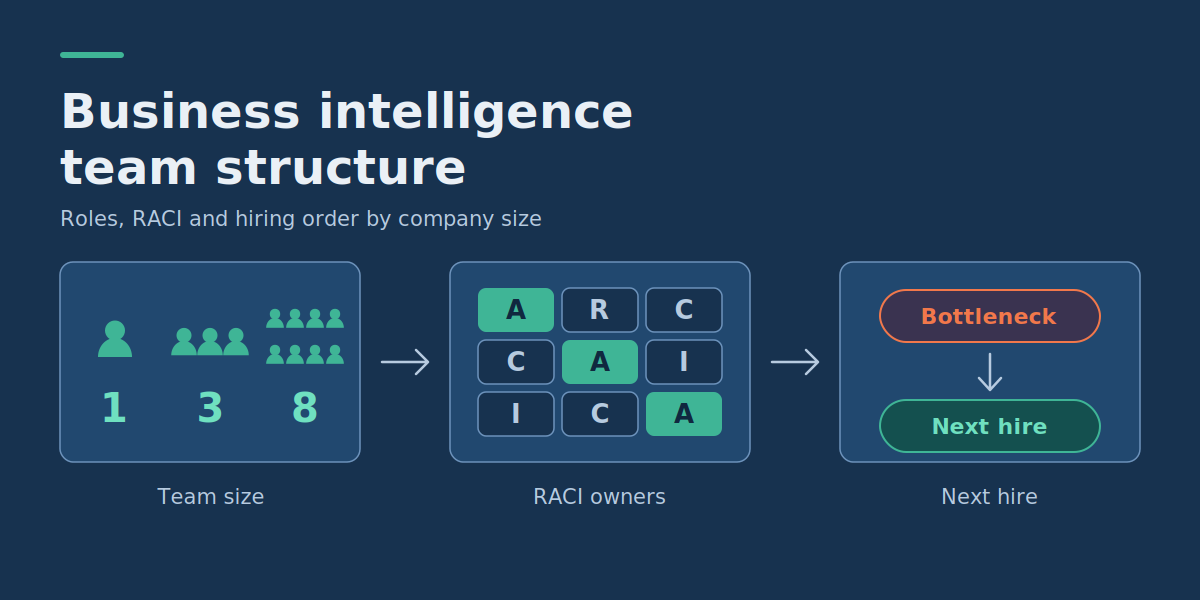
Business Intelligence Team Structure: Roles, RACI and Hiring Order by Company Size
A business intelligence team turns organizational data into reliable reporting and analysis. The right business intelligence team structure depends on the decisions the business needs to make, the complexity of its data and the amount of ongoing analytical work. A small company may succeed with one versatile BI professional, while a larger organization may need separate specialists for data engineering, analytics, reporting and governance.
This guide presents three illustrative BI team structures (1, 3 and 8 people), a reusable RACI matrix and a practical method for deciding which role to hire or outsource next.
What is the best structure for a business intelligence team?
- A one-person BI team can work when reporting needs are focused, data sources are manageable and business owners remain accountable for metric definitions.
- A three-person team can separate data engineering from reporting. This becomes useful when maintaining data pipelines and developing dashboards compete for the same person’s time.
- An eight-person team can introduce specialist roles for shared data models, analytics delivery, platform operations and business engagement.
- Data ownership is not the same as dashboard ownership. Business leaders approve what important metrics mean; BI specialists implement, validate and present them.
- Hire or outsource according to the bottleneck. A defined integration project may not justify a permanent engineer, while continuous analysis may need someone embedded in the business.
The most effective starting point is to identify the work that needs ownership before selecting job titles.
What does a business intelligence team actually do?
BI work extends beyond designing dashboards. A reliable reporting function must connect business requirements to trusted data, maintain the systems that produce it and help people act on the results. These responsibilities exist regardless of company size; what changes is how many people share them.
1. Translate business decisions into reporting requirements
Someone must understand why a department needs information, what decision the report will support and which measures are relevant. For example, a sales director asking for a revenue dashboard might need to distinguish completed sales, recognized revenue, recurring revenue and sales pipeline value. Those measures serve different purposes and should not be treated as interchangeable.
A BI analyst, product owner or team lead can gather requirements, but the relevant business leader should approve the intended meaning of important measures.
2. Integrate and prepare data
Business information often comes from customer relationship management (CRM) systems, accounting software, operational databases, marketing platforms and other applications. The BI function must ensure that necessary data can be extracted, transformed and made available reliably through scheduled integrations, database queries, transformation models and monitoring.
A data engineer may own these technical processes in a larger team. In a small company, the work could be handled by a BI generalist, an existing engineering team or a specialist implementation partner.
3. Create consistent business metrics
When different dashboards use different calculations for the same metric, stakeholders may lose confidence in reporting even when each individual calculation is technically correct. BI professionals help implement reusable definitions for key performance indicators (KPIs), including the calculation, included records, reporting period, units and applicable exclusions.
The business data owner should approve the definition. An analytics engineer or BI developer can implement it in a shared reporting model.
4. Build reports and perform analysis
Dashboards help users monitor performance, compare outcomes and identify exceptions. Analysts go further by investigating what changed, exploring possible explanations and presenting findings with appropriate limitations. A useful BI team can answer both “What happened?” and “What should we investigate next?” without confusing correlation with a proven cause.
5. Maintain reporting reliability and data access
Data sources change, queries fail, refreshes are delayed and permissions must be updated when employees change roles. Critical reports need a named operational owner, a process for investigating discrepancies and documented access restrictions. Business data owners, IT and information security may share these responsibilities with BI.
Microsoft’s Center of Excellence guidance lists generalized roles for this kind of work, including data engineer, data modeler, report creator, trainer and user support. It notes that it is common for one person to serve several roles, and that having a team formally recognized in the organizational chart is recommended but not required, as long as the roles and responsibilities are identified, prioritized and assigned.
Business intelligence team structures: 1 vs 3 vs 8 people
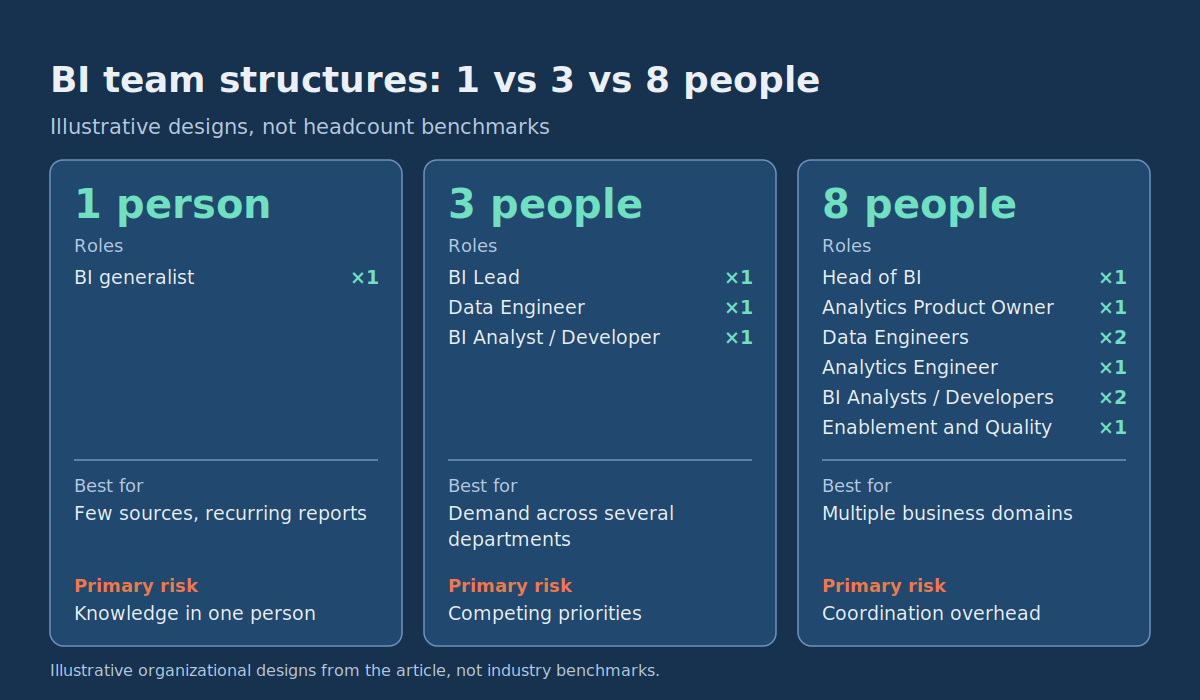
The following comparison provides three practical staffing scenarios. The numbers are illustrative organizational designs, not industry benchmarks or recommended headcount ratios.
| Team size | Suggested structure | Best suited to | Primary risk |
|---|---|---|---|
| 1 person | One BI generalist supported by business owners and existing technical resources. | A limited set of data sources and recurring reports. | Too much operational knowledge concentrated in one person. |
| 3 people | BI Lead, Data Engineer and BI Analyst/Developer. | Growing reporting demand across several departments. | Competing priorities and insufficient specialist capacity. |
| 8 people | BI leadership, product ownership, data engineers, analytics engineering, analysts and enablement. | Multiple business domains and significant shared reporting infrastructure. | Coordination overhead and distance from business users. |
Base the choice on workload and operational complexity. A business with a small employee count but numerous complicated data integrations may need more technical capacity than a much larger business with a simple reporting environment.
Example 1: Building a one-person BI team
Illustrative scenario: A small B2B company has a CRM, an accounting system and a limited number of operational reports. Management wants a consistent view of sales performance, customer activity and business expenses. The company has no dedicated BI department and wants to establish reporting without immediately hiring several specialists.
Recommended first role: BI generalist
The first hire should be comfortable with SQL, dashboard development, data preparation and communication with nontechnical stakeholders. The role combines:
- Collecting reporting requirements.
- Preparing and querying existing data.
- Building and updating reports.
- Maintaining basic metric documentation.
- Checking calculations against agreed source records.
- Investigating routine reporting problems.
The person does not need to be an expert in every aspect of data engineering, security and analytics architecture. However, work outside their capabilities must have another owner.
Worked hiring plan: one-person BI function
| Planning item | Illustrative decision |
|---|---|
| Internal BI headcount | 1 BI Generalist. |
| Business sponsor | Operations Director, outside BI headcount. |
| Data owners | Sales Manager for pipeline metrics and Finance Manager for accounting-related measures. |
| Initial sources | CRM and accounting software. |
| Initial outputs | Sales pipeline dashboard, completed-sales reporting and an expense summary. |
| Specialist support | Existing IT staff or an external engineer for complex integrations and infrastructure. |
| Acceptance criteria | Reports reconcile with approved examples; refresh processes and metric definitions are documented. |
| Next hiring trigger | Recurring engineering or reporting work consistently prevents the generalist from completing priorities. |
This design makes business ownership explicit without creating additional permanent positions. For example, the Finance Manager determines which transactions belong in a particular financial report. The BI generalist implements the calculation and checks the resulting data. The Finance Manager then validates that the calculation follows the agreed definition.
What can go wrong with one BI employee?
The biggest risk is a single point of failure. If one person builds every integration and report without documentation, their absence can interrupt reporting. A practical safeguard is a short operating guide containing source connections, key calculations, refresh procedures, access administration contacts and common failure scenarios.
For complex one-time integrations, an external specialist may be more appropriate than hiring a permanent data engineer immediately.
Example 2: Building a three-person BI team
Illustrative scenario: A growing company now needs reporting across sales, marketing and operations. The original BI generalist spends significant time repairing data integrations while new dashboard requests accumulate. This is a situation where introducing specialization can improve delivery.
Recommended three-person structure
| Role | Core responsibility | Expected deliverable |
|---|---|---|
| BI Lead / Senior Analyst | Business requirements, priorities, coordination and reporting quality. | Approved reporting backlog, KPI ownership records and accepted releases. |
| Data Engineer | Data integrations, transformations, refreshes and pipeline reliability. | Documented and monitored data pipelines. |
| BI Analyst / Developer | Dashboard development, investigation, validation and user support. | Usable reports with verified calculations and defined audiences. |
The BI Lead coordinates requests with business owners. The Data Engineer maintains the technical data foundation, allowing the Analyst to focus on analytical delivery.
Worked hiring plan: growing from one to three people
Assume the company already has one capable BI generalist who can become the BI Lead. The team reviews its work and finds two recurring problems:
- CRM and operational data pipelines regularly require engineering intervention.
- Important reporting requests are delayed because the lead handles most dashboard development personally.
The hiring sequence is:
- Second position: Data Engineer. Transfer recurring integration and pipeline maintenance work from the BI Lead. Establish monitoring, documentation and recovery procedures.
- Third position: BI Analyst/Developer. Expand report delivery and investigative analysis, using the datasets maintained by the engineer.
In this example, the Data Engineer joins first because unstable data pipelines are preventing other work. If the integrations were already reliable and the main constraint was an expanding reporting backlog, the Analyst could reasonably be hired before the Engineer.
Acceptance test: Recurring pipeline issues have a named technical owner, priority reports are completed against agreed requirements and business users can resolve ordinary questions without depending entirely on the BI Lead.
Which responsibilities remain outside the BI team?
Even with three employees, departments still need to own their business definitions and reporting decisions. For example, marketing leadership should approve how qualified leads are defined. The BI team can implement the calculation, investigate inconsistencies and explain how the metric changes over time.
Similarly, security-sensitive access must follow organizational policy. A BI developer’s ability to configure permissions does not mean they have authority to approve access to every dataset.
Example 3: Building an eight-person BI team
Illustrative scenario: An established organization operates across several business functions, uses multiple operational systems and supports a growing number of dashboards and analytical models. Reporting requires continuous data engineering, business engagement and maintenance of shared metrics. The BI team is no longer just a dashboard delivery function.
Recommended eight-person structure
| Position | Headcount | Primary responsibility |
|---|---|---|
| Head of BI | 1 | Leadership, budget, cross-department coordination and overall BI delivery. |
| Analytics Product Owner | 1 | Roadmap, stakeholder needs, prioritization and acceptance criteria. |
| Data Engineers | 2 | Source integration, data pipelines, infrastructure reliability and performance. |
| Analytics Engineer | 1 | Reusable data models, shared metric implementation and transformation testing. |
| BI Analysts / Developers | 2 | Departmental analysis, dashboards, user requirements and reporting validation. |
| BI Enablement and Quality Specialist | 1 | Documentation, training, reporting quality coordination and support processes. |
| Total | 8 | Dedicated BI staff, excluding business data owners and shared IT/security support. |
This is one possible configuration, not a universal recommendation. Companies with stable managed data infrastructure may need fewer dedicated engineers, while organizations with extensive analytical requirements may need additional analysts or specialized modeling expertise.
Worked hiring plan: expanding an established BI function
Assume a three-person team already handles basic data integration and reporting. The organization now experiences several operational problems:
- Different departments repeatedly implement the same KPI calculations.
- Reporting requests compete for attention without a clear product roadmap.
- Additional data sources place pressure on engineering operations.
- Business users cannot consistently locate trusted reporting datasets.
The proposed additional hires are:
- Analytics Engineer: Introduce shared data models and centrally implemented KPI calculations. Business owners continue approving definitions.
- Analytics Product Owner: Coordinate priorities across departments, maintain a reporting roadmap and agree on acceptance criteria.
- Second Data Engineer: Improve capacity for integrations, pipeline operations and performance as demand grows.
- BI Enablement and Quality Specialist: Improve report discovery, documentation, training and recurring support.
- Second BI Analyst/Developer: Provide additional analytical delivery capacity for important business functions.
The original BI Lead becomes Head of BI. With five additional positions, the organization reaches the illustrative eight-person model. That order follows the assumed problems, not an externally validated staffing formula. Modify it according to your actual bottlenecks.
What changes operationally at this size?
The team needs a way to distinguish work that should be shared across the organization from work that can remain within departments. A company-wide definition of “active customer” should be implemented consistently. A departmental dashboard exploring the performance of one sales campaign may remain under that department’s control, provided it follows relevant policies.
Microsoft’s Center of Excellence documentation describes four ways to structure analytics expertise: centralized, unified, federated and decentralized. It notes that a highly centralized team tends to be authoritarian, a highly decentralized one tends to be siloed, and that for most organizations the unified or federated approach, which bridges organizational boundaries, tends to be the most effective. It also advises starting centralized if that is easier and evolving over time.
An eight-person BI team can borrow this principle (shared standards plus business-domain knowledge) without creating an additional management layer or a formal Center of Excellence.
BI team RACI matrix: who owns each decision?
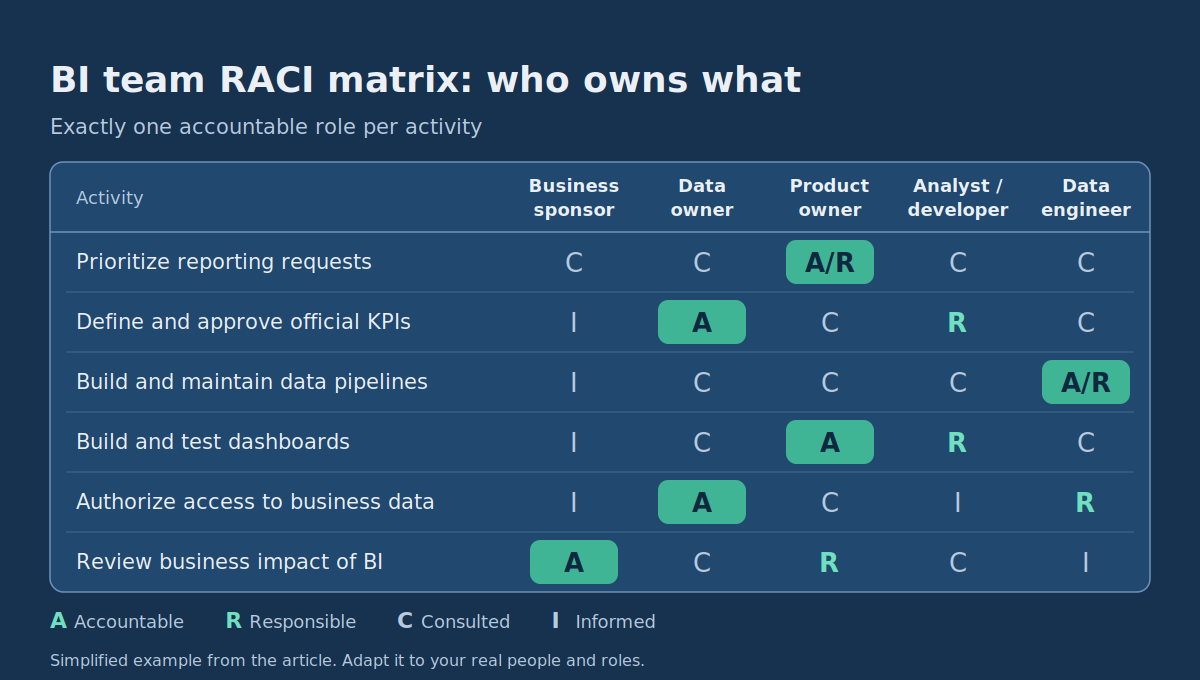
A RACI matrix assigns responsibility and accountability to important activities. It is particularly useful when several teams contribute to the same reporting system. RACI stands for:
- R, Responsible: Performs the activity.
- A, Accountable: Owns the outcome and final decision.
- C, Consulted: Provides input before the work or decision is completed.
- I, Informed: Receives relevant updates.
One person can be both responsible and accountable, marked A/R. In this example, each activity has exactly one accountable role.
Reusable business intelligence RACI matrix
Abbreviations: BS = Business Sponsor; DO = Business Data Owner; PO = BI Product Owner or BI Lead; BA = BI Analyst/Developer; DE = Data Engineer.
| Activity | BS | DO | PO | BA | DE |
|---|---|---|---|---|---|
| Approve BI objectives and budget | A | C | R | I | I |
| Prioritize reporting requests | C | C | A/R | C | C |
| Define and approve official KPIs | I | A | C | R | C |
| Build and maintain data pipelines | I | C | C | C | A/R |
| Investigate data-quality issues | I | C | A | R | R |
| Build and test dashboards | I | C | A | R | C |
| Approve business acceptance of a report | I | A | R | R | C |
| Authorize access to business data | I | A | C | I | R |
| Coordinate reporting incidents | I | C | A | R | R |
| Review business impact of BI | A | C | R | C | I |
The data owner is accountable for the business meaning and authorized use of information. The product owner coordinates delivery. Analysts create and validate reporting outputs, while engineers manage the technical data foundation.
For security-sensitive or regulated data, additional information security, privacy or compliance roles may need to approve access. Update the matrix to reflect those requirements rather than treating this simplified example as sufficient for every environment. For a deeper look at the policies behind these decisions, see DataColab’s guide to data governance strategy, compliance and trust.
Microsoft’s governance guidance supports this approach. It lists an accountability and decision-making matrix as a key output of governance planning, and stresses that someone must have enough authority to enforce governance decisions across organizational boundaries. It also recommends naming a backup for each key role so time-sensitive decisions are not blocked.
How to adapt the RACI matrix to your organization
- Replace role labels with actual people. A matrix assigned only to departments often leaves ambiguity when a decision is required.
- Identify missing activities. Add relevant responsibilities such as vendor management, semantic model certification, data retention or production support.
- Confirm one accountable owner per activity. Several people can contribute, but the final decision must have a clear owner.
- Check authority. Nobody should be accountable for approving a business definition or security exception they do not have authority to decide.
- Review the model when roles change. Hiring, outsourcing and organizational changes may shift implementation responsibilities without changing business accountability.
In a one-person BI team, the generalist may act as product owner, analyst and technical implementer, but the business sponsor and business data owner should still be identified separately. In an eight-person team, those responsibilities can be distributed among dedicated specialists. The same responsibility framework can evolve with the organization rather than being rebuilt every time another employee is hired.
Where should the business intelligence team report?
A BI team may report to IT, Finance, Operations or a central data function. Each structure creates different advantages and trade-offs.
| Reporting line | When it can work well | Main risk |
|---|---|---|
| IT / CTO | Technical integration, infrastructure and application data are central to BI delivery. | Reporting needs may compete with broader engineering priorities. |
| Finance | Financial performance and management reporting dominate the workload. | Other business functions may receive less attention. |
| Operations | Reporting primarily supports operational performance and process improvement. | The team may become overly focused on one function. |
| Head of Data / Analytics | Multiple departments depend on shared data infrastructure and common metrics. | Central teams may become disconnected from day-to-day business decisions. |
The reporting line should make it clear who sets priorities, approves resources and resolves conflicts between departments. Placing BI under IT can work well when engineering reliability is the main issue, but business stakeholders still need an effective way to prioritize and accept reporting work. Likewise, placing BI under Finance can work when financial reporting dominates, but Finance should not unilaterally define operational measures belonging to other functions.
When should you outsource BI work instead of hiring?
The outsourcing decision should consider whether the work is a bounded implementation project or a continuing business capability. Hiring is generally more attractive for recurring analytical work closely connected to business decisions. Outsourcing can be appropriate for clearly specified implementation tasks or temporary specialist gaps.
| Work | Consider internal hiring when… | Consider outsourcing when… |
|---|---|---|
| Requirements and reporting priorities | Ongoing decisions require frequent collaboration with business leaders. | External help is needed for a bounded discovery or requirements exercise. |
| Data integration | Sources change frequently and require continuous engineering attention. | A defined integration can be delivered with documentation and handover. |
| Dashboard development | Reporting needs evolve continuously and depend on deep business knowledge. | Specific reports have approved requirements and a clear maintenance owner. |
| Data architecture | Platform design and operations are sustained internal responsibilities. | Specialist assistance is required for a particular migration or implementation. |
| Business metric ownership | The organization must remain accountable for definitions and decisions. | External specialists assist with implementation and validation, not final business authority. |
| Support and maintenance | Issues are frequent and require rapid context-specific investigation. | A provider offers a clearly defined support arrangement with appropriate access and escalation rules. |
Worked example: an outsourced BI implementation
Suppose a business has one BI generalist who can build dashboards but lacks experience integrating its accounting software with a CRM. The company could hire a full-time Data Engineer, or it could commission a defined integration project. An illustrative scope might include:
- Connect two approved data sources.
- Prepare documented transformations for a small set of agreed metrics.
- Set up scheduled refreshes and basic failure monitoring.
- Apply the required access restrictions.
- Reconcile results against representative source records.
- Hand over the code, configuration, documentation and operating procedures.
The acceptance test should demonstrate that the internal BI generalist can maintain the reporting process, understand the calculations and investigate a failed refresh using the handover materials. The external provider should not become the only party who understands the system or controls critical credentials. This arrangement is sensible only if someone is responsible for ongoing operation and the support terms cover any work the organization cannot perform internally.
For a broader discussion of project prerequisites, see DataColab’s article on business intelligence key implementation factors, including requirements, data quality, stakeholder involvement and technical planning.
Compare total ownership cost, not only initial delivery cost
Before choosing between a permanent hire and an external provider, compare:
- Recruitment, compensation and employee onboarding.
- External project fees and recurring support commitments.
- Software, infrastructure and integration expenses.
- Time required from internal business and technical employees.
- Training, documentation and knowledge-transfer effort.
- Consequences of delayed delivery or unavailable expertise.
There is no universal cost threshold at which outsourcing becomes preferable. A short specialist project and an ongoing analytical role have different cost structures and business purposes.
Common mistakes when building a BI team
Hiring job titles before identifying responsibilities
A company may hire a data scientist because it wants to become more data-driven, even though its actual problems involve disconnected databases and inconsistent sales reports. Start with the missing capability. If the primary need is dependable reporting, a BI analyst or data engineer may be more relevant than a specialist in predictive modeling.
Expecting analysts to own business definitions
Analysts can investigate how a metric is calculated, but they should not be expected to resolve fundamental business policy disputes without an accountable business owner. For official KPIs, separate business definition approval from implementation responsibility.
Making every reporting request a custom project
If multiple departments repeatedly ask for the same information, rebuilding each dashboard independently creates unnecessary work and inconsistent results. Develop reusable datasets and approved metric definitions when repetition justifies them. Keep the implementation simple when a handful of reports is sufficient.
Creating a single point of failure
One employee or external developer may understand every report, connection and credential. The system can function until that person becomes unavailable. Document critical processes, establish controlled access to implementation assets and arrange appropriate backup support. Microsoft’s governance guidance lists over-reliance on undocumented “tribal knowledge” among common process challenges.
Outsourcing without a handover plan
A delivered dashboard is not a complete implementation if the organization cannot maintain its data connections, investigate incorrect numbers or modify calculations. Define operational handover as an acceptance requirement rather than an optional final activity.
Centralizing every analytical decision
A central team that must approve every chart or filter can create unnecessary delays. Business users may respond by maintaining their own spreadsheets and unofficial reports. Govern critical definitions and access controls while allowing authorized exploration where practical.
Microsoft’s analytics governance guidance frames the goal as balancing user empowerment, regulatory compliance and internal requirements. It recommends the most lightweight governance model that meets the objectives, an iterative approach that does not significantly impede productivity, and a “yes, and” answer to new data requests, with clear and simple rules, rather than “no” by default.
How to decide your next BI hire: a practical checklist
Before creating a job description, identify the most important current reporting constraint.
| Observed problem | Likely response | What to verify first |
|---|---|---|
| Critical data refreshes repeatedly fail. | Data engineering capacity or specialist support. | Are failures caused by missing expertise, insufficient maintenance or defects in source systems? |
| Stable datasets exist, but reporting requests accumulate. | Additional BI Analyst/Developer. | Is the backlog genuinely valuable and properly prioritized? |
| Departments use conflicting versions of important KPIs. | Metric governance and analytics engineering. | Have accountable business owners agreed on the definitions? |
| Business requests have competing priorities. | BI leadership or product ownership. | Is there already a designated person with authority to prioritize? |
| Users struggle to understand existing reports. | Analytical support, documentation and enablement. | Are reports poorly designed, definitions unclear or users insufficiently trained? |
| A one-time technical project needs specialist knowledge. | Defined external implementation. | Can the result be maintained internally after delivery? |
Use this checklist as a decision tool rather than automatically assigning every problem to a new employee. For each issue, document the current impact, the work being delayed, the person accountable for resolving it and the expected result of additional capacity. If a process improvement or focused external engagement can solve the problem, an additional permanent role may not be necessary.
A simple 30-day plan for designing your BI team
This illustrative planning exercise is intended to produce an actionable staffing decision, not a complete BI transformation.
Week 1: Inventory reporting requirements
List important dashboards, source systems, recurring reports and the decisions they support. Identify which metrics are inconsistent, which processes require manual intervention and where requests are delayed.
Output: A concise inventory of reporting assets and current problems.
Week 2: Assign ownership
Adapt the RACI matrix to your organization. Identify the business sponsor, metric owners, reporting delivery owner and technical operations contacts. Resolve significant ownership gaps before making staffing decisions.
Output: A responsibility matrix with named people and clear decision authority.
Week 3: Identify the capability gap
Review which activities consume most of the available BI capacity. Distinguish recurring work from temporary projects and confirm whether the underlying problem is insufficient expertise, inefficient processes or conflicting priorities.
Output: One prioritized capability gap with evidence of its impact.
Week 4: Choose a hiring or outsourcing response
Define the role or project, its required skills, expected deliverables and acceptance criteria. Decide who will manage the work and maintain the result.
Output: A justified staffing or outsourcing decision and a practical implementation plan.
Repeat the process as reporting demand evolves. Expand the BI team because responsibilities and workload require it, not because it has reached an arbitrary organizational size.
Frequently asked questions about business intelligence teams
Can a small company start with one BI person?
Yes. A BI generalist can manage a focused reporting environment when data sources are manageable and business stakeholders provide clear requirements and metric ownership. Specialist technical work can be provided by existing IT staff or outsourced when appropriate. Critical processes should be documented to reduce dependence on one employee.
Who should own business intelligence metrics?
The relevant business data owner should approve what an official metric means. The BI team is responsible for implementing, testing and maintaining the calculation according to that definition. For metrics affecting several departments, establish an agreed decision-maker or governance process rather than allowing incompatible official definitions.
Should the first BI hire be an analyst or a data engineer?
If reliable data is already available and the primary need is reporting and investigation, a BI analyst or generalist may be the better first hire. If integrations are unreliable or significant technical data preparation is required, a data engineer may provide greater immediate value. Consider whether the engineering work is continuous or could be delivered through a bounded external project.
When should BI development be outsourced?
Outsourcing is suitable when a project has clear requirements, requires expertise that is not continuously needed and can be delivered with adequate testing, documentation and handover. Internal staffing is often more appropriate when analytical work is ongoing, requires frequent business interaction or involves operational systems needing continuous attention.
Does every company need a BI Center of Excellence?
No. According to Microsoft’s Center of Excellence guidance, a formally recognized team is recommended but not required; what matters most is that the roles and responsibilities are identified, prioritized and assigned. Smaller organizations can perform these functions through existing employees. More formal structures become useful when numerous departments depend on common data assets and need coordinated standards.
Build a BI team around decisions, not headcount
A well-structured business intelligence team ensures that important data is reliable, reports are useful and every critical activity has an accountable owner. It does not require a particular number of employees or a predefined list of specialist titles.
Begin with the work your organization needs to perform. Use the one-, three- and eight-person structures to understand how responsibilities can evolve, adapt the RACI matrix to your actual decision-makers and identify the next hire based on a demonstrated bottleneck.
If you need stronger reporting but are not ready to hire a full internal team, a defined external implementation can be a practical option. DataColab can scope custom software development for business workflows, including data integrations, reporting models and dashboards built around specific business requirements, while keeping ongoing ownership and operational responsibilities clear.
The most useful first step is to identify one reporting problem, its business owner, the data it requires and the capability currently preventing its resolution.
Pingback:Business Intelligence Implementation: 9 Critical Success Factors