
Data Science Consulting vs DSaaS: Which Delivery Model Fits Your Business?
What matters most when choosing between the two
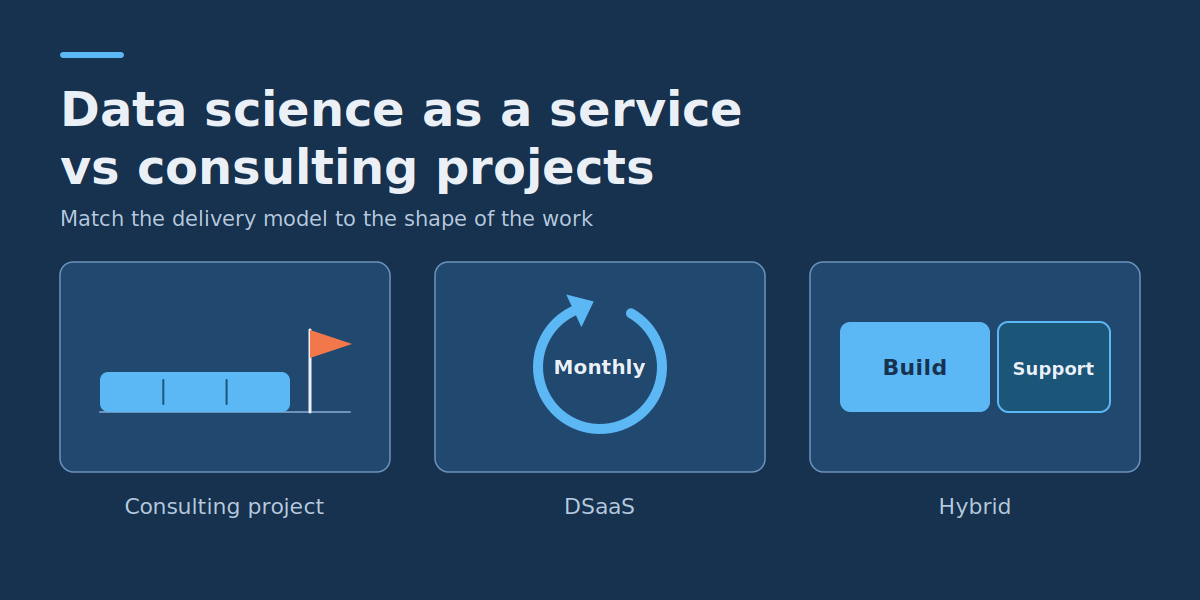
- Project-based consulting fits best when the problem is still unclear, or when the work has a clear end point and will rarely change after handover.
- Data science as a service (DSaaS) fits best when the workflow is known and recurs, such as retraining a model, refreshing forecasts or changing reports, and nobody in-house can own it.
- A hybrid, meaning a fixed-scope build followed by a small support retainer, often suits teams that have one capable analyst or engineer but no data science function.
- Day rates rarely decide this. What decides it is how much recurring work you have, who holds the knowledge, and what happens when the supplier leaves.
If you are weighing data science consulting vs DSaaS (data science as a service), the short answer is to match the model to the shape of the work. Hire consultants to answer a question or build something once. Pay for a managed service when the same work comes back every month and you have nobody to run it. Use a hybrid when you want to build once, then keep light support available while your own team takes ownership. The rest of this article gives you definitions, a 12-month cost model you can edit, and a scoring tool for choosing between the three.
Data science consulting vs DSaaS: what each delivery model means in practice
Neither term has a standard contract form. Suppliers use “data science as a service” and “data scientist as a service” for quite different arrangements, so treat the definitions below as working definitions and check what a proposal actually promises.
Data science consulting (project-based)
You buy a defined outcome: an analysis, a prototype, a model, a pipeline or a recommendation. There is a scope, a set of deliverables, acceptance criteria and an end date. The supplier is responsible for delivering the scope. After handover, running and improving the result is your responsibility unless you agree otherwise.
DSaaS (ongoing or managed data science)
You buy continuing capacity or a continuing capability, usually for a monthly fee. That might be a set number of data science days per month, or the operation of specific things such as model monitoring, scheduled retraining, report maintenance and ad hoc analysis. The supplier is responsible for keeping agreed work running or for providing the agreed capacity. The scope can evolve, but only inside the terms of the agreement.
Hybrid
A fixed-scope build is followed by a smaller, defined support arrangement. The aim is to get the benefits of a project (clear scope, clear end) without being left alone the day after handover.
| Dimension | Consulting project | DSaaS / managed | Hybrid |
|---|---|---|---|
| Best when | Problem is unclear or one-off | Work is known and recurring | Build once, then light recurring need |
| You pay for | Deliverables or days against a scope | Committed monthly capacity or service | Build scope plus a small retainer |
| Who holds the knowledge | Transfers to you at handover | Stays largely with the supplier unless you require otherwise | Transfers during build, supplier keeps context |
| Who is accountable after launch | You, unless a support term is agreed | Supplier, for the services defined | Shared, so split it explicitly |
| Typical failure | Model decays or breaks with no one assigned to it | Paying for unused capacity, or dependence on one supplier | Vague boundary between “support” and “new work” |
The three questions that change the decision
1. Is the problem defined, or are you still finding it? If you cannot state in one sentence which decision or workflow the work supports and how you will know it succeeded, you are not ready for a recurring service. A short, fixed-scope discovery project is cheaper than months of retainer spent working out what to do.
2. Will the same work come back? Models need retraining when data changes, dashboards need changes when the business changes, and stakeholders keep asking questions. If you can name specific recurring tasks and roughly how often they happen, a managed or hybrid model becomes realistic. If you cannot, assume the work is a project.
3. Who will own it inside your business? This question matters more than the price. A named internal owner with time and access can take over a finished project. Without one, the same finished project tends to degrade quietly, which pushes you towards a service or a hybrid.
Pricing assumptions and a 12-month cost model
Do not compare quotes on day rate alone. Compare total cost over the same period for the same recurring need. The model below does that using transparent, illustrative inputs. The figures are not market prices, and a real supplier’s rates and package terms will differ, so replace every input with numbers from your own proposals. Amounts are shown in pounds for readability.
Inputs (hypothetical assumptions)
| Input | Illustrative value | What it represents |
|---|---|---|
| Day rate (r) | £800 | Same rate in every route so only the structure differs |
| Build effort (B) | 20 days | Months 1–3: the initial model, pipeline or report build |
| Run period | 9 months | Months 4–12 after launch |
| Recurring need (d) | 1, 3 or 6 days per month | Monitoring, retraining, changes and ad hoc analysis after launch |
| Re-ramp premium (p) | 25% | Extra time when a supplier must relearn your context for each ad hoc request after a project ends |
| Managed capacity (c) | 5 days per month, all 12 months | Committed capacity; extra work billed at the day rate |
| Hybrid retainer (h) | 2 days per month for 9 months | Light support after a fixed-scope build; extra work billed at the day rate |
Formulas
Project + ad hoc = B*r + 9*d*r*(1+p)
Managed          = 12*c*r + max(0, B + 9*d - 12*c)*r
Hybrid           = B*r + 9*h*r + 9*max(0, d - h)*r
Results for the three recurring-need cases
| Recurring need (days/month) | Project + ad hoc | Managed | Hybrid | Lowest cost |
|---|---|---|---|---|
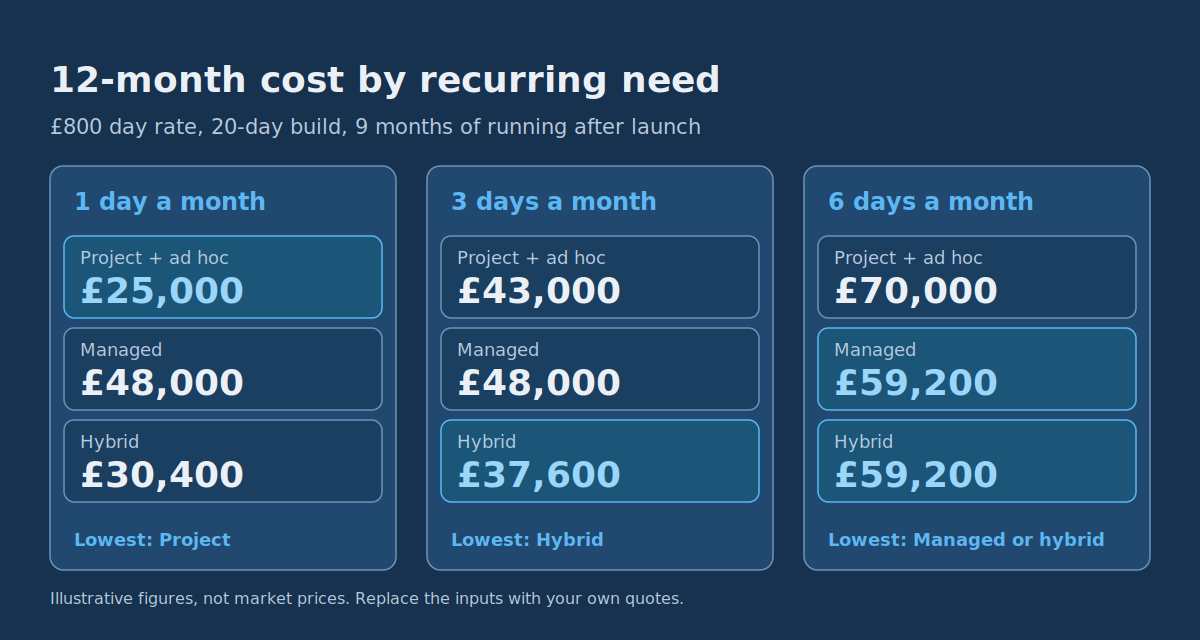
| 1 | £25,000 | £48,000 | £30,400 | Project |
| 3 | £43,000 | £48,000 | £37,600 | Hybrid |
| 6 | £70,000 | £59,200 | £59,200 | Managed or hybrid (tie) |
How to read the result
At one day a month, the project route wins because you are not paying for capacity you do not use. In the managed column, only 29 of the 60 committed days would be needed in that case. At three days a month, the hybrid is cheapest, because it covers the build and a modest retainer without paying the project route’s re-ramp premium. At six days a month, the work is effectively continuous and both ongoing models beat the project route.
Check the sensitivity before you trust any of this. Set the re-ramp premium to zero and the project route falls to £23,200, £37,600 and £59,200 for the three cases. It then ties the hybrid at three days a month and the other two models at six. In other words, the price advantage of ongoing models in this example comes entirely from the re-ramp assumption. If your project supplier can pick up small requests quickly because the work is documented and the team is stable, the case for a managed service rests on continuity, response time and risk rather than on cost. That is a legitimate reason to buy one, but be honest about which reason you are paying for.
To adapt the model, replace the day rate with each supplier’s quoted rate or effective rate, estimate your recurring need from the real tasks you can name (not from a hope), and add what the model leaves out: your own staff time, cloud and tooling costs, licences, and any minimum term or notice period in the contract.
Internal capacity: what you have to own whichever model you pick
Outsourcing the work does not outsource the accountability. Someone inside the business must define what the output is for, grant access to the data, accept or reject the deliverables, and notice when results stop making sense.
Microsoft’s guidance on the analytics Center of Excellence describes it as an internal team of technical and business experts that actively helps others in the organization who work with data. The guidance is written for Microsoft Fabric and Power BI users, but the principle carries over to any supplier arrangement. It also says that a formally recognized team on the organization chart is recommended but not required. What matters most is that the roles and responsibilities are identified, prioritized and assigned, and it notes that one person often covers several roles. A small business does not need a formal center, but it does need those functions covered by one or two named people: who owns metric definitions, who answers questions, and who decides what counts as good enough.
The same logic applies to systems that make predictions. The NIST AI Risk Management Framework is a voluntary framework, first released in January 2023, that aims to help organizations build trustworthiness into the design, development, use and evaluation of AI products, services and systems. It is organized around four functions: govern, map, measure and manage. NIST also states that version 1.0 is being revised, so check the page for the current version. It is a US framework, but UK buyers can use it as a practical checklist. Our takeaway for buyers, which is our reading rather than NIST’s wording, is that someone should be accountable for monitoring a model after it goes live. Decide explicitly whether that someone is you, the supplier, or both, and write it into the agreement.
Ownership and contract risks to settle before you sign
- Code, models and documentation. State who owns them, where they are stored, and that you hold admin access to the repositories and cloud accounts. Ask for a documented handover as a deliverable, not a courtesy.
- Data handling. Confirm where your data is stored, who can access it and what happens to it when the contract ends. If it contains personal data, check that the contract meets the data protection rules that apply to you.
- Scope boundaries. In a hybrid or managed agreement, define what counts as support, what counts as new work and how new work is priced. Vague boundaries are the most common source of disputes.
- Minimum term, notice and unused capacity. Check whether unused days roll over, expire or are refunded, and how long you are committed.
- Key-person dependency. Find out whether the person doing the work can be replaced without losing context, and who covers absences.
- Exit plan. Agree what the supplier delivers if you leave: documentation, a handover session, data return and a transition period.
- Acceptance criteria. For projects, write down how a deliverable is judged before work starts. For managed services, write down the service levels you expect and how they are measured.
A scoring tool for team maturity and risk
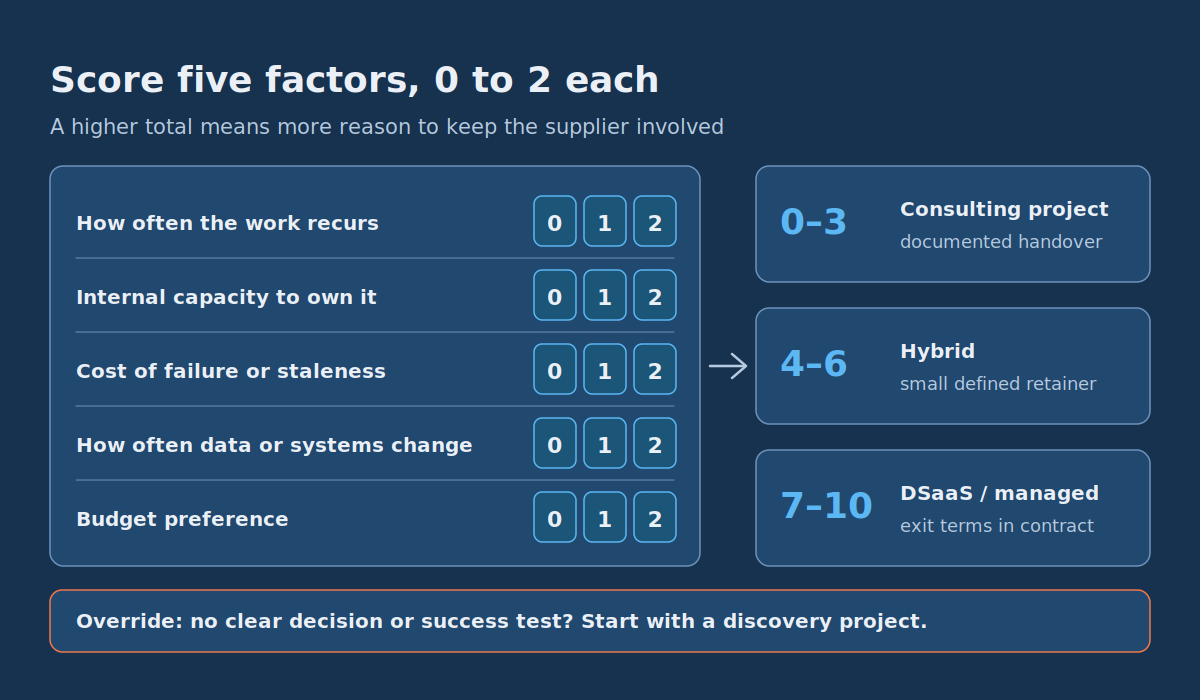
Score each factor from 0 to 2 for your situation, then add the points. A higher total means more reason to keep the supplier involved after launch.
| Factor | 0 points | 1 point | 2 points |
|---|---|---|---|
| How often the work recurs | Less than quarterly | Monthly | Weekly or continuous |
| Internal capacity to own it | A capable owner with time | A part-time analyst or generalist | Nobody |
| Cost of failure or staleness | Outputs inform occasional decisions | Used in monthly operations | Customer-facing or revenue-critical every day |
| How often data or systems change | Stable sources | Occasional changes | Frequent changes or new sources |
| Budget preference | Prefer a fixed one-off cost | Either is workable | Prefer predictable monthly cost |
Reading the total
- 0–3: a consulting project with a documented handover.
- 4–6: a hybrid: fixed-scope build, then a small defined retainer.
- 7–10: DSaaS or a managed service, with documentation and exit terms written into the contract.
Two overrides that beat the score
- If you cannot state the decision the work supports and how success will be judged, start with a short, fixed-scope discovery project, whatever the score says.
- If nobody on your side can approve deliverables and grant data access, fix that first. No delivery model works without it.
Three decision examples (hypothetical scenarios)
A trade supplier with falling margins. The owner suspects pricing or product mix but cannot say which. There is no analyst and no defined question. The override applies: commission a short discovery project to find and size the problem. Only after that is there anything to price as a build or a service.
A subscription business with a weekly demand forecast. The forecast feeds purchasing every week, data sources change often and nobody in-house can maintain the pipeline. Scores: recurrence 2, capacity 2, risk 1, change 1, budget 2, total 8. A managed service fits, provided the contract covers documentation, access and exit. If the forecast also has to flow into purchasing or stock systems automatically, that integration is often a separate piece of custom software development for business workflows rather than a data science task.
A regional distributor with one data engineer. The company needs a forecasting model built, which is the kind of work covered by custom AI and ML software services, then retrained quarterly and checked monthly. The engineer can own day-to-day operation but has not built models before. Scores: recurrence 1, capacity 1, risk 1, change 1, budget 1, total 5. A hybrid fits: a fixed-scope build with structured handover to the engineer, then a small retainer for retraining and review.
Frequently asked questions
What is the difference between data science consulting and DSaaS? Consulting is a project with a defined scope, deliverables and end date. DSaaS is a continuing monthly arrangement for capacity or for running specific work, such as monitoring and retraining.
Is DSaaS more expensive than a consulting project? It depends on how much recurring work you have. In the illustrative model above, the project route is cheapest at one recurring day a month, and managed or hybrid is cheapest at six. Use your own quotes to check.
When is a hybrid model the best choice? When you need something built once and have one capable analyst or engineer who can own it, but still want light support for retraining and review.
What should a data science contract cover? Ownership of code and models, data handling, scope boundaries, minimum term and unused capacity, key-person cover, an exit plan and acceptance criteria.
Next step: choose the scope before the contract
Before you ask any supplier for a quote, write down the decision the work supports, the recurring tasks you can already name, and who on your side will own the result. Then run the scoring table and the cost model with your own numbers. If you are comparing suppliers, our guide on how to choose a data science consulting partner sets out the questions to ask. If the answer is still unclear, a short discovery conversation with a prospective supplier can help you choose between a project scope and managed support. DataColab can be one of the suppliers you talk to, and you should compare it against the others using the same criteria as above.