
How to Compare Data Science Service Providers
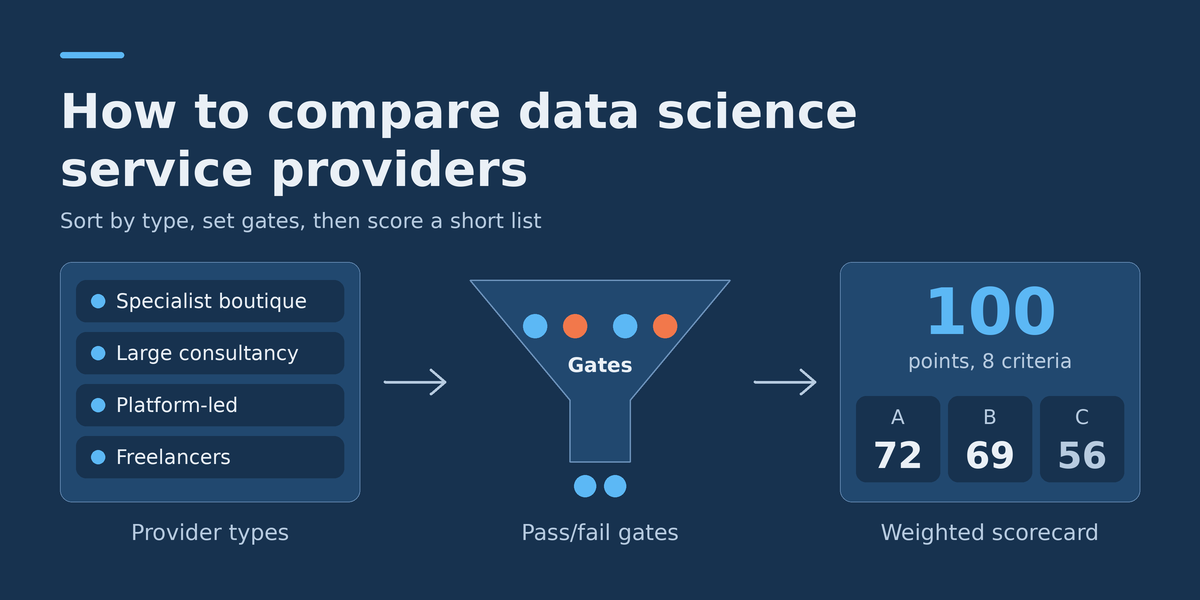
To compare data science service providers well, sort them by type, match the type to your use case, apply a few pass/fail checks, and then score a short list against criteria you set in advance. This guide walks through each step and ends with a worked scorecard you can copy. It deliberately does not rank any companies.
The article is written for business buyers: the person who owns the budget or the problem and has to choose, justify and manage the provider, even without a data science background. If you want a shorter, printable version, use our compare data science vendors checklist alongside this guide.
What matters most when comparing data science service providers
- Compare provider types before names. A specialist boutique, a large consultancy and a platform-led service are built for different jobs, so the same score means different things for each.
- Define the use case and success metric first. A provider cannot be judged “good” in general, only for a defined problem, data situation and delivery need.
- Ask for evidence you can check: a comparable project, a named delivery team, a documented evaluation method and security documentation with a clear scope. Confident claims and logos are not evidence.
- Use a weighted scorecard with pass/fail gates, then test whether the winner changes when the weights change. A narrow lead is a tie.
If you search for data science service providers, you will find ranked lists, directories and “top ten” pages. Most cannot tell you which provider suits your project, because they do not know your data, your systems or your risk. Working through the steps below gives you a decision you can defend.
Know the main types of data science service providers
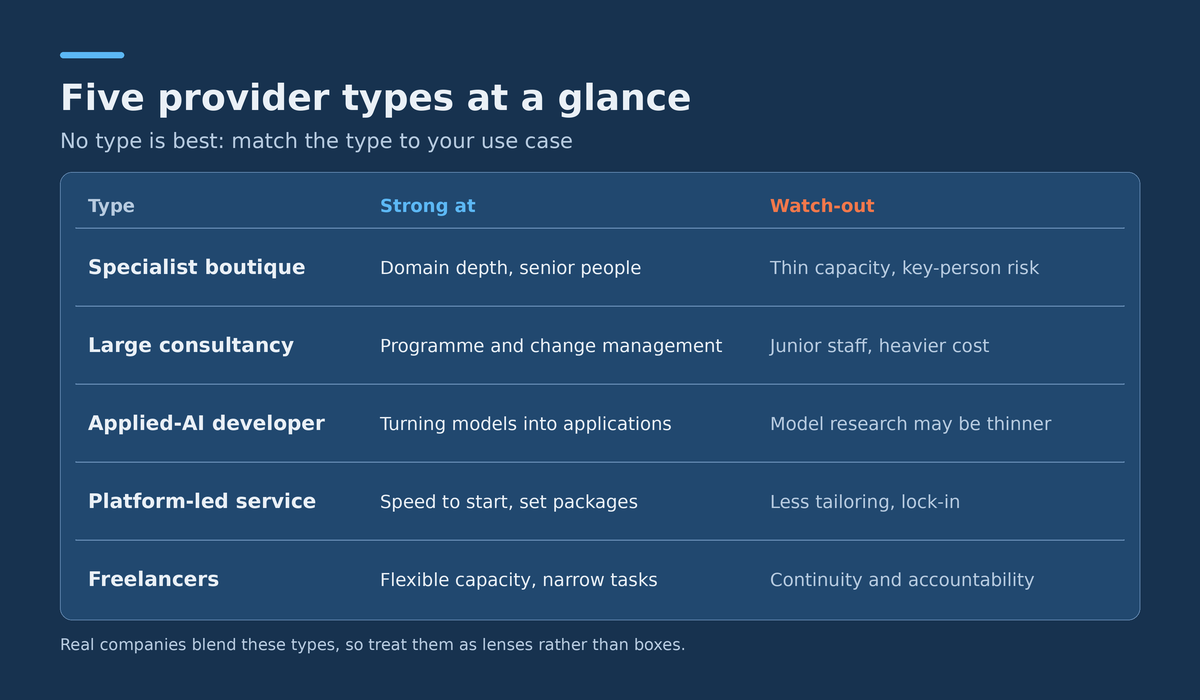
Providers of data science and analytics services tend to fall into a few recognisable models. Real companies blend them, so treat these as lenses rather than boxes.
| Type | Usually strong at | Typical watch-outs | Often a fit when |
|---|---|---|---|
| Specialist or boutique firm | Depth in a domain or technique, senior people close to the work | Limited capacity, key-person dependence, thinner security and support processes | You have one well-defined problem and want deep expertise |
| Large consultancy or systems integrator | Programme management, change management, enterprise security and procurement readiness | Junior staff doing delivery work, heavier cost, generic methods | The project spans many teams, systems or regulatory reviews |
| Custom software and applied-AI developer | Turning a model into a working application, integration and ongoing maintenance | Model research may be less deep; check the analytic rigour as well as the engineering | The result must live inside your systems and be used daily |
| Platform-led “data science as a service” | Speed to start, predictable packages, managed tooling | Less tailoring, platform lock-in, harder to take the work elsewhere | Your problem is standard and fits the platform’s assumptions |
| Freelancers and contractor networks | Flexible capacity, narrow tasks, low overhead | Continuity, handover quality and accountability for the outcome | You have an internal lead who can direct, review and own the work |
Two things stand out. First, no type is best. Second, the cost of choosing the wrong one usually shows up after the contract, in handover, integration and support, rather than in the proposal. If you are leaning towards an advisory-led engagement, our guide on how to choose a data science consulting partner goes deeper on that route.
Choose the use case before the shortlist
Write one paragraph that answers four questions: what decision or process will change, which data exists and where it lives, what the result must connect to (a dashboard, an ERP, a customer-facing app), and who will operate it after the project ends. Your answers narrow the field quickly.
- A one-off analysis to inform a decision rewards analytical quality and clear communication. Integration matters little.
- A prototype model rewards fast experiments and honest evaluation. Beware of providers who show polished demos without a held-out test.
- A production system rewards engineering, integration, monitoring and a clear owner for support. This is where the gap between “built a model” and “runs reliably” appears. For this kind of work, look at providers offering custom AI and ML software services.
- An ongoing service rewards stable teams, service levels and transparent change control.
If you cannot state the success metric, pause. A provider who is willing to start without one is not saving you time; they are leaving the definition of success to be argued about later.
Apply pass/fail gates before scoring
Some requirements should disqualify a provider rather than lose points. Decide yours first and apply them to every candidate equally. Typical gates are:
- The provider will sign terms that give you ownership or a clear licence to the deliverables, and you retain ownership of your data.
- They can describe where your data is stored and processed and who can access it. If personal data is involved, they will agree a suitable data processing contract.
- They can provide security documentation whose scope covers the services you are buying (see the evidence list below).
- They will name the people who will do the work, not only the people who present the pitch.
Gates save you from scoring a provider highly on method and then discovering a deal-breaker late. They also keep a slick sales process from lifting a weak candidate into your final round.
The data science provider scorecard: criteria, weights and evidence
The scorecard below uses eight criteria that add up to 100 points. The weights are a starting point for a production project that integrates with existing systems; adjust them to your priorities before you look at any proposals, not afterwards. Score each criterion from 0 to 5 using the evidence column as your guide.
| Criterion | Weight | What earns a high score |
|---|---|---|
| Success metric and problem framing | 15 | Restates your problem accurately, proposes a measurable metric, names assumptions and what would make them stop or change course |
| Delivery ownership and team | 15 | Named lead and team, clear division of responsibility between provider and your staff, a single accountable person |
| Relevant evidence | 15 | Comparable work they can explain in detail, with reference contacts or verifiable material; limits and failures discussed honestly |
| Security and data handling | 15 | Documentation that covers the relevant services, access controls, data location, incident process, subcontractor disclosure |
| Integration and deployment | 15 | A concrete plan for connecting to your systems, handling failures, monitoring and handover, with named environments and responsibilities |
| Validation method | 10 | Evaluation on data held out in time, comparison against a simple baseline, and a plan for monitoring drift after launch |
| Commercial terms and exit | 10 | Transparent pricing basis, change-control process, portable code and documentation, reasonable termination terms |
| Governance and communication | 5 | Regular reporting rhythm, risk and issues log, a defined way to escalate problems |
Calculate each criterion’s points as weight × (score ÷ 5), and add them up. Score each criterion independently, ideally by two people who compare notes afterwards, because the first provider you meet tends to set the yardstick for the rest.
What evidence to request, and how to read it
- A comparable project walkthrough. Ask what the problem was, what data they had, how they evaluated the result, what did not work and what happened after delivery. Specifics are more convincing than a polished case-study page, which may be shaped by marketing.
- Reference contacts. Speak to someone who worked with the delivery team, not a sponsor who signed the contract. Ask about handover and how problems were handled.
- Security documentation, with scope. A SOC 2 report is an independent auditor’s report on controls; check whether it is Type 1 (design at a point in time) or Type 2 (operation over a period), the period covered and which services are in scope. An ISO/IEC 27001 certificate applies to a defined scope too, which may not include the team or system that would handle your data.
- A sample of their working documents. A redacted evaluation report, a data validation checklist or a runbook shows how they actually work.
- Their approach to AI risk. The NIST AI Risk Management Framework (AI RMF) was released on 26 January 2023 and is intended for voluntary use. NIST describes its aim as improving the ability to build trustworthiness into the design, development, use and evaluation of AI products, services and systems. Its core is organised around four functions: Govern, Map, Measure and Manage. NIST has since published a Generative AI Profile (NIST-AI-600-1, July 2024) to help organisations identify risks specific to generative AI, and states that AI RMF 1.0 is being revised as part of the White House AI Action Plan. Because the framework is voluntary guidance and not a certification, “aligned with NIST” is not proof of anything on its own. A useful question is how the provider identifies, tests and monitors the risks of the system they propose for you.
Red flags when comparing data science providers
- A guaranteed accuracy or result before they have seen your data. Performance depends on data quality and the problem itself.
- No baseline. If they cannot say what a simple rule would achieve, you cannot judge whether a model adds anything.
- Evaluation on the same data used for training, or a random split where the production use is predicting the future.
- Vague answers about who does the work, or heavy use of unnamed subcontractors.
- Security answers that avoid scope, such as quoting a certificate without saying what it covers.
- No plan for after launch: monitoring, support, retraining, and who is responsible when the system breaks.
- Proprietary lock-in with no exit path, for example code, models or documentation you cannot take with you.
- Ratings and “best provider” badges with no stated method, especially where the site that awards them also takes referral payments.
Questions to ask data science service providers
Problem and success
- How would you restate our problem, and what would you measure to decide if the work succeeded?
- What would make you advise us not to build a model at all?
Delivery
- Who exactly will work on this, at what level of seniority, and for how much of their time?
- What do you need from our team each week, and what happens if we are late?
Evaluation
- What is the baseline, and how will you test on data the model has never seen?
- How will you tell us if a result is weak or unstable?
Security and data
- Where will our data be stored and processed, who can access it, and how is that access logged?
- Which subcontractors or tools would see our data?
Integration and operation
- How will the output reach our systems, and what happens if the feed fails?
- What will running and monitoring it cost after the project, and who does it?
Commercial
- What do we own at the end, and how would we move to another supplier?
Worked scorecard example (illustrative)
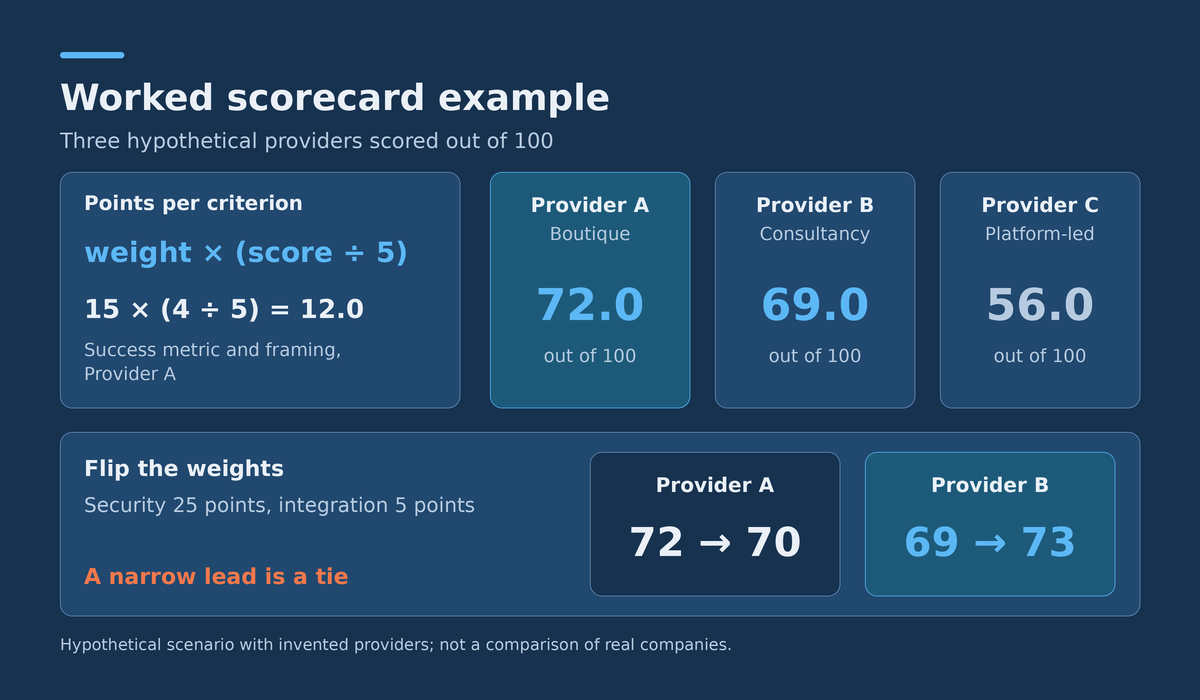
This is a hypothetical scenario with invented providers. It shows the mechanics and is not a comparison of real companies.
Assumptions: a regional distribution company wants a demand-forecasting service that feeds its ordering system. The data sits in a cloud warehouse and contains no personal data. The company has one analyst and no data scientist. It uses the weights from the table above and scores three anonymous providers: Provider A (a specialist boutique), Provider B (a large consultancy) and Provider C (a platform-led service). All three passed the gates.
| Criterion (weight) | A: score | B: score | C: score |
|---|---|---|---|
| Success metric and framing (15) | 4 → 12.0 | 3 → 9.0 | 2 → 6.0 |
| Delivery ownership and team (15) | 3 → 9.0 | 4 → 12.0 | 3 → 9.0 |
| Relevant evidence (15) | 4 → 12.0 | 3 → 9.0 | 2 → 6.0 |
| Security and data handling (15) | 3 → 9.0 | 5 → 15.0 | 4 → 12.0 |
| Integration and deployment (15) | 4 → 12.0 | 3 → 9.0 | 2 → 6.0 |
| Validation method (10) | 4 → 8.0 | 3 → 6.0 | 3 → 6.0 |
| Commercial terms and exit (10) | 3 → 6.0 | 3 → 6.0 | 4 → 8.0 |
| Governance and communication (5) | 4 → 4.0 | 3 → 3.0 | 3 → 3.0 |
| Total (out of 100) | 72.0 | 69.0 | 56.0 |
How to read the result
Provider C is clearly behind on the criteria that matter for this project, mainly integration and problem framing. Providers A and B are only three points apart, which is too narrow a margin to call a winner on arithmetic alone. Test how fragile it is: if the company decides security should count for 25 points and integration for only 5, Provider A’s total becomes 70 while Provider B’s becomes 73, and the ranking flips. In that case the question is no longer “who scored highest” but “which risk matters more to us”, and that is a discussion for the decision-maker, ideally with a short paid pilot or a second reference call to settle it.
How to adapt the scorecard
- Set the weights first and write down why. If you change them after seeing proposals, you are scoring your preferences, not the providers.
- Use the pass/fail gates for anything non-negotiable, such as data residency or a regulatory requirement.
- Raise the weight of integration and operation for production systems; raise analytical method and evidence for research-heavy work.
- Record the evidence behind each score in a column beside it so another person could challenge your reasoning.
Frequently asked questions
How many data science providers should I shortlist?
Three is usually enough. It is enough to see real differences in approach, and few enough that you can run proper reference calls and review evidence for each.
Should I score providers before or after reading proposals?
Set the criteria and weights before you read any proposals. Changing them afterwards means you are scoring your preferences rather than the providers.
Is a certification enough to prove a provider is secure?
No. Certificates and audit reports apply to a defined scope, so check that the services and teams handling your data are actually covered, and for SOC 2 whether the report is Type 1 or Type 2.
A note on this article and on ranked lists
This article intentionally names no “best” providers. A ranking implies a single set of priorities, and we have no way of knowing yours. We also provide data, software and applied-AI services ourselves, so you should treat us as one more provider to be scored on the same terms, not as a neutral referee.
If you would like to see how DataColab measures up against the criteria above, send us your use case and run us through the same scorecard; we are happy to answer the questions in this article on a call.
Pingback:Data Science Vendor Evaluation Checklist and Scorecard